
Restoring order in management and implementing urban land projects.
(Baonghean) - Regarding urban land projects, townhouses, and apartment buildings (collectively referred to as housing development projects), the people and voters have long raised many issues with elected representatives. Recently, the Provincial People's Council conducted supervision of the management and implementation of several urban projects in the province and pointed out many shortcomings and inadequacies that need to be addressed soon.
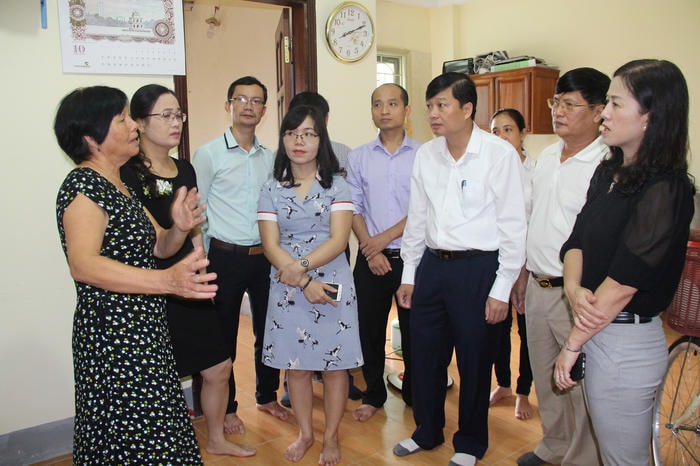 |
| Residents of the Loc Chau high-rise apartment building (Cua Lo town) raised concerns with the provincial People's Council's monitoring team. Photo: Mai Hoa |
The reality is that shortcomings exist.
To date, the province has 166 urban housing development projects that have been licensed for investment. Of these, 66 projects are underway, and 26 projects have been completed or partially completed and put into use.
It is undeniable that housing development projects contribute to improving urban architecture and landscape; increasing land use efficiency and land use revenue; and addressing housing needs and improving housing conditions for many people in some localities, especially Vinh City.
However, through monitoring the management and implementation of urban land projects in the province, specifically in some projects in Vinh City and Cua Lo Town, and through recent working sessions with the People's Committees of Vinh City and Cua Lo Town, several departments and agencies, and the Provincial People's Committee, the Provincial People's Council has pointed out many shortcomings and limitations in the management of urban projects in the province.
It's not difficult to point out investment projects involving small-sized apartments interspersed within residential areas, putting immense pressure on the infrastructure system in Vinh City, such as PVLAND 2 apartment complex (Hung Binh ward); Kim Truong Thi Commercial Center and apartment complex project (Truong Thi ward)... Then there's the situation where many housing development projects have had their planning adjusted, not just once, twice, but even three or four times.
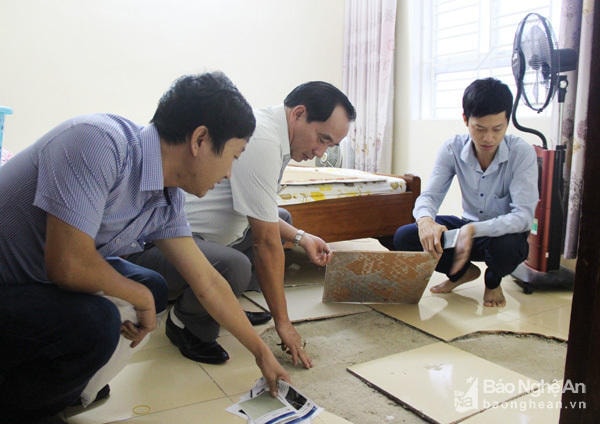 |
| Through direct monitoring of several projects, the Standing Committee of the Provincial People's Council has noted that the quality of the Glory apartment building in Vinh City is not up to standard. (Photo: Archival image) |
It is noteworthy that most of the adjustments were in favor of investors, such as increasing the number of floors, expanding the construction area, converting public areas into subdivided plots for sale, and reducing green spaces and other living conditions for residents.
To illustrate, Mr. Ho Phuc Hop - Head of the Provincial Party Committee's Propaganda Department and Head of the Culture and Social Affairs Committee of the Provincial People's Council - cited the example of the complex project comprising a commercial center, high-rise hotel, office space for rent, high-rise apartments, and townhouses, invested by Construction Company No. 9.1 (in Quan Bau ward, Vinh city). The apartment building was initially planned for 15 floors, but was later adjusted to 20 floors, meaning an increase in the number of people in the project area. Meanwhile, the initial plan, from the transportation system to the parking garage and even the elevator system, was only suitable for the scale of residents as initially planned. This has affected the use of public areas such as internal transportation, parking spaces, and green areas.
The situation of delayed, incomplete, or behind-scheduled projects remains prevalent. Out of a total of 166 licensed investment projects, 100 are behind schedule or have not been implemented. Regarding the low project implementation rate, Mr. Cao Tien Trung, Deputy Head of the Economic and Budget Committee of the Provincial People's Council, stated that many investors are simultaneously licensed for multiple projects, all of which are behind schedule; some investors lack financial capacity, and previously licensed projects have not shown clear effectiveness, yet are still granted licenses for subsequent projects.
Mr. Trung cited the example of the Vietnam-Laos Economic Cooperation Company, which has 4 licensed projects, of which 3 projects had their planning approved in 2010 and 1 project in 2013; however, to date, only the high-rise apartment building combined with a commercial center in Quan Bau ward has been completed and partially put into use, including 58 out of 59 low-rise houses; the other 3 projects have not yet started construction.
The issue that voters and the public have long been concerned about regarding the issuance of land use right certificates and house ownership certificates has also been thoroughly assessed by the Provincial People's Council. To date, the rate of issuing land use right certificates to households receiving land transfers in adjacent projects and new villas has only reached 37.35%, and the rate of issuing house ownership certificates to those receiving apartment transfers has only reached 48.49%.
Furthermore, the quality and lifespan of some apartment buildings are limited. For example, the Glory Palace apartment building (Truong Thi ward, Vinh City), developed by Vinh Urban Development Joint Stock Company (Vinh Land), after only 3 years of use, has peeling floor tiles in apartments and corridors; windows in some apartments are not secure, allowing water to leak into the rooms during rain; sanitary facilities in some apartments are dilapidated and damaged; and elevators frequently malfunction.
Furthermore, a number of projects in Vinh City, such as social housing in Le Loi ward; Tan Phuc apartment building (Vinh Tan ward); CTA apartment building in Nghi Phu urban area; Vicentra apartment building (Quang Trung ward)..., also have problems with mold and peeling paint on some areas of walls and ceilings, or water leaks in the basement and roof areas, and cracks in the exterior walls. Administrative management in these apartment buildings remains neglected.
Although the 2014 Housing Law mandates the establishment of a Management Board or Apartment Building Management Board to act as a bridge between apartment users and the investor in the management, use, operation, maintenance of apartment buildings, and protection of the legitimate rights of apartment users...; in reality, out of 59 completed apartment projects in the province, only 10 have established a management board.
A decisive approach is needed to restore order in management.
The management of housing projects in the province falls under the responsibility of multiple levels and sectors. For example, the appraisal and advisory services for investment licensing are under the Department of Planning and Investment; the advisory services for planning and construction quality are under the Department of Construction; finance and taxation are under the Department of Finance and the Tax Department; land allocation and issuance of land use right certificates are under the Department of Natural Resources and Environment; urban order management and administrative management of apartment complexes are at the district level; and handling violations falls under the authority of the Provincial People's Committee. To create a shift in management, especially to overcome existing shortcomings and inadequacies, each sector and locality, based on its authority and responsibility, needs to take more decisive action.
To restore order in the management of housing development projects, Mr. Le Van Ngoc, Vice Chairman of the Vinh City People's Council, suggested that the Provincial People's Committee should build a comprehensive land database for all housing development projects. Based on this database, they should evaluate, review, and develop appropriate development plans, while also conducting regular and surprise inspections and strictly handling violations.
According to Mr. Ngoc, in addition to the regular maintenance responsibilities of the investors, the Provincial People's Committee needs to have regulations binding investors with commitments on the "warranty" period for the quality of the construction to avoid the rapid deterioration in some apartment buildings as is currently the case. During the "warranty" period, if damage occurs, the investor is responsible for bearing a portion of the cost of repair, instead of just 2% of the maintenance fund.
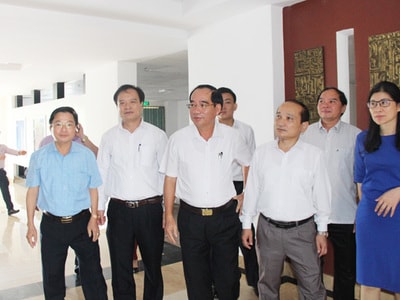 |
| On-site supervision at the Golden City I urban project. (Photo courtesy) |
Regarding proposals to improve the quality of investor capacity assessment and reduce the number of unfinished or unimplemented investment projects, Deputy Director of the Department of Planning and Investment Nguyen Xuan Duc stated: Although not stipulated by law, the Department of Planning and Investment has advised the Provincial People's Committee to seek opinions from the Department of Finance and the Tax Department during the investor capacity assessment process. This avoids discrepancies between the investor's financial reports submitted to the Tax Department and the Department of Planning and Investment; and to combine the results of the feasibility assessment of the project and collateral from credit institutions.
Regarding the difficulties in issuing land use right certificates and house ownership certificates, there are currently many reasons: many land plots in urban projects have not yet had houses built on them, so they do not meet the conditions for issuance; some transferees owe money to the investor, and some investors owe tax obligations to the State; in some projects, the investor has even mortgaged the entire project's certificate to the bank; and in some cases, houses are built contrary to the approved design…
Therefore, according to Vice Chairman of Vinh City People's Committee Le Sy Chien, the Provincial People's Committee needs to hold a meeting with relevant departments, localities, and investors to find solutions to the difficulties and obstacles currently facing the project, clearly assigning responsibilities to each level and unit.
Based on the results of the monitoring work, Comrade Nguyen Xuan Son - Standing Deputy Secretary of the Provincial Party Committee and Chairman of the Provincial People's Council - requested the Provincial People's Committee to conduct a comprehensive inspection and examination of urban projects in the province, thereby developing a plan to definitively resolve existing problems and obstacles related to land allocation, land leasing, quality management of apartment buildings, issuance of land use right certificates, and ownership of houses and assets on land in urban projects…
The Chairman of the Provincial People's Council also pointed out that the process of appraising projects requires strict adherence to investment preparation, especially the assessment of the investor's financial capacity, and that projects lacking sufficient financial capacity will not be approved. Regarding adjustments to project planning, the Chairman of the Provincial People's Council requested that the area of green spaces and public facilities that were previously approved not be reduced.
The Provincial People's Committee also needs to direct a focused review and urging of investors to accelerate the completion of projects; resolutely terminate operations for projects that are not implemented or are behind schedule according to the law; inspect and penalize investors who do not fulfill their commitments, affecting the rights of transferees in the projects…
Mai Hoa


