
Academic integrity: Reflections from the National Science and Technology Competition
Academic integrity needs to be a value cultivated in a consistent environment where honesty is not juxtaposed with achievement.
Perform:Phuoc Anh| 04/4/2026
*****
The national science and technology research competition for junior and senior high school students in the 2025-2026 academic year has just concluded with a record scale: 457 students, 242 projects, and for the first time, students from 100% of provinces and cities participated. However, less than a week later, public opinion was stirred up when the first-prize winning project was accused of having many similarities in structure, data, and details with a scientific paper and doctoral dissertation by a research group at the Institute of Chemistry, Vietnam Academy of Science and Technology.
.webp)
This is not the first time a project participating in this competition has faced questions about scientific integrity. Last year, the Ministry of Education and Training also revoked the award and certificate of the first-prize winning project after checking, verifying, and clarifying allegations that the project was similar to a product by an engineer in Indonesia. At that time, the general consensus among many lecturers and scientists was that the topic showed clear signs of plagiarism, violating scientific integrity and the competition regulations.
The controversies surrounding the science and technology competition have sparked much reflection. On the surface, everyone can agree that academic cheating is unacceptable. But if we only focus on ethical judgments, we will overlook a more important question: what allowed products that should have undergone rigorous verification to pass multiple rounds of evaluation, only to be discovered when public opinion spoke out? A sufficiently rigorous and consistent evaluation system would not easily overlook fundamental doubts about the creativity or independence of the projects.
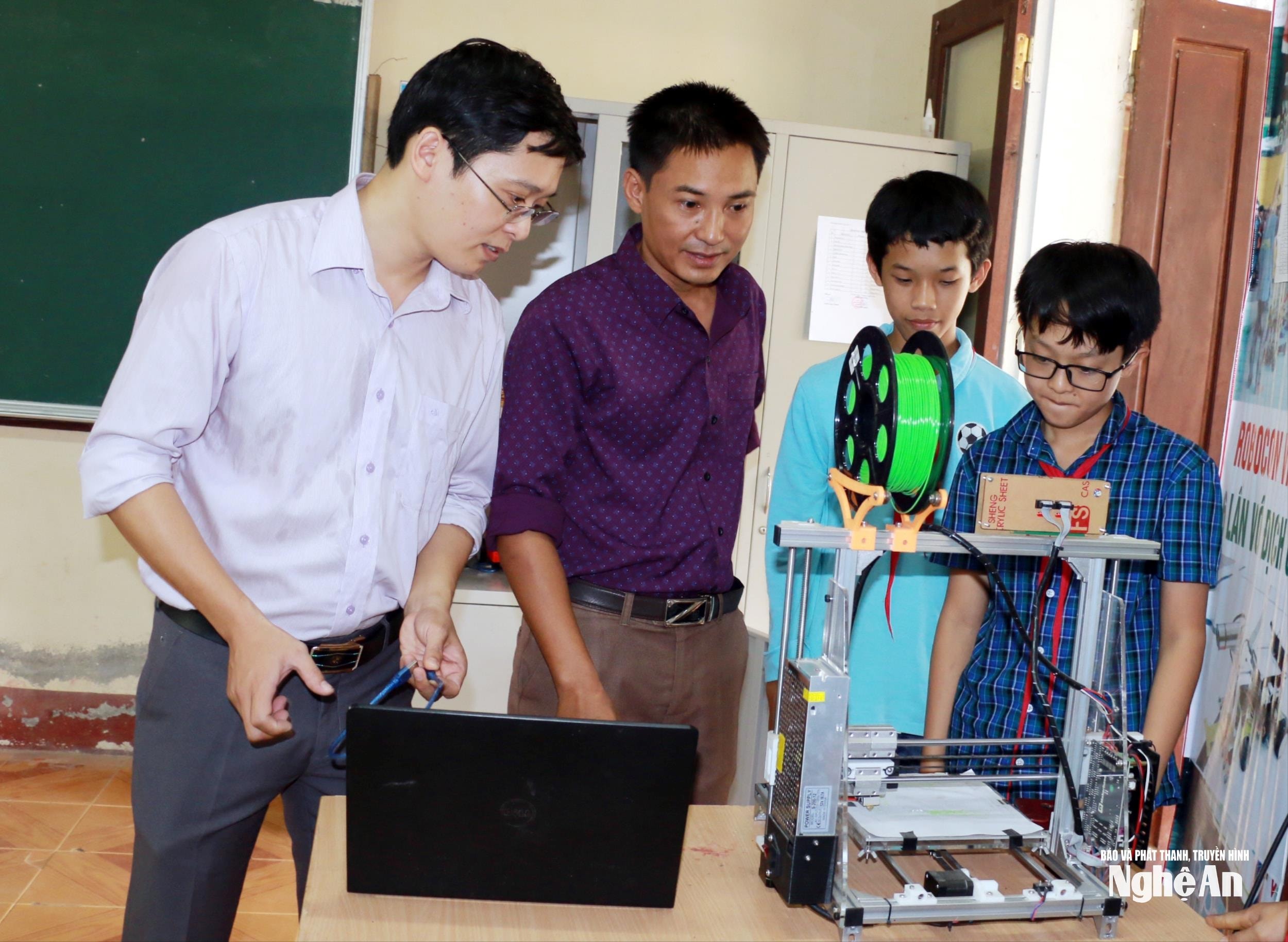
The competition, designed to encourage research—an activity that demands almost absolute honesty—is operating in an environment where the pressure to achieve results is an undeniable reality.
This largely stems from the fact that the prizes from the competition are accompanied by a "golden ticket" for direct university admission, a strong academic record for individuals applying for overseas study, and even the reputation of the school and the local area.
This reality leads us to question whether the motivation for participating in the competition is still purely about discovering knowledge. And in such a context, the possibility that a student's scientific topic or project might be "designed" to exceed their actual abilities is not difficult to imagine.
The problem becomes more complex when the line between academic support and alternative intervention is not clearly defined. At the secondary school level, students need guidance, that's obvious. However, the extent to which guidance remains their own work, and where it becomes someone else's work, is not always clearly defined. It seems that when evaluation criteria prioritize the completeness of the product over the idea generation and implementation process, it encourages the "upgrading" of the topic in ways that are difficult to control.
.jpg)
One noticeable trend in the list of winning projects at the National Science and Technology Research Competition is the "university-level" standardization of high school-level topics. Many projects are presented with structures, terminology, and complexity far exceeding the typical learning experience of middle and high school students.
The title of the research topic sounds impressive, suggesting that the project must be substantial and persuasive, having passed the judging rounds. However, public opinion questions whether a student aged 14 to 17 or 18 can truly master the entire research process. When the requirements exceed their capabilities, the risk of borrowing ideas, or even plagiarism, is undoubtedly a readily apparent consequence.
Here, perhaps we need to revisit a common misconception: equating scientific research with the creation of a finished product. In reality, especially in the early stages, the value of research lies in the way the problem is framed, in the ability to question, verify, and accept mistakes. A research topic with many flaws but that honestly reflects the student's thought process is, from an educational perspective, more meaningful than a complete product whose true author is unclear.
Academic integrity, therefore, needs to be a value cultivated in a consistent environment where honesty is not juxtaposed with achievement. If students understand that award is the ultimate goal, then finding ways to achieve it, even those they know are not entirely ethical, is easily justified. Conversely, if process is valued more than outcome, the pressure to be "perfect" diminishes, giving way to more genuine learning experiences.
Following the controversy surrounding the competition, several universities, including top-tier institutions, have announced they will stop offering direct admission to winners of the national science and technology competition. This is a noteworthy adjustment. With the reduced "bonus rewards," the competition has a chance to return closer to its original goal. However, this is only a change in the "output" aspect. Without simultaneous adjustments to the organization and evaluation methods at both the "input" and "process" levels, the core concerns will remain.
Perhaps the most important question right now isn't whether or not to continue the competition. I believe that a platform for scientific and technological research for students is still truly necessary in an education system focused on developing competencies, but a competition is only meaningful when it isn't consumed by a race for achievements. If it exists, it needs to exist in a different way: with more transparency in evaluation, more modest expectations and less hype, and a more honest assessment of the value of each project.
The recent controversies, viewed positively, can be seen as an opportunity to re-examine our approach to science education in secondary schools. It's time for educators, teachers, parents, and students to think more deeply about fundamental questions: What should students learn from science, and how are we helping them learn it? When these questions are answered seriously, perhaps prizes from competitions will no longer be the most important thing.


