
Collaboration - an effective solution in pig farming.
(Baonghean) - Given the current situation where the market for pork products is fraught with risks and shortcomings, the linkage between businesses and farmers is considered a good solution.
Still have concerns about coordinating livestock farming?
Having started operations in Nghe An province in 2013, CP Vietnam Livestock Corporation has now developed 11 contract farming facilities in the province, of which only 2 are pig farms, one in Thanh Chuong district and one in Nghia Dan district, with a scale of 7,000 fattening pigs and 6,000 breeding sows.
Mr. Nguyen Huu Thuyet, the Nghe An regional manager of this company, said: In this form of partnership, the company signs contracts with farm owners who meet the conditions regarding land area and barns for contract farming.
Farmers only need to invest in building the barns; the company provides all the necessary conditions throughout the entire breeding process, such as breeding stock, feed, veterinary medicine, care techniques, and guaranteed output purchase. With a stable contract signed every 5 years, the farm owner receives 3,500 VND per kilogram of weight gain.
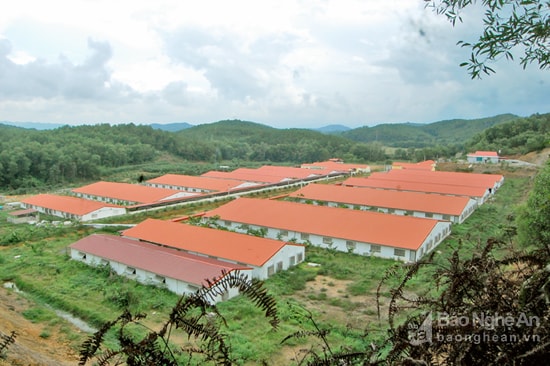 |
| The closed-loop livestock farm of Dai Thanh Loc Company in Nam Dan. Photo: Chau Lan |
This is a fairly feasible approach in the current situation. Farmers can rest assured, without worrying about or being pressured by market price fluctuations, and without having to find outlets for their pork products themselves, which is very uncertain and entirely dependent on traders.
However, the expansion of this linkage model between farmers and businesses remains limited and difficult to develop. According to Mr. Nguyen Huu Thuyet, the first difficulty hindering the development of this model is the lack of capital and land for building pigpens. To participate in contract farming, the minimum scale must be at least 1,000 pigs, requiring a concentrated land area of about 1 hectare and capital for building pigpens exceeding 1 billion VND.
These are conditions that not every household can meet. “We plan to expand this linkage system to mountainous districts of Nghe An province such as Nghia Dan, Con Cuong, Thanh Chuong… but to do so, we urgently need the support and cooperation of local authorities and relevant agencies in providing land and capital for the people.”
The level of linkages in agricultural development remains very low, and the same is true for livestock farming. These linkages still reveal limitations. Many pig farmers still prefer other forms of linkage with businesses to share profits, rather than contract farming for businesses due to the relatively low profit margins compared to regular sales. Mr. Nguyen Van Loi, from Phuong Dinh hamlet, Dong Van commune, Thanh Chuong district, established his pig farm in 2006. Normally, his farm houses around 500 pigs; currently, he still has nearly 270 fattening pigs and 30 sows.
Thanks to the network of traders, his pigs are either exported to China through unofficial channels or consumed domestically. According to him, for almost a year now, the pigs have mainly been sold domestically because the selling price is higher than exporting them to China. "Having built relationships with traders, my pigs are almost never left unsold; in fact, they even buy them at a few prices higher than the market price."
"From nearly the end of last year until now, pork prices have plummeted, currently only slightly above 20,000 VND/kg live weight." However, when asked about the issue of contract farming, Mr. Loi flatly refused, saying that such a model, "although safer, yields lower profits and has quite strict conditions." To participate in the contract farming system, farmers also need capital to build barns.
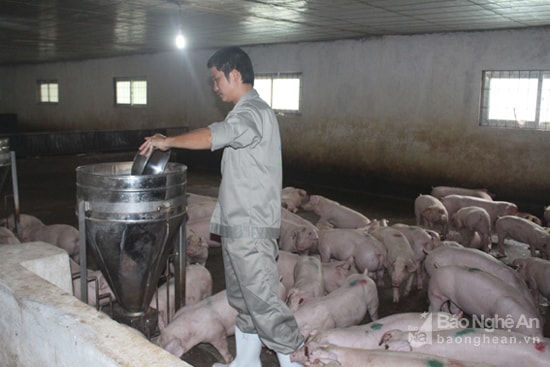 |
| Pigs are being fed at the Tien Thanh Company's pig farm in Yen Thanh. Photo: Phu Huong |
During the production process, the contract farmers will provide labor, equipment, and farming tools. The Joint Stock Company is responsible for providing breeding stock, animal feed, veterinary medicine, and vaccines to the contract farmers. It will then guide and supervise the implementation of technical procedures, collect the products, and pay the contract farmers based on their farming results.
In the current livestock farming environment, which is fraught with risks due to disease outbreaks and uncertain input and output prices, contract farming between businesses and farms is a safe solution for those with capital and land, but it requires farmers to raise a large number of animals to be profitable.
Collaboration is essential.
Besides CP Vietnam Livestock Corporation's investment and support for farms, several companies in the province have effectively established pig farming partnerships between farmers and businesses. Thai Duong Feed Company established a farm raising foreign pig breeds in Dai Son commune, Do Luong district, expanding production by partnering with several farmers in Do Luong and Nghi Loc districts. To date, there are two farms involved in the joint production of fattening pigs and breeding sows.
One newly established private enterprise, Nguyen Van Thanh Enterprise in Tan Thanh commune, Yen Thanh district, has also followed this approach. Starting in 2013, they collaborated with several livestock farmers in Yen Thanh and Dien Chau districts, and now have three linked pig farms. Farmers build the barns, cover electricity, water, labor costs, and environmental management; the enterprise supplies the breeding stock, feed, veterinary medicine, vaccines, and provides market support and pays the farmers.
In Nam Dan district, since 2000, Dai Thanh Loc Co., Ltd. (Ho Chi Minh City), fulfilling its investment commitment at the invitation of the provincial leadership, has invested in Nam Hung commune to build the largest pig farm in Nghe An province and the entire North Central region. The farm, covering 26 hectares and isolated from residential areas, has been operational since 2013, with a total herd of 2,400 breeding sows, producing 5,200 piglets per month.
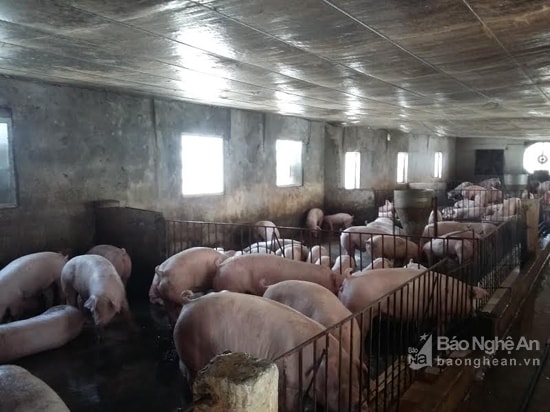 |
| Nguyen Ha Trung's livestock farm in Nam Dan. Photo: Kim Dung |
The farm's success is due to a joint venture with CP, a Thai animal feed company. Here, pigs are raised in a standardized environment with stable temperatures, disease control, and wastewater treatment through a system of seven settling and filtering ponds. The farm then sells the piglets to smaller farms in the region.
According to Mr. Le Duc Quynh, Deputy Head of the Department of Livestock and Veterinary Medicine, the policy of encouraging and supporting farms with the capacity to invest in large-scale livestock farming and link with businesses to stabilize production is being emphasized by all levels of government in the province. This is a form of cooperation between businesses and livestock farmers for sustainable development.
This approach aims to produce high-quality livestock products, ensuring food safety and hygiene, and achieving high livestock productivity. Through this method, farmers have the opportunity to access modern practices and master techniques through guidance and technology transfer from engineers and veterinarians of companies and businesses, allowing them to confidently engage in livestock production without excessive worry about product sales.
Phu Huong
| RELATED NEWS |
|---|


