
The sacred banyan tree of Tru Thach village
(Baonghean) - Anyone who has ever visited Ly Thanh (Yen Thanh) and admired the banyan tree by Tru Thach village communal house will be amazed by its majestic and awe-inspiring beauty. Through countless historical ups and downs, for hundreds of years, the banyan tree has remained lush and green, as if sheltering and protecting the village. Even those from this land who have ventured to the ends of the earth still remember the banyan tree as a piece of their homeland's soul...
The banyan tree preserves the soul of the countryside.
The banyan tree in Tru Thach village stands majestically and solemnly beside the Cua Dinh field, embracing the base of the Tru Thach village communal house. No one knows exactly when the tree originated. The oldest villagers all say that they have seen the ancient tree standing beside the communal house, casting its shade, since they were born. Tru Thach village is located near the Nong Giang River. The village's name dates back to the reign of Le Chan Tong in 1643, and although it underwent several changes, it reverted to Tru Thach during the reign of King Tu Duc in 1853, remaining so to this day. This ancient village has a tradition of scholarship with many successful scholars, so the locals often recite the saying: "Tru Thach is a land of literature and Confucianism / In front is the Canh Phuong field, behind is the winding Dong hill." Besides famous families, the village also has a complex of communal houses, temples, and shrines such as the Tru Thach communal house, the Confucius shrine, the Nha Ong shrine, the Tam Quan gate… all clustered under the shade of the centuries-old banyan tree.
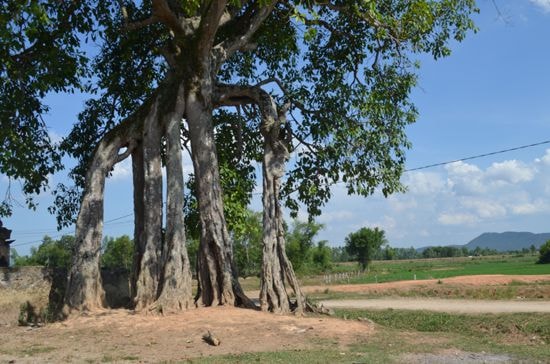 |
| The banyan tree in Tru Thach village. |
Mr. Lang Trong Ngoi, Chairman of the Elderly Association of Ly Thanh Commune, was born and raised in Tru Thach village. When talking to him about the ancient banyan tree, he relived distant memories, as his childhood was deeply intertwined with the village's banyan tree. As a barefoot, bareheaded child, he and his friends would herd buffalo in the village fields every day, and the banyan tree became their meeting place. When the buffalo rushed out to the fields, the whole group would compete to climb the branches of the banyan tree and then slide down to see who was the fastest. In the summer, the children would often see the woodpeckers coming here to build nests, and then cuckoos coming to lay their eggs in the woodpeckers' nests. These nests always aroused the children's curiosity. They would eagerly await the day the woodpeckers hatched their chicks and brought them home to raise.
The banyan tree is the embodiment of war elephants.
Today, many villagers still recount a fascinating story, which can be considered the legend of the village's banyan tree. The story goes that a general riding an elephant to battle was wounded and stopped at this spot on his way back. After the elephant died, a banyan tree grew here, thriving and remaining to this day. Many who come to admire it comment that the tree resembles an elephant, with its head facing the village temple and its tail pointing towards the village fields. For hundreds of years, the people of Tru Thach village have believed in this story and the sacredness of the ancient banyan tree.
In Tru Thach village, farmers would choose the shade of the banyan tree to sit, chat, and rest during the sweltering summer afternoons or while working in the fields. During Tet (Lunar New Year) and other festivals, they would gather under the banyan tree, temporarily leaving the fields behind, to play games like swings and human chess. Today, these games are no longer organized locally, but in the memories of many elderly people, the childhood spent under the village's banyan tree never fades.
During the Nghe Tinh Soviet movement of 1930-1931, under the leadership of the Van Tu commune Party branch, the people of Tru Thach village and surrounding areas gathered to demonstrate at the village communal house. There, the red flag with the hammer and sickle was planted on a banyan tree by Soviet soldiers and the people. In 1945, under the leadership of the Viet Minh Front of Yen Thanh district, the people of Tru Thach village gathered in the communal house courtyard to hear military order No. 1. The red flag with a yellow star was hoisted on the village banyan tree. The people of Tru Thach fanned out in all directions to capture traitors, overthrow the colonial and feudal regime, and seize power for the people.
During the two wars of resistance against the French and the Americans, under the shade of the banyan tree, countless young people from the village eagerly enlisted to defend their homeland and country. Mr. Lang Hong Quang, a son born and raised in Tru Thach village, choked up when I asked him about his memories of the village banyan tree. It was during the fierce years of the war against the Americans that he and a friend parted ways under that tree before enlisting. Under the dim moonlight of the village night, beneath the old banyan tree, the two friends resolutely wrote a letter before going to fight the enemy and promised to return. But his friend died on the battlefield forever. “Every time I visit my hometown, I spend time standing by the banyan tree and remembering those memories. My heart is comforted knowing that my friend fell so that our village banyan tree could remain green and healthy forever.”
And in that same overwhelming love, he wrote these passionate poems:
"I grew up seeing old banyan trees."
It is believed that the banyan tree gave birth to Tru Thach village.
The banyan tree in my village is a fairytale banyan tree.
"Protecting the years of a person's life…".
Today, Tru Thach village is changing day by day. No matter where they go in the world, no matter how many storms they have weathered in life, whenever they return to the village and see the banyan tree, they find peace and tranquility in their souls.
Thai Orchid
| RELATED NEWS |
|---|


