
Liverpool lost 0-3 to Man City and Forest: crisis
Two consecutive 0-3 defeats dragged Liverpool down to 11th place: 0.71 xG against Man City, 1.18 xG against Forest, Doku's pressure, VAR denied Van Dijk, disjointed pressing, defense conceded 6 goals in 2 games.
Two consecutive 0-3 defeats against Manchester City and Nottingham Forest have pushed Liverpool down to 11th place, exposing a complete crisis: a powerless attack, a fragile defense, and a broken pressing. In 180 minutes, The Kop failed to score and conceded six goals.
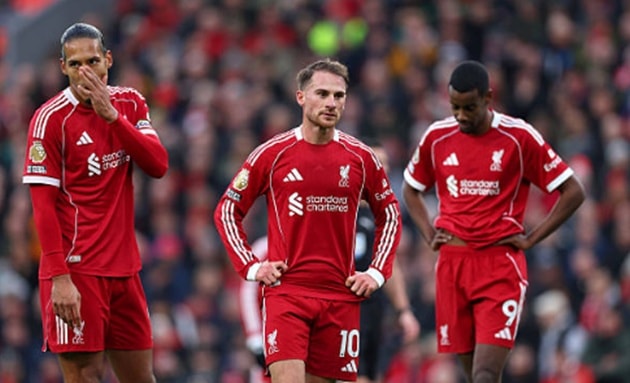
Against Manchester City: the opening blow and the turning point of VAR.
Liverpool were almost completely stifled by City for the entire 90 minutes. They only generated 0.71 xG despite having Salah, Ekitike, Szoboszlai, and Wirtz on the field, while City dominated with 1.60 xG.
The big difference came from Doku's speed and disruptive ability: 10 touches in the penalty area, 5 successful dribbles, and 2 clear-cut chances created. Every time Doku received the ball, Liverpool's defensive structure was stretched.
Van Dijk's disallowed VAR goal – seemingly a morale boost – turned into a negative turning point. Just minutes later, Liverpool crumbled, conceding two consecutive goals at the end of the first half and the first half of the second, exposing their alarming fragility.
Returning to Anfield to face Nottingham Forest: plenty of possession but no real threat.
Opponents from the bottom of the table didn't help Liverpool get back on track. Despite generating 1.18 xG, they still couldn't score. Their periods of 60-65% possession didn't translate into enough pressure.
Gakpo's chances, Mac Allister's header, and Salah's runs were all easily thwarted. No one in the attack showed the necessary composure in the penalty area.
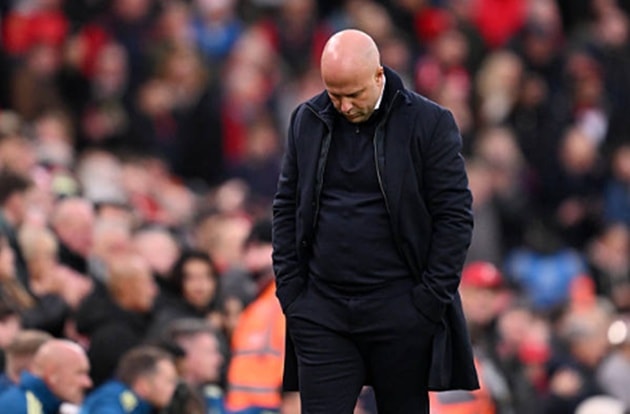
Defense in a critical state: conceding goals from simple situations.
In just two matches, Liverpool conceded six goals, mostly from basic plays. Against Man City, they allowed Haaland to comfortably head the ball in and failed to neutralize attacks down the flanks.
Against Forest, Van Dijk's mistake at the near post after a corner led to the first goal. The second and third came from crosses and runs that went wide of their opponents, leaving them unmarked; by the time the opposition took a shot, it was too late. A lack of concentration, loose organization, and slow retreat resulted in repeated breaches of their defense.
Goalkeepers Mamardashvili and Alisson faced far too many dangerous shots. This wasn't just individual error; the goal was under threat due to a defensive structure lacking sufficient protection.
Arne Slot's Pressing: Right idea, disjointed execution
Arne Slot wanted to implement high-pressure pressing, but the lines were out of sync: the attacking line didn't create enough initial pressure, the midfield was bypassed too easily, and the team's formation was stretched too wide. When the blocks didn't move in sync, gaps appeared in every crucial area, from the central flanks to the wings.
Attack lacking ideas, defense lacking discipline – that's how Liverpool put themselves on the defensive against both a shrewd team like Man City and a simple counter-attacking side like Forest.
The big picture requires change.
Liverpool entered November hoping to rejoin the Premier League race, but the reality was two consecutive 0-3 defeats and 11th place. A team that was the champion last season now plays as if it has lost its identity.
If Slot doesn't quickly solve the problem of signing a "big-name" striker and rebuild Liverpool's trademark pressing system, The Kop risks being knocked out of the top four race sooner than expected. The two 0-3 defeats are just symptoms; the underlying structural and intensity problems are what urgently need fixing.


