
Six notable features revealed on Apple's first foldable iPhone model.
Apple is expected to unveil its first foldable iPhone this fall, tentatively named the iPhone Ultra, bringing with it a host of major changes to design, software, and hardware.
Book-style folding design, ultra-thin and wrinkle-free.
According to the latest rumors, the iPhone Ultra will be Apple's most uniquely designed iPhone to date. The device is said to use a book-style folding mechanism, similar to a horizontally opened notebook, instead of the vertical folding design found in many current smartphones.
Notably, when unfolded, the device has a wider-than-height ratio. The outer screen is designed to be shorter and wider than traditional iPhone models, while the inner screen has a size and feel similar to the iPad mini.
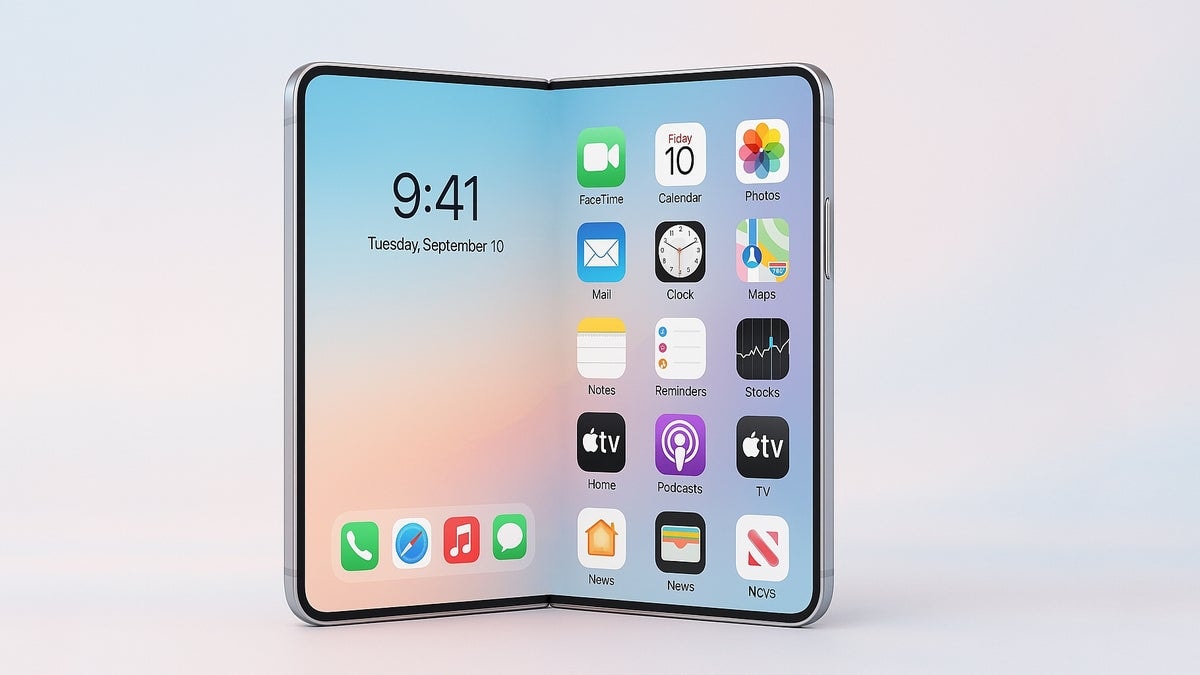
One of the most anticipated upgrades lies in the inner folding screen. Apple is said to have solved the problem of the crease, a long-standing weakness in foldable smartphones. If this information is accurate, it would be a major design leap forward for the new product line.
The iPhone Ultra is also said to inherit the ultra-thin design language from the iPhone Air series. It uses a titanium frame, has a thin body when unfolded, and when folded, looks like two iPhone Airs stacked on top of each other.
Additionally, the device may only be sold in two colors: black and white.
Two screens of unusual size
Apple's first foldable iPhone is expected to have two separate screens.
The external display is said to be around 5.3 to 5.5 inches in size, similar to the previous iPhone mini series but with a wider aspect ratio.
Meanwhile, the inner screen, when unfolded, will measure between 7.6 and 7.8 inches, approaching the experience of the iPad mini. This suggests that Apple is aiming to combine the experience of a phone and a tablet in a single device.
Dual rear cameras, two separate selfie cameras.
In terms of photography capabilities, the iPhone Ultra is rumored to feature a dual 48MP rear camera system, including a main camera and an ultrawide camera.
However, using only two cameras means the device may not be equipped with a telephoto lens like the Pro versions. Users will therefore miss out on advanced optical zoom capabilities.
Because it has two screens, the iPhone Ultra will also have two separate front-facing cameras, one for each screen.
Currently, there isn't much information available about this selfie camera setup, but many sources suggest that Apple may use an 18MP sensor similar to the previous iPhone 17 series. The punch-hole design will continue to appear on the new device.
iOS 27 adds iPad-style multitasking.
In addition to hardware changes, Apple is also reportedly developing several software features specifically for the iPhone Ultra based on iOS 27.
According to Bloomberg journalist Mark Gurman, the two most notable upgrades will include the ability to run apps side-by-side for multitasking and an app interface that is more iPad-like in style.
Although the device is not expected to fully support the windowed interface like iPadOS 26, Apple will still incorporate many elements from the iPad operating system into the new foldable iPhone to take full advantage of the large screen inside.
The A20 Pro chip is manufactured using process 2. nanometer
In terms of specifications, the iPhone Ultra is expected to be equipped with the A20 Pro chip and the C2 cellular modem, a combination that will also appear in the iPhone 18 Pro series.
The A20 Pro is considered a significant leap forward thanks to the new 2-nanometer manufacturing process. In addition, Apple has applied advanced semiconductor chip packaging technology to improve performance and power efficiency.
The new chip will come with 12GB of RAM, similar to the previous generation, but will use the high-speed LPDDR5 memory standard to boost overall performance.
Meanwhile, the C2 modem is Apple's next-generation, self-developed 5G modem, replacing the solution from Qualcomm. This is seen as a significant step that will give Apple better control over the connectivity hardware on future devices.
Touch ID returns to replace Face ID.
One surprising detail is that the iPhone Ultra may not be equipped with Face ID.
Instead, Apple is reportedly planning to bring Touch ID back and integrate the fingerprint sensor into the power button, similar to how it's doing on the iPad Air and iPad mini.
The reason is believed to be that the device's body is too thin, preventing Apple from shrinking all the Face ID components to fit simultaneously on both screens. However, analysts suggest this could change in future generations of foldable iPhones.
The price of the iPhone Ultra is still a subject of debate. Most analysts predict the device will have a starting price of around $1,999 for the 256GB version.
Although the final price has not been confirmed, it is highly likely that this will be the most expensive iPhone Apple has ever sold.
By combining the iPhone and iPad experiences in a single device, Apple expects the iPhone Ultra to open up an entirely new segment within its ecosystem.


