
Fearing tax increases, Vietnamese people are rushing to buy imported cars.
Imported car sales doubled in November compared to October, while domestically assembled car sales saw a slight decrease.
According to a report by the Vietnam Automobile Manufacturers Association (VAMA), in November 2015, total market sales reached 29,706 vehicles, a 33% increase compared to the previous month, with strong growth across all three categories: passenger cars, commercial vehicles, and specialized vehicles.
Notably, there was a contrasting trend: sales of domestically produced vehicles reached only 17,129 units, a decrease of 7.6% compared to the previous month, while the number of imported vehicles was 12,577 units, an increase of 95% compared to the previous month. If we consider cumulative sales for 2015 up to the end of November 2015, domestically assembled vehicles increased by 50% while imported vehicles increased by 78% compared to the same period last year.
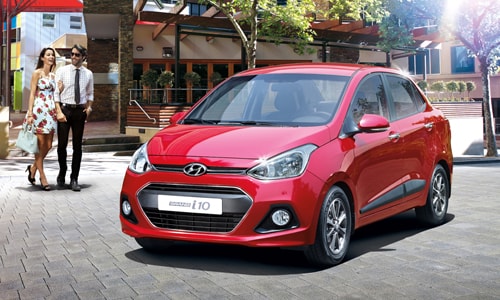 |
| Hyundai Grand i10. |
Another figure from the General Statistics Office shows that in November, approximately 14,000 vehicles were imported into the country, with a value of 240 million USD, almost equivalent to the previous month. Overall, in the first 11 months of 2015, an estimated 120,000 complete automobiles were imported into Vietnam, with a total value of 2.579 billion USD, an increase of 83% in volume and 91% in value compared to the same period last year.
Thus, in November, the number of imported cars did not increase compared to the previous month, but the number of cars sold nearly doubled (95%). The chart below shows that the number of completely built-up imported cars (red column) in November jumped significantly compared to the other 10 months of the year.
According to industry experts, the significant change in imported car sales stems from newly enacted tax and fee policies as well as the overall market growth.
The government recently issued Decree 108 in early November, adjusting the tax base for special consumption tax, effective from January 1, 2016. Accordingly, the tax base for special consumption tax will shift from cost price to wholesale price (cost price + profit, selling expenses, marketing, and transportation costs). The special consumption tax rate under the new calculation method will increase, therefore the selling price of imported vehicles will also increase from the beginning of 2016.
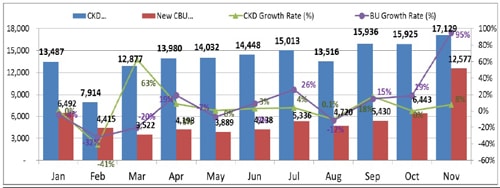 |
| Sales figures for all car models in the market in 2015. |
Customers have two months left, November and December, to take advantage of buying cars and avoid the tax increase that will drive prices up at the beginning of next year. Prices could even be higher next year if the National Assembly approves the new special consumption tax rate, which heavily targets cars with engines of 2 liters or more, a segment with many imported models.
Furthermore, the overall development of the industry has not only boosted domestic car assembly but also increased imported cars. Previously, imported cars were limited to a small number of luxury vehicles valued at billions of dong, but now the range of imported cars has expanded, from small cars like the Grand i10 priced at 400 million dong to luxury and super luxury cars costing tens of billions of dong.
The growth of the imported car market gives customers more options to compare with domestically assembled vehicles.
"The advantage of imported cars is that customers place greater trust in their quality, so if the price is competitive, this type of car can easily become the best-seller," one expert commented. In fact, in November 2015, the best-selling model on the market was no longer the locally assembled Vios (1,257 units) as usual, but the imported Ford Ranger pickup truck (1,333 units).
Imported car brands are all facing a year of strong growth before confronting the "storm" in 2016. Data from Lexus, a member of VAMA, shows that the company sold 56 cars in November, compared to only 45 in October.
The Vietnamese automotive market in 2015 shows strong potential for growth compared to last year. To date, the industry has sold 215,517 vehicles, compared to 137,602 in the same period last year, and even just over 180,000 in 2014. If this growth continues until the end of the year, total industry sales could reach 230,000-240,000 vehicles, far exceeding the 150,000 predicted by VAMA at the beginning of the year.
The market is growing, but car prices show no signs of cooling down, and are even rising despite the imminent advantages of reduced import taxes. Car prices in Vietnam are unlikely to decrease unless policymakers remove automobiles from the list of luxury goods that need to be restricted.
According to VnExpress
| RELATED NEWS |
|---|


