
Exploiting language barriers to undermine and divide national unity.
Recently, in areas inhabited by ethnic minorities, some malicious individuals have frequently exploited the language barriers of these groups to spread fake news, distort the policies and guidelines of the Party and State, incite ethnic conflict, create regional divisions, and destabilize social order and security... Therefore, we need to be extremely vigilant, identify this issue promptly, and develop effective methods for combating and preventing it...
Recently, in addition to fabricating and slandering the religious and human rights situation in Vietnam to undermine the Party and the State, some reactionary, extremist, and ill-intentioned individuals and organizations have frequently exploited and intensified the politicization and internationalization of ethnic issues to create pretexts for exerting pressure and interfering in Vietnam's internal affairs.
They exploit shortcomings in the preservation and development of the languages of ethnic groups in some localities, calling for the organization of international conferences on ethnic minorities to stir up nationalist and separatist ideologies among certain ethnic groups. Many distorted contents have been published in some overseas magazines and social media to call on international public opinion to "speak out" about the issue of ethnic minorities in Vietnam.
 |
The charm of a Thai girl from western Nghe An province in traditional attire. Photo courtesy of Dinh Tuan. |
For example, reactionary elements have established illegal groups with the slogan "preserving and developing the history, religion, and culture of the Khmer people," but in reality, their main activities are propaganda, distortion, and division among the Khmer people in Southern Vietnam from the Kinh people, slandering and undermining the prestige of patriotic and progressive religious leaders and monks, thereby inciting separatism and calling on people to participate in the struggle to establish the so-called "Khmer Krom State"...
Through programs focusing on the spoken and written languages of ethnic minorities in the Northwest and Central Highlands regions, some opposition groups have employed the tactic of "peaceful evolution" by distorting and misrepresenting the cultural preservation of ethnic minorities; distorting historical issues to sow discord between ethnic minorities and the Kinh people. Even more insidious, they frequently use bribery and manipulation to influence influential figures within ethnic communities, thereby propagating and distorting the policies and guidelines of the Party and State in their own languages.
In particular, some individuals, backed by reactionary organizations abroad, have used overseas radio stations broadcasting in ethnic languages, and printed and distributed cultural materials in the languages and scripts of ethnic groups to spread propaganda and information opposing the Party and the State, and to divide national unity. They exploit isolated issues related to ethnic groups, such as language, writing, or cultural preservation, then exaggerate them into ethnic conflicts and call for measures to "protect human rights," "protect the rights of ethnic minorities," etc., to incite and mislead some naive, gullible, or uninformed people.
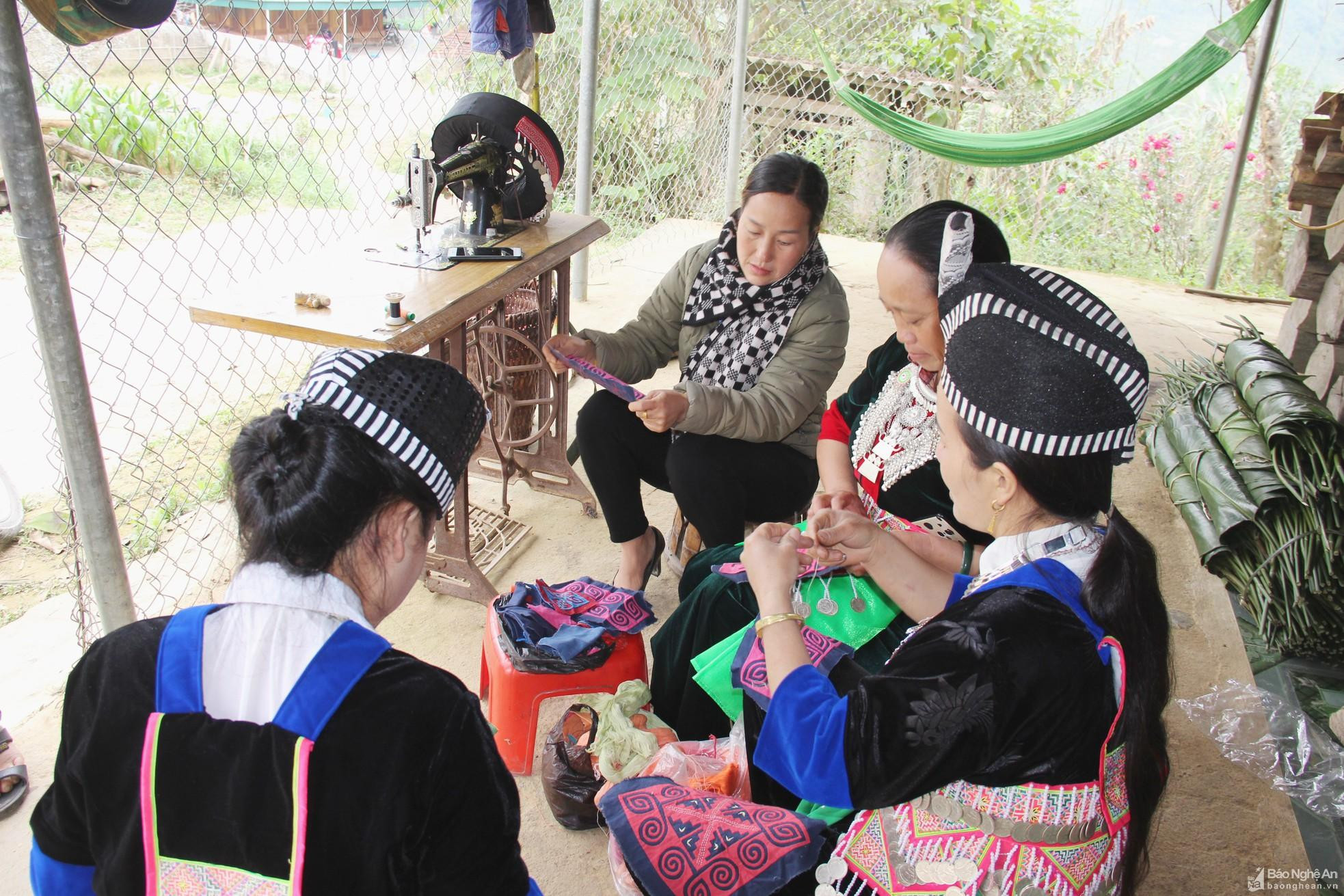 |
The weaving group in Pha Xac village, Huoi Tu commune, Ky Son district, produces and sells brocade products through social media. (Photo: Hoai Thu) |
In fact, since the founding of the country, the Party and State's policy on preserving and promoting the spoken and written languages of ethnic minorities has always been consistent in its guidance and implementation. Article 15 of the first Constitution of the Democratic Republic of Vietnam (1946) clearly states: "In local primary schools, ethnic minorities have the right to study in their own language. Poor students will be assisted by the Government."
This is affirmed in the 1992 Constitution, the 2013 Constitution, as well as numerous legal documents of the National Assembly and the Government. Clause 3, Article 5 of the 2013 Constitution stipulates that “The national language is Vietnamese. Ethnic groups have the right to use their spoken and written languages, preserve their ethnic identities, and promote their customs, traditions, and fine cultural heritage.”
In 1980, the Council of Ministers issued Decision No. 53-CP dated February 22, 1980, regarding the writing systems of ethnic minorities, which stipulated: “The spoken and written language of each ethnic minority in Vietnam is both a valuable asset of those ethnic groups and a common cultural asset of the entire country. In ethnic minority areas, the ethnic language and script are used concurrently with the common language and script.” The Law on Universal Primary Education of 1991 also clearly stipulates that ethnic minorities have the right to use their own spoken and written language alongside Vietnamese to conduct primary education.
The Education Laws, enacted in 1998 and 2019, both affirm that the State encourages and facilitates ethnic minorities to learn their own languages and scripts, thereby promoting the good customs, traditions, and culture of each ethnic group, contributing to the diverse cultural values of the Vietnamese nation.
The effectiveness of these policies has been demonstrated in practice. Previously, only a few ethnic groups like the Cham and Khmer had their own spoken and written languages, while most other minority groups only had their own spoken languages without written scripts. Now, the Latinization of pronunciation in the languages of some ethnic groups that only have spoken languages without written scripts, such as the Hmong, Ede, and Jrai, and the systematization of the writing systems of the Tay, Dao, and Thai people, have been implemented. Through these efforts, the spoken languages of ethnic minorities are preserved and passed on to future generations.
Statistics show that by 2020, in Vietnam, over 90% of ethnic minority households listened to programs from the Voice of Vietnam radio station, and over 80% watched television. Radio and television programs from the central to local levels, broadcast in 26 ethnic languages, reached even the most remote villages.
Vietnam National Radio alone has 6 in-depth Vietnamese-language programs on ethnic minority topics; 13 radio programs in ethnic minority languages covering areas with large concentrations of ethnic minorities in the Northwest, Northeast, Central, Central Highlands, Southeast, and Southwest regions; and more than 400 radio programs (from 2011-2021) to disseminate information to ethnic minorities about Program 135, improve livelihoods, and raise awareness of human rights issues...
Currently, 30 provinces nationwide have implemented programs with 700 schools teaching ethnic minority languages; published 8 ethnic language curricula (Cham, Khmer, Jrai, Bahnar, Ede, Hmong, M'Nong, Thai); and 6 sets of ethnic language textbooks (Cham, Khmer, Jrai, Bahnar, Hmong, Ede); 23 provinces and cities are teaching ethnic minority languages in general education schools... Among these, the teaching of Khmer is particularly noteworthy (there are approximately 1.3 million Khmer people, accounting for 7% of the population). Disseminating information in ethnic languages and incorporating ethnic languages into the education program helps ethnic minorities maintain their cultural identity while ensuring equality in enjoying cultural and educational values.
In addition, the movement of "eating together, living together, working together, and speaking the ethnic language together" has been widely implemented. Article 21 of the Law amending and supplementing a number of articles of the Law on Cultural Heritage, promulgated in 2009, stipulates the requirement: "Teaching the spoken and written languages of ethnic minorities to officials, civil servants, and officers and soldiers of the People's Armed Forces working in ethnic minority areas according to job requirements."
In reality, understanding the language and speech of ethnic minorities helps in detecting and monitoring the local situation, promptly combating negative phenomena, and contributing to maintaining security, political stability, and social order; it also supports propaganda, education, and mobilization efforts to help ethnic minorities correctly understand the Party and State's policies on ethnicity and religion in the new situation.
Furthermore, to ensure the right of ethnic minorities to use their own language in legal proceedings, Vietnamese law stipulates that participants in civil, criminal, and administrative proceedings have the right to use their own spoken and written language. Accordingly, in necessary cases, the court will invite interpreters to assist. This regulation has both socio-political significance, demonstrating equality among ethnic groups, and ensures accurate and transparent judicial proceedings.
In the coming period, to continue effectively preventing and combating the exploitation of ethnic issues for subversive purposes by reactionary and hostile organizations and individuals, each of us citizens needs to constantly strengthen national unity.
Besides focusing on building a team of ethnic minority cadres, Party committees and authorities at all levels need to concentrate on building and ensuring that cadres working in areas with ethnic minority populations understand the language, speech, and culture of the ethnic minorities, thereby contributing to creating consensus and trust among the people.
Emphasis should be placed on effectively disseminating the Party's guidelines and the State's policies and laws on ethnic issues, preventing ethnic minorities from being misled, exploited, or incited by malicious elements. Simultaneously, efforts should continue to refine ethnic policies, gradually improve economic living standards, narrow the development gap between regions, and effectively carry out the task of preserving and developing the culture of ethnic minorities.


