
Group interests erode the integrity of officials and civil servants.
Group interests are daily corrupting the system and eroding the integrity of officials and civil servants...
Seventy-one years have passed since September 2nd, 1945, and for centuries to come, even millennia to come, the lessons of seizing opportunities swiftly and uniquely, of the wise and skillful leadership of the Party, and of the people's unwavering trust in the Party that led to victory and history, will forever remain invaluable.
The Party considers "the people as the foundation," and the people's unwavering trust in the Party led the two wars of national defense during the "30 years of democratic republic" to complete victory, unifying the country and bringing the nation together as one. This is a value of enduring significance.
After 10 years of suffocating hardship and living in a "bureaucratic, centrally planned economy," with the economy plummeting to the depths of poverty and misery, the people compared the situation to a war. While the people may have become disillusioned with the Party, they still have faith and remain united in overcoming these challenges.
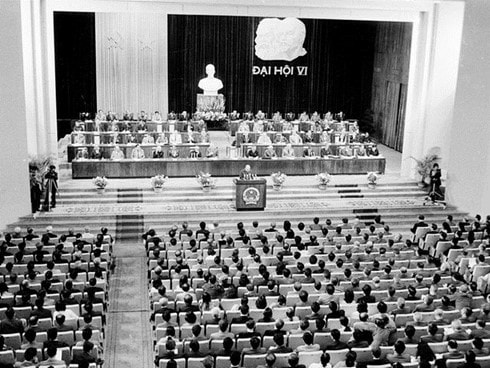 |
| The 6th National Congress of the Communist Party of Vietnam in 1986 (Photo: VNA) |
The 8th Central Committee Conference of the 5th Party Congress (June 1985) marked the second breakthrough with decisive action to abolish the centralized bureaucratic subsidy mechanism, implement a single-price mechanism, eliminate the system of supplying goods at low prices, shift all production and business activities to a business accounting mechanism, and transform banks to business principles. The 6th Central Committee Conference of the 4th Party Congress (August 1979) proposed the first breakthrough in the reform process: "to unleash production." Directive 100 (1981) of the Party Secretariat on improving the contract system and expanding product-based contracts to groups and individual workers in agricultural cooperatives created a new impetus in agriculture.
The Party has defined a multi-sector economic mechanism, correctly utilizing commodity-money relations and applying the law of value. This is the third breakthrough.
The 6th National Congress of the Party (December 1986) awakened awareness and a perspective of "facing the truth, accurately assessing the truth, and clearly stating the truth," setting forth a comprehensive reform policy for the country. This was a turning point, a major and comprehensive breakthrough that brought confidence to the people.
Overall, the 30 years of reform have been a period of stability and development. The political system has been institutionalized in stages, term by term. The head of the Party, National Assembly, State, and Government serves no more than two terms. While this system may not necessarily guarantee full and comprehensive democracy, it is crucial to put an end to the feudal ideology of lifelong office, the belief that the king is the son of heaven, and that those who do not retire can only be deposed.
In the process of comprehensive reform and democratic practice, the people are paying more attention to the qualities of Party members and leaders from the grassroots to the central level. In political life, especially during the preparation for the National Party Congress, the National Assembly elections, and the elections for People's Councils at all levels, the people are very concerned about terms of office, personnel, and the transfer of power, with feelings ranging from hope to disappointment. This is also a common sentiment.
It is important to note that during the relatively stable process of reform, special interest groups have emerged. Globally, these interest groups are formed alongside the development of market economies. Interest groups that align with the country's progress and the community's interests become a driving force for development. Any group that acts solely for its own self-interest, going against the common good, or monopolizing all benefits for personal gain, will be an obstacle and a counter-move.
American economics professor Mancur Olson observed: “Any country that has a sufficiently long period of political stability will see the emergence of special interest groups, and these groups will become increasingly sophisticated and skillful. They will then increasingly learn how to manipulate the most important public policies of the nation, its economic development, its political apparatus, especially its administration and legal system, understanding how to create convincing justifications for their manipulation. Because their skills become more refined, the benefits they gain become more certain and substantial. Ultimately, this gradually leads to the transformation of the nation's institutions, policies, and organizations in economic, social, administrative, and legal aspects into arrangements perfectly suited to these special interest groups, stifling the nation's development and causing its various sectors to become increasingly rigid. This inevitably leads to the nation's downfall.”
In our country, negative vested interests have long been prevalent, embedded within the Party, government, and state-owned enterprises, but people dare not speak out against them due to sensitivity and fear of internal disunity. Only when the collusion between businesses, economic conglomerates, and Party and state agencies, and those who make and implement policies, becomes apparent in practice do they begin to raise the alarm. Better late than never.
Group interests are daily corrupting the system, eroding the integrity of officials and civil servants, and eroding public trust in the Party and the State. The interests of these corporations are extending their tentacles, attempting to hold national policies hostage. All the economic and social burdens and consequences fall on the shoulders of the vulnerable. The people have become hostages of these vested interest groups.
Experience also shows that not all vested interest groups wield absolute power.
The electoral system, with universal suffrage, which has existed since the first Constitution, elects the National Assembly, the head of the National Assembly, the Government, and the State. A truly open, transparent, and democratic system will select leaders who are "for the people and the nation."
Group interests cannot manipulate or single-handedly obscure the media, even if they may exert some influence on certain groups during a particular event.
In the age of globalization, vested interests can be transnational. But in the fierce competition for survival and growth, corporations are forced to compromise.
These restraining factors are only effective when there is a mechanism in place and a rigorous, transparent, clear, open, and truly democratic implementation, not a formal or pseudo-democratic system. Achieving this will not only prevent the people from becoming "hostages" but also restore their trust, further illuminating the historical value of the "Declaration of Independence" that President Ho Chi Minh solemnly proclaimed to the nation and the world 71 years ago in the historic Ba Dinh Square.
According to VOV.VN


