
The mysterious anti-submarine class of the Vietnamese Navy.
The history of the Vietnam People's Navy records the existence of Project 201 small anti-submarine vessels, however, there are virtually no photographs of them.
The Project 201 (NATO designation SO-1) small anti-submarine ships, produced by the Soviet Union during the 1950s and 1960s, along with many other torpedo boats and fast attack missile boats, formed an extremely formidable "mosquito fleet".
The basic specifications of the SO-1 anti-submarine vessel include: standard displacement of 170 tons and up to 215 tons when fully loaded; length of 42 m; width of 6 m; draft of 1.8 m; crew of 30 people.
The anti-submarine class is equipped with three diesel engines, with the most powerful engine boasting a power output of 7,500 horsepower, giving it a maximum speed of 28 knots and a range of 1,100 nautical miles when operating at the economically optimal speed of 13 knots.
|
| Project 201 (SO-1) small anti-submarine vessel of the Soviet Navy |
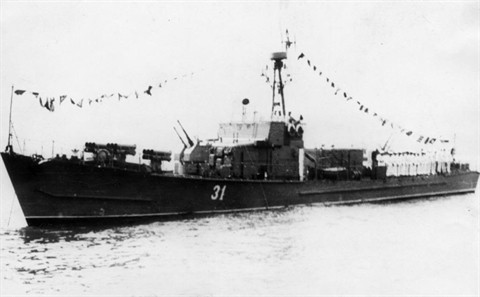
The armament of the Project 201 small anti-submarine vessels includes two twin 2M-3 25 mm gun mounts positioned forward and aft, four RBU-1200 anti-submarine rocket launchers, and also mounts for deploying mines and depth charges.
The ship's electronic systems include the Pot Head surface surveillance radar, the Don 2 navigation radar, and the Pot Head active sonar.
During the war against the US, the Soviet Union provided the Vietnamese Navy with a total of 8 Project 201 anti-submarine vessels. In Vietnam, these vessels were simply called 200-ton anti-submarine ships. They served from the mid-1960s to around the 1980s before being retired.
|
| A rare photograph of the RBU-1200 anti-submarine rocket launchers on the SO-1 anti-submarine ship of the Vietnamese Navy. |
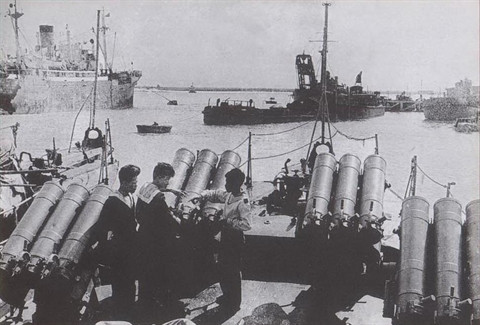
The Project 201 anti-submarine warfare class ships in the Vietnamese Navy did not have many operational activities, with the two most famous events being on August 5, 1964, when the SO-1 squadron deployed its ships at sea to use 2M-3 cannons to repel an American air raid.
Subsequently, around the mid-1980s, a rare exercise was recorded between these SO-1 anti-submarine ships and Kilo-class submarines of the Soviet Navy in the waters off Cam Ranh port.
Photographs of this class of small anti-submarine vessels of the Vietnamese Navy are extremely scarce. After we received five Petya-class anti-submarine frigates with larger displacement and superior capabilities, all eight SO-1 vessels were retired.


