
Reasons why a fourth dose of the Covid-19 vaccine is not yet needed.
The SARS-CoV-2 virus is constantly mutating, but vaccines are still following the same formula.
Both Pfizer and Moderna are requesting permission from the U.S. government to administer the vaccine.COVID-19 vaccineWednesday.
Last week, Pfizer announced it had filed an application with the U.S. Food and Drug Administration (FDA) for emergency use authorization to increase the dosage for adults aged 65 and older.
Pfizer CEO Albert Bourla suggested that Americans should get a Covid-19 vaccine annually, just like they get a flu shot in the fall.
"Currently, the third dose still protects against hospitalization and death," Bourla said. However, he stressed concerns that the protection might not last long.
Moderna also stated that it has applied for authorization for a fourth dose of the vaccine for all adults, allowing healthcare providers to determine the appropriate use of the booster dose by considering factors such as an individual's age and underlying health conditions.
However, according to infectious disease experts, administering a fourth dose to the US population may not be appropriate.
The virus has changed, but the vaccine remains the same.
The current vaccines from Moderna and Pfizer still follow the original formula and have not been adapted to address circulating variants, such as Omicron and its rapidly spreading subvariant, BA.2.
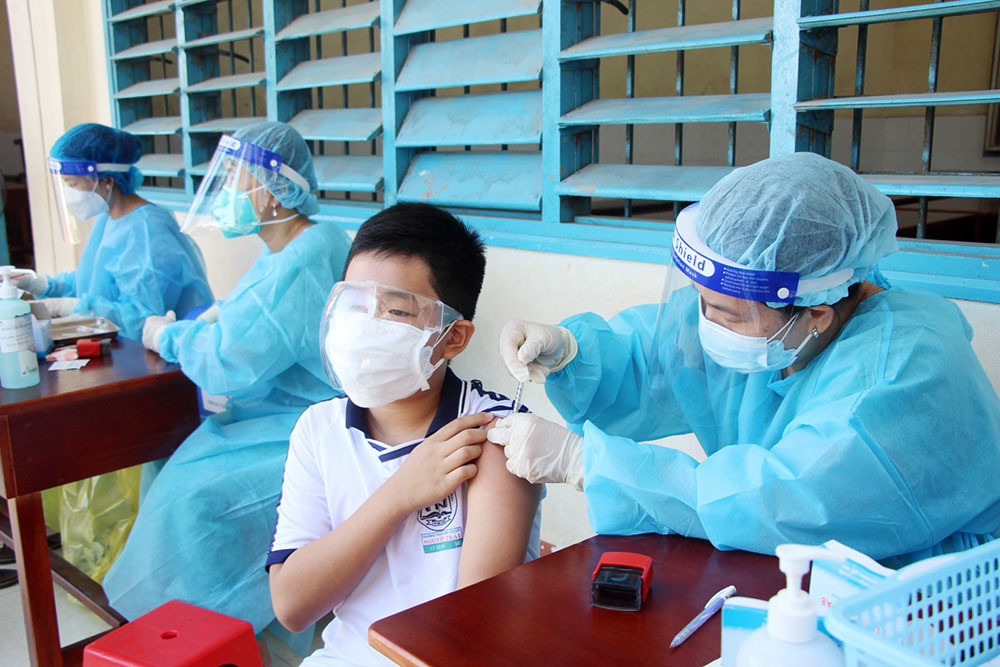 |
| The Prime Minister has repeatedly instructed that all necessary conditions be prepared for vaccinating children. (Photo: Archival image) |
All of those vaccines were developed based on the virus that was decoded in Wuhan in January 2020. Over the past two years, the virus has evolved, but the vaccines have not.
Dr. James Hildreth, a leading infectious disease expert, commented: “I don’t think pharmaceutical companies should be talking about booster doses with existing vaccines. I want to focus on looking at the sequences emerging from the variants and trying to create a vaccine that is effective against them, rather than just giving everyone a fourth dose.”
Dr. Hildreth is concerned that continuing to use vaccines that are appropriate for a two-year-old virus could create new problems. Boosting with an outdated vaccine could produce antibodies of little value against circulating strains of the virus. Or, as it evolves, the virus could learn to develop better resistance to the vaccine.
In addition to researching supplemental doses for each variant, several independent groups and pharmaceutical companies are also developing vaccines that target different virus strains simultaneously, hoping to achieve broad immunity against future variants. However, developing such a versatile vaccine will take at least several years.
There is no data yet on whether a fourth dose is effective for most people.
The available data on the fourth vaccine dose only show benefits for older adults and those with underlying health conditions. There is no data to demonstrate that booster shots are significantly better for the immune system of young, healthy individuals in preventing severe illness.
Recent research from the U.S. Centers for Disease Control and Prevention (CDC) noted that the vaccine's effectiveness against serious risks such as mechanical ventilation and death during the peak of the Omicron wave was 88% with two doses and 94% with three doses. This suggests that a booster shot only provides a small improvement in vaccine effectiveness for most people.
According to another CDC analysis, over 96% of fully vaccinated individuals hospitalized with Covid-19 during the Omicron outbreak had underlying health conditions. This was also true for 9 out of 10 adults who received a booster shot and were hospitalized due to Omicron infection.
Even Moderna's leadership agrees that fourth-dose vaccination programs, at this point, should focus on high-risk patients.
Moderna's chairman, Stephen Hoge, said that for people with cancer, Covid-19 can indeed be a life-threatening disease, even after vaccination. But he said a fourth dose is not necessarily required for people under 65 without underlying conditions.


