
The reason the US didn't launch an assassination attempt when Kim Jong-un was near a missile.
The U.S. may refrain from launching missiles at North Korean leaders because it wants to avoid provoking Pyongyang.
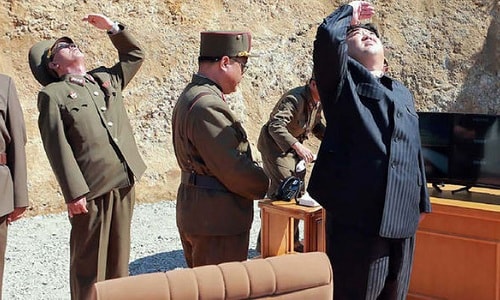 |
North Korean leader Kim Jong-un observes the ICBM after it was fired on July 4. Photo: KCNA. |
When North Korea test-fired the Hwasong-14 intercontinental ballistic missile (ICBM) on July 4, US military and intelligence personnel not only monitored the entire launch crew's activities for 70 minutes but also closely followed every move of North Korean leader Kim Jong-un, Business Insider reported on July 12.
Earlier, the Pentagon also confirmed that its RC-135S reconnaissance aircraft in Japan had detected the Hwasong-14 missile right from the refueling stage and closely monitored the entire launch process.
According to military experts at The Diplomat, this is a very opportune time for the US to launch a preemptive strike, especially since images released by North Korean media show Kim Jong-un smoking and standing close to the missile launch pad during preparation. The liquid fuel used on the Hwasong-14 missile is highly flammable and could explode on the launch pad, destroying any surrounding targets.
What surprised analysts was that the U.S. did not make any move to carry out such an attack, even though the North Korean leader had been within the range of U.S. missiles for more than an hour.
Previously, both the US and South Korea had repeatedly mentioned military action against North Korea, including the option of a preemptive strike targeting leader Kim Jong-un and high-ranking North Korean military commanders.
Rodger Bake, a leading expert on Asia-Pacific and South Asia at the Stratfor Institute for Strategic Analysis, argues that American strategists decided not to act and deliberately released this information as a strong message to North Korea.
According to Bake, by letting North Korea know that its leader was being closely monitored during the ICBM launch, Washington wanted Pyongyang to see that it was only seeking to reassure rather than provoke North Korea, and that assassinating the leader or overthrowing the government was not an objective of the US.
The U.S. and South Korea subsequently held joint missile exercises involving precision-guided missiles such as ATACMS and Hyunmoo-II. This appeared to be a way for the U.S. to demonstrate to North Korea that it was fully capable of striking to assassinate Kim or prevent the test launch, but they chose not to act in that way.
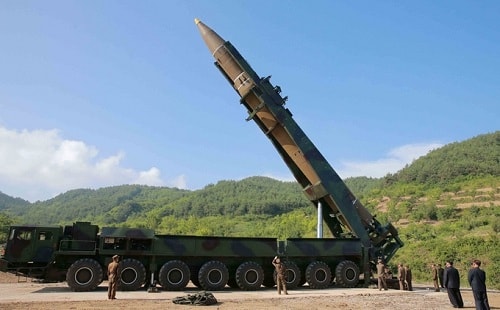 |
Kim Jong-un smokes next to the Hwasong-14 missile before firing it. Photo: KCNA. |
Washington may hope that if they can prove the U.S. has no intention of assassinating Kim, Pyongyang might voluntarily halt all its missile and nuclear development programs. In the event that North Korea continues its provocative actions, the U.S. could launch a precision strike targeting North Korean ICBMs and Kim at an opportune moment, Bake noted.
"Instead of assassinating Kim and provoking a potentially very strong reaction from North Korea, the U.S. chose to send the message that the best way to protect the regime is for Kim to stay home and not go near dangerous missile engines that could explode at any moment," expert Baker emphasized.
According to VNE


