
Lynk & Co 10 sets charging record: Charges from 10-97% in just 9 minutes.
Equipped with the Energee Golden Brick 900V battery, Geely's sedan achieves a maximum charging capacity of 1,100kW, promising to eliminate the waiting time barrier for electric vehicles.
On April 8, 2026, Geely Group, through its Lynk & Co brand, set a new milestone in the global automotive industry. The Lynk & Co 10 sedan successfully completed a fast-charging test, reaching 10% to 97% battery capacity in less than 9 minutes. This is a significant step towards narrowing the gap in driving experience between electric vehicles (EVs) and traditional gasoline-powered cars, amidst the increasingly fierce race in super-fast charging technology.
Maximum charging power of 1,100kW and 900V architecture.
The Lynk & Co 10 model is equipped with the Energee Golden Brick battery based on a high-voltage 900V architecture. Real-world results show that it only takes 4 minutes and 22 seconds to charge from 10% to 70% capacity. When higher energy levels are needed, charging from 10% to 80% takes only 5 minutes and 32 seconds. The entire charging process from 10% to 97% takes a total of 8 minutes and 42 seconds.
Notably, Geely's battery management system allows for maintaining very high and stable charging power. Throughout the testing process, the peak power reached 1,100kW. Even when the battery capacity exceeded 80%, the system continued to maintain power above 500kW, far surpassing the most common fast charging standards currently available.
| Charging phase (SOC) | Execution time | Sustained capacity |
|---|---|---|
| 10% – 70% | 4 minutes 22 seconds | Maximum power 1,100kW |
| 10% – 80% | 5 minutes 32 seconds | Over 500kW |
| 10% – 97% | 8 minutes 42 seconds | High stability |
Megawatt charging station infrastructure and cooling technology
To achieve this record-breaking performance, Lynk & Co 10 combined with an advanced charging infrastructure developed by Zeekr. The Megawatt V4 charging station played a key role, with each port delivering a maximum power of 1,300kW and a peak current of 1,300A.
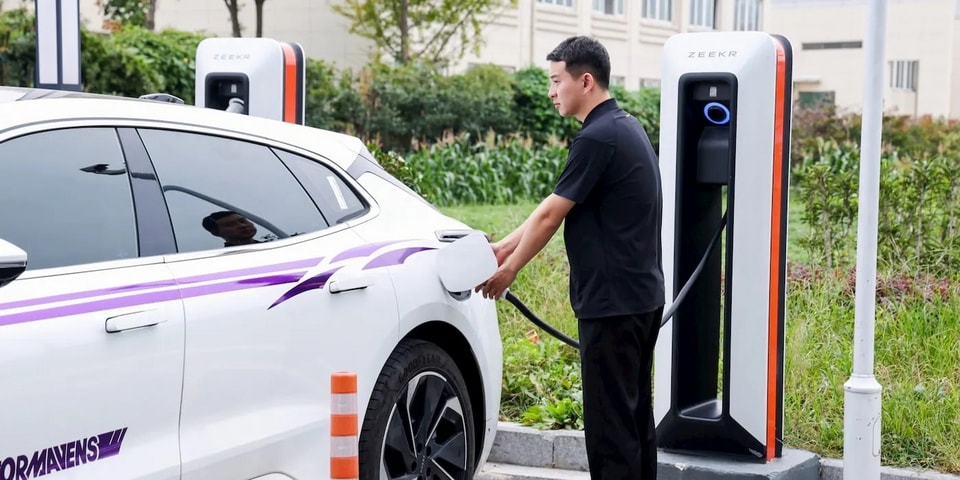
To address the heat generation challenge during high-power charging, the V4 system utilizes a fully liquid-cooled system for both the charging pole and cables. This mechanism helps control temperature at a safe level, protecting battery cell lifespan and ensuring stability throughout the transmission of massive amounts of energy.
As of the end of February 2026, Geely's charging network had reached over 2,100 stations with 10,000 charging poles in 215 cities in China. However, the company has yet to announce a specific roadmap for deploying these megawatt V4 charging poles in international markets.
A direct confrontation with BYD
Geely's achievement is seen as a strong response to rival BYD. A month earlier, BYD had introduced the second-generation Blade battery along with a megawatt charging system capable of charging 10-70% in 5 minutes. However, real-world performance from the Lynk & Co 10 shows superior speed on all charging slopes.
While Geely focuses on maximizing peak charging capacity, BYD prioritizes expanding its infrastructure with the goal of reaching 20,000 megawatt charging stations by the end of 2026. This competition directly benefits consumers by minimizing waiting times at charging stations. However, experts still note the compatibility issues between different charging systems due to differences in each manufacturer's technical standards.
Challenges in durability and the future of high-density batteries.
Despite the rapid advancements in fast charging technology, users remain concerned about battery durability when subjected to frequent high-intensity currents. Automakers assert that modern battery management systems (BMS) have been optimized to reduce thermal stress on battery cells.
Besides charging speed, the electric vehicle industry is also aiming to improve energy density. Some new battery types are reaching levels above 700Wh/kg, allowing vehicles to travel more than 1,000km on a single charge. The combination of large storage capacity and fast charging speeds of 8-9 minutes is expected to completely eliminate users' "range concerns" in the near future.


