
Facebook social network - Advantages and disadvantages
(Baonghean) - In the rapid development of the internet, Facebook is also widely used due to its speed in sharing information and connecting people. However, nowadays, many individuals are exploiting Facebook to distort information, gain personal profit, and negatively impact society, making this tool a "double-edged sword".
Misrepresenting information on Facebook and its negative consequences.
In recent days, the story of Tran Tuan Vinh (26 years old, residing in Quy Hop town) distorting information on Facebook to "slander" Hanoi Beer has become a hot topic of discussion. Vinh runs a Huda Beer business in Quy Hop, but business wasn't going well, so he devised a plan to create a Facebook account named "Viet Dai" and post false information about Hanoi Beer to damage the brand's reputation and increase his Huda Beer business profits.
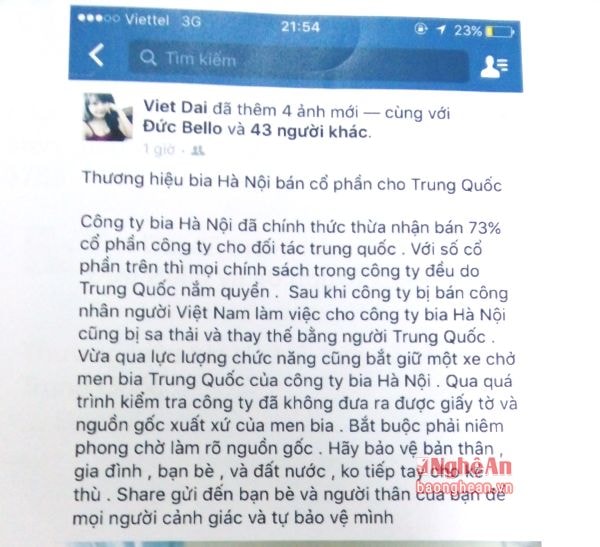 |
| Fabricated information about Hanoi Beer was posted on Tran Tuan Vinh's Facebook page. |
Upon discovering the incident, Hanoi Beer, Alcohol and Beverage Joint Stock Company (Habeco) filed a complaint with the Cybercrime Prevention and Control Department, General Department of Police, Ministry of Public Security, requesting an investigation. As a result, Tran Tuan Vinh was fined 12.5 million VND for providing false information, slandering, distorting, and insulting the reputation of an agency or organization.
This is not the first time this has happened. Previously, Facebook has also been exploited to spread false rumors and scams for profit, even with very absurd reasons to gain likes and views. For example, on May 3, 2016, the Con Cuong District Police summoned Le Van Son, 40 years old, residing in Con Cuong town, who spread rumors of child kidnapping on Facebook on April 22, 2016. The announcement included an image of a blue car allegedly belonging to the scammers and kidnappers, causing widespread panic and fear. Just two days after being posted, the post received over 53,000 likes and nearly 10,000 shares. At the police station, Mr. Son confessed that the information about child kidnapping posted on social media was inaccurate and fabricated solely to gain likes. For example, information spread on Facebook and other social media platforms claiming that women who eat a lot of grapefruit are at increased risk of breast cancer. Despite numerous seminars and statements from reputable agricultural and forestry scientists reassuring the public and providing evidence to refute the information, this still had a severe psychological impact on consumers and caused serious damage to grapefruit growers. Tragically, the rumors were spread during the peak season, leaving farmers in dire straits. In just over a month, the price of grapefruit in the Mekong Delta plummeted from 8,000-10,000 VND/kg to 1,000 VND/kg, forcing many farmers to cut down their grapefruit trees due to economic losses.
Many believe that the spread of false and fabricated information on the internet, which negatively impacts public opinion, stems from a lack of understanding of the law and a failure to grasp the consequences of their actions. However, this misinformation is attention-grabbing and disseminated rapidly through Facebook. For example, in the case of Tran Tuan Vinh, he clearly understood that spreading false rumors about Hanoi Beer would inevitably lead to a boycott, which was his ultimate goal. The resulting consequences would be a decrease in Hanoi Beer's revenue and, more importantly, the collapse of customer trust in a brand built up over many years. Similarly, recently, taking advantage of the Formosa incident, many spread false rumors about people being poisoned and dying from eating seafood, calling for a seafood boycott and causing public panic.
There are even more cases where the public witnesses heartbreaking stories of victims of false rumors from Facebook taking their own lives due to humiliation. For example, a 12th-grade female student in Huong Ngai commune, Thach That district (Hanoi) committed suicide by drinking herbicide after her photos were used to shame her on Facebook...
| Mr. Nguyen Ba Hao, Deputy Director of the Nghe An Department of Information and Communications, stated: “Spreading false rumors and untrue information on social media is a violation of the law. In fact, functional agencies have repeatedly issued administrative decisions to penalize individuals spreading false rumors on social media in order to increase deterrence against violations in this area. However, due to the limited understanding of the law among some Facebook users, the act of spreading false rumors on social media continues to occur.” |
Are internet users too passive when receiving information?
From another perspective, the loophole that allows those who exploit Facebook for personal gain lies in the indiscriminate reception and dissemination of information by netizens. Any information posted on Facebook, as long as it resonates with users, spreads like a supervirus… And with simple "like" and "share" buttons, netizens unwittingly become accomplices, assisting those spreading baseless rumors. Perhaps it's time we discussed the culture of behavior on social media. In the context of Facebook becoming one of the gateways to communication with the outside world, each person must know how to use it appropriately and carefully consider the information they receive.
Faced with the proliferation of "keyboard warriors" and self-proclaimed "prophet" on Facebook, users should remain level-headed, avoid falling into the trap of seeking likes and shares, and refrain from worrying prematurely before receiving official information from relevant authorities.
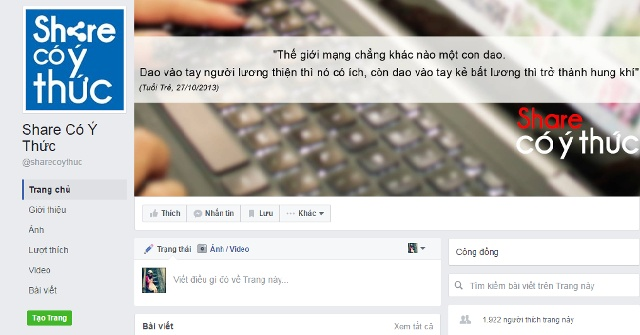 |
| The online community is launching a campaign for conscious sharing. |
Recently, a campaign called "Responsible Sharing" has been circulating on Facebook, urging people to be cautious about unverified and unsubstantiated information online. The campaign encourages the online community to research and verify any content they share to determine if it might harm anyone.
However, in the context of the widespread development of social media, where thousands upon thousands of pieces of information are posted daily, mixing truth and falsehood, it is thought that authorities need to have stricter regulations in managing the internet in general, and Facebook in particular, to prevent acts of distortion and the spreading of baseless rumors that create negative public opinion.
| Article 122 of the Penal Code stipulates that anyone who fabricates or disseminates information that they know to be false in order to insult the honor or cause harm to the legitimate rights and interests of others, or fabricates that another person has committed a crime and denounces them to competent authorities, shall be punished with a warning, non-custodial rehabilitation for up to 2 years, or imprisonment from 3 months to 2 years. Depending on the specific circumstances, the prison sentence may range from 1 to 7 years. |
Phuong Thao


