
Marine Le Pen: The 'earthquake' is about to happen.
(Baonghean.vn) - Despite a troubled childhood and an incomplete personal life, far-right candidate Marine Le Pen has stunned the French public as she enters the second round of the French presidential election. With her strong personality and determination to "France First," will Le Pen be able to overcome the mountain of challenges ahead and become the first female president in French history on May 7th?
A turbulent childhood
Marine Le Pen was born in 1968 in Neuilly-sur-Seine, a suburb of Paris. She had a tumultuous childhood, witnessing the breakdown of her family at the young age of eight. Her mother divorced her husband, leaving behind three children. Despite being the youngest, her family environment shaped her strong personality early on. While generally private about her personal life, some information about her has been made public. She was married twice, in 1997 and 2002, but both marriages failed. Le Pen currently has three children.
Born into a family with a political tradition, Marin Le Pen was exposed to this harsh environment from an early age. From childhood, she accompanied her father, Jean-Marie Le Pen – the former leader of the National Front (FN) – to far-right meetings.
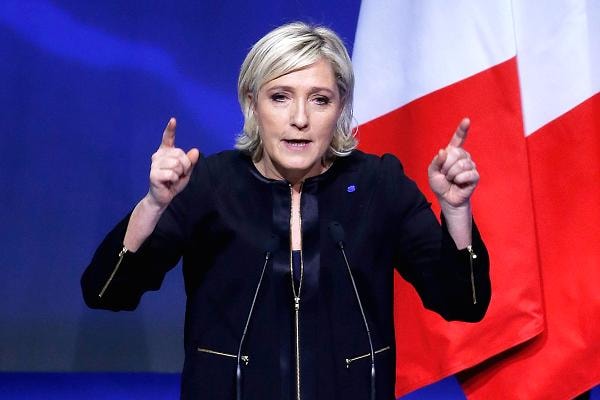 |
| Marine Le Pen is known for her hardline nationalist policies and her motto "France First". Photo: Getty |
Jean-Marie Le Pen founded the far-right National Front party in 1972. As an adult, Le Pen studied law at the University of Paris 2 Pantheon-Assas, and at the same time, she joined the National Front party at the age of 18.
After graduating in 1991, Le Pen worked as a lawyer until 1998. It was then that she truly began her political career, taking a humble position on the legal advisory board of the National Front (FN) party.
In 2011, Le Pen was elected party president, succeeding her father. With over two decades of experience in politics, Le Pen transformed the National Front (FN) from a weak party into one of the most influential and prominent political parties in France in recent years.
In 2012, Le Pen ran for president for the first time but finished in third place with a low 17.9% of the vote. However, over time, with the growing wave of populism and protectionism, her party began to receive more attention from voters. Recognizing that the time was ripe, on February 5th, Le Pen officially announced her campaign for a second term as President of France.
Differential policy
Over the past six years, Marin Le Pen has built the National Front (FN) party into a popular platform known for its populism and anti-globalization movement. Public opinion has seen Le Pen as a strong supporter of Britain leaving the European Union.
She also pledged to hold a referendum on France's withdrawal from the Eurozone, bringing the franc back into circulation. She even supported France's withdrawal from the North Atlantic Treaty Organization (NATO).
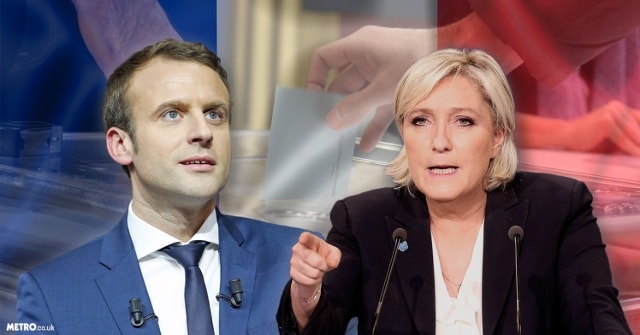 |
| The two candidates who advanced to the second round of the French presidential election: Marine Le Pen (right) and Emmanuel Macron (left). Photo: Getty |
On the issue of immigration, like her father, Le Pen, in her campaign pledge, set a goal of reducing the number of immigrants each year from 200,000 to 10,000, while also limiting their use of public services. Le Pen believes that only in this way can the negative influences of foreign culture be combated and France be protected.
In terms of security, Le Pen has demonstrated herself to be a tough and assertive politician in the fight against terrorism, tightening immigration controls into France and Europe. This has become her strength, given the increasing number of terrorist attacks in France and across Europe.
Le Pen has also been likened to the "Donald Trump of France" with her "France First" stance and nationalism, prioritizing issues that strengthen France rather than any common community. It is no coincidence that US President Donald Trump recently praised Le Pen as the "strongest candidate on immigration and terrorism."
However, despite being a far-right politician, Le Pen is known not to be overly conservative on social issues. This is evidenced by her opposition to same-sex marriage and her advocacy for women's abortion rights.
The diversity in her policies, as well as her ability to address pressing social issues in France, earned Le Pen and her party significant voter support in the first round of the recent election.
Will there be a surprise?
The effort to overcome her father's shadow is what the public is discussing about Le Pen these days. It's worth remembering that in 2002, her father, Jean-Marie Le Pen, failed in the final round of the French presidential race. His defeat was associated with racist and anti-Semitic images.
Aware of this extremism, upon assuming the presidency of the National Front (FN) party in 2011, Le Pen embarked on a roadmap to "refresh the image" and reshape the party's brand in the public eye. She succeeded in emphasizing patriotism rather than the extreme nationalism of her father before her.
As a result, the National Front party has solidified its position, with numerous representatives in both houses of Parliament, 11 mayors, and hundreds of local councils at all levels.
Her recent actions also demonstrate this determination to change. Specifically, on April 24th, she announced her resignation as Chairwoman of the National Front party to focus on her election campaign. However, this is actually a message she wants to send to undecided voters: that, despite being far-right, her policies remain open once she becomes President.
 |
| Marine Le Pen poses for a photo with supporters outside the Whirlpool factory in Amiens, northwestern France, on April 26. Amiens is also the hometown of moderate candidate Emmanuel Macron. Photo: AFP |
Le Pen's victory over numerous candidates from major parties in the French political arena was, in fact, a huge success for her and her far-right party. Comparing this to her father's 2002 election, the National Front (FN) party has twice the number of votes. This represents a significant shift in voter support for the far-right over the past 15 years.
But that's certainly not all! At this moment, a series of difficulties await Le Pen, first and foremost the 2 percentage point gap with the leading candidate, Emmanuel Macron.
Although not large, this gap could widen, as Macron is a formidable opponent with many advantages: youth, competence, dedication, and the expectation of a "fresh start." Macron also enjoys strong support from candidates of major political parties.
French President François Hollande recently called for support for Macron and a crackdown on far-right views. Furthermore, Le Pen faces a disadvantage as her National Front (FN) party is under investigation. She herself is also facing scrutiny from the European Parliament regarding the potential removal of her immunity from prosecution, due to allegations of misuse of EU funds.
But despite all this, observers believe that, following Brexit in the UK and Donald Trump's unexpected victory in the US, coupled with the current anti-globalization wave, no one can predict the future. If strong enough, candidate Le Pen could completely become a "seismic event" that breaks all barriers and brings her to the Élysée Palace this coming May.
Khang Duy
| RELATED NEWS |
|---|


