
Food safety testers: Are they really safe?
Many types of food safety testing devices are currently circulating on the market, advertised with seemingly miraculous effects, as "magic tools" to protect consumers from the maze of contaminated food, chemically treated vegetables and fruits, and meat and fish containing banned substances. However, whether these devices actually function as advertised remains a major concern for consumers.
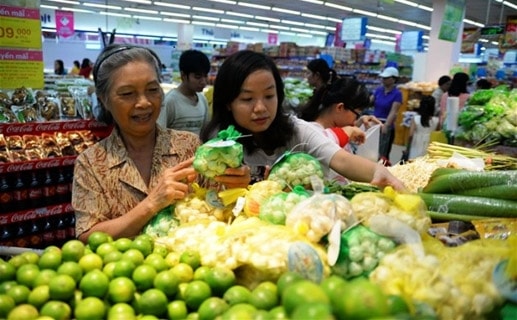 |
| Consumers find it difficult to choose safe food. (Photo: Provided) |
Faced with the widespread problem of chemically treated fruits and vegetables, and food containing banned substances on the market, many businesses have quickly grasped consumer demand and imported and distributed various types of food safety testing devices. These devices are widely advertised with claims of "detecting toxins in just 15 seconds." Simply searching "food safety testing device" online yields nearly 400,000 results in less than a second, with advertisements for various devices, distributors, and promotions, leaving consumers lost in a maze of devices designed to protect their family meals.
Safety meter advertising matrix
Ms. Nguyen Hoang Anh (Trung Van Ward, Nam Tu Liem District, Hanoi) after much deliberation, purchased the SOEKS NUC-019-1 for 4.5 million VND from a distribution company advertised online. This price was said to have been discounted by 17%. She had previously heard many friends recommend and researched the device's functions and features. “But amidst the flood of information, from imported goods to those brought in unofficially, I didn't know which to choose. In the end, I opted for an imported product from a reputable distribution company for peace of mind,” Ms. Hoang Anh said.
With its compact design, the food safety testing device is used regularly by Ms. Hoang Anh, even considered an "indispensable item." Since getting the device, she uses it to test everything from tomatoes to jackfruit, oranges, and watermelons, whether she buys fruit to bring home or visits her in-laws' house to prepare food. The device will report the approximate levels of harmful nitrates in foods such as meat, fruit, and fish in just 15 seconds.
In the Hanoi market, there are two types of nitrate residue detectors for fresh vegetables, fruits, and meat, both originating from Russia: SOEKS NUC-019-1 (priced at 4.5 million VND) and Ecotester (priced at 6.5 million VND). Both devices have Vietnamese language versions installed, containing data on standard nitrate levels for over 60 food types as per WHO regulations. Besides imported products distributed by companies, there are also unofficial imports, usually priced at around 1 million VND less.
By calling the sales representative listed on the website http//maydothucpham.com, the reporter received advice that, given the alarming state of food safety, consumers need to equip themselves with a measuring device. The sales representative stated that this is a reputable product certified by the Ministry of Health. However, the website representative also admitted that the device currently only measures one criterion: the amount of residual nitrate in food.
One indicator cannot be called safe.
While many people are enthusiastic about and recommend food safety testing machines, some consider them to be worthless devices.
Mr. Hoang Anh Minh (alley 259, Cau Giay, Hanoi) said: "There are ozone generators, then food testing machines... it's all just following trends. 'So, if the machine's reading exceeds the regulations, we don't eat or drink anymore?'" - Mr. Minh countered with a question.
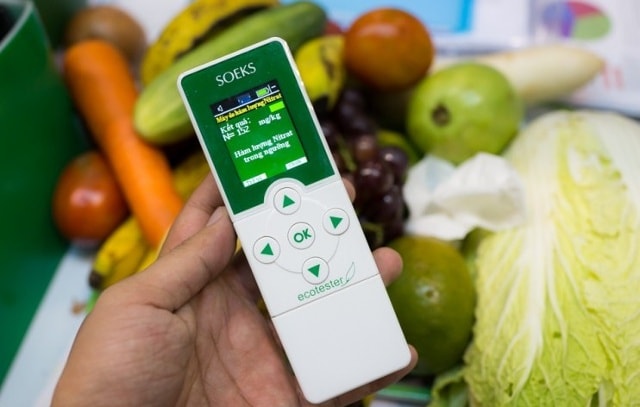 |
| A type of food meter that is sold on the market. |
Sharing the same distrust, Ms. My Hanh (Cau Giay) also said: "When going to the market, if you keep holding out the device to test it at the door, who will sell it to you? You might even get yelled at. If you wait until you get home to test the device, it's pointless."
Currently, commercially available food nitrate residue meters manufactured in Russia and licensed by the Ministry of Health are highly sought after. Many housewives see them as a tool to combat the widespread problem of contaminated food. However, because their function is limited to measuring only nitrate, they still have many limitations. Although nitrate residue in food is a major health hazard, many other preservatives and chemicals are also present. Nitrate meters cannot measure these substances. For example, nitrate residue meters are ineffective against other criteria such as heavy metals, pesticide residues, and other toxic substances.
Associate Professor Dr. Nguyen Duy Thinh (Institute of Biology - Food Technology, Hanoi University of Science and Technology) argues that this device should be called a nitrate residue meter in food, not a food safety meter, to avoid consumer misunderstanding of its function. Dr. Thinh explains that this is an automatic electronic device with a sensor whose sensitivity changes after a period of use. To ensure the device operates accurately after a period of use, consumers need to take it to a testing facility for inspection.
Experts believe that food contamination comes from many factors, such as preservative residues, pesticides, and various bacteria and parasites. One should not rely on a single indicator to determine whether a product is clean or not.
This type of device, called a food safety meter, has many limitations because its function is limited to measuring only nitrates. Although residual nitrates in food are a major health hazard, many other preservatives and chemicals are also present. Nitrate meters cannot measure these substances. Therefore, according to Associate Professor Dr. Nguyen Duy Thinh (Institute of Biology - Food Technology, Hanoi University of Science and Technology), this device should be called a food nitrate residue meter, not a food safety meter, to avoid misleading consumers about its function. |
According to Dai Doan Ket


