The car driver nearly caused an accident because he was blinded by the headlights.
Blinded and blinded by the headlights of an oncoming vehicle, the driver of the car narrowly avoided colliding with a motorbike traveling in the opposite direction.
Currently, the market offers many types of lights for motorcycle headlights, such as xenon, bi-xenon, HID, and LED lights. These types of lights provide stronger light intensity and longer visibility compared to the standard halogen bulbs that come standard on motorcycles.
There have been many complaints about super-bright headlights on car and motorcycle forums, along with numerous videos shared on social media showing these lights in use while driving.
According to Mr. Le Nguyen Hoang Nam, the owner of a motorcycle parts store in Vinh Long, many people are currently tending to replace or add super-bright lights to their motorcycles. These lights are quite diverse in design and price, ranging from a few hundred thousand to several million dong, and the light is also stronger than regular halogen bulbs.
"The demand for super-bright, auxiliary lights is relatively high. Some people genuinely want to improve their vehicle's lighting, while others modify their lights simply to look cool and make their car 'shine' at night," Nam said.
|
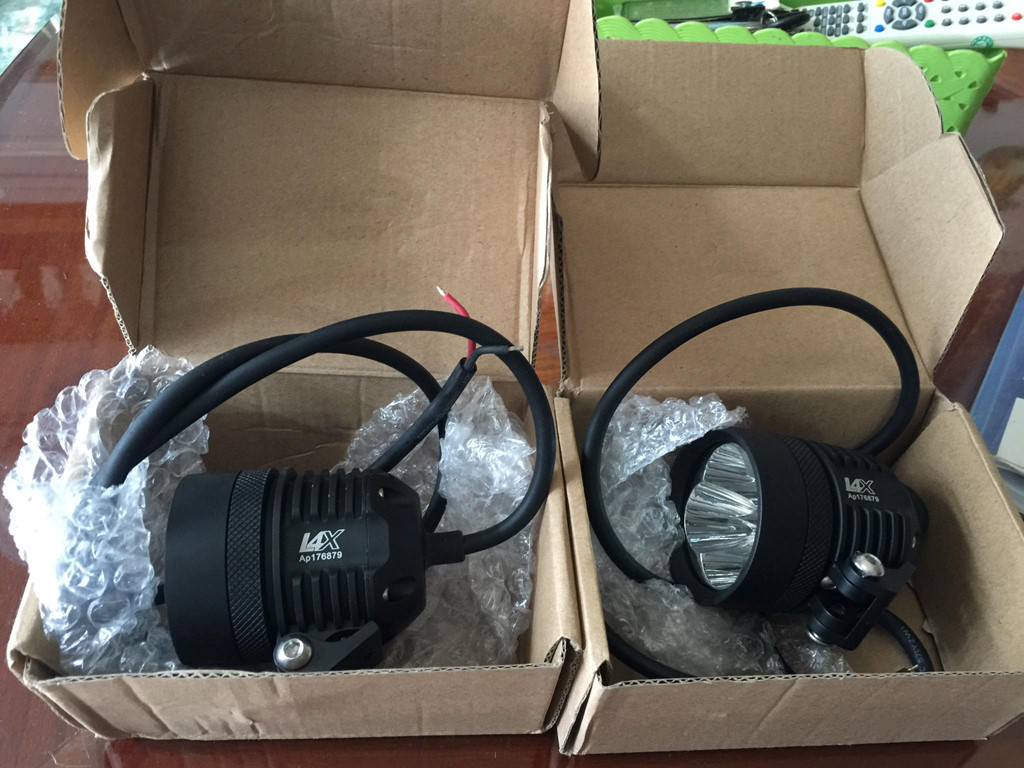
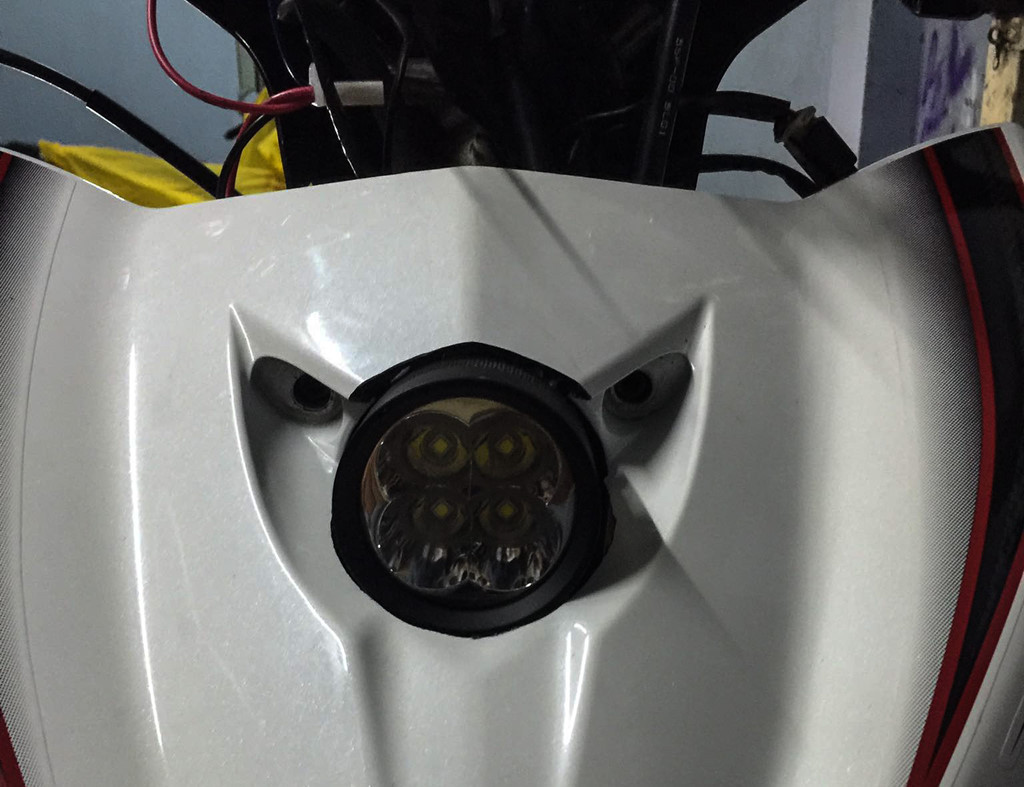
| A type of LED light that is commonly used. This is a high-performance auxiliary light that provides strong white light and a much longer viewing distance than conventional halogen lights. |
Because they lack filaments and are less affected by external vibrations, high-brightness lights like LEDs or xenon bulbs from major manufacturers such as Osram and Philips can last up to 2,000 hours (four times longer than halogen bulbs). They emit a white light, almost like daylight.
Moreover, these ultra-bright lights have a luminous efficiency 3-4 times greater than halogen bulbs. LED or xenon bulbs with only 30-35 W power output provide brightness equivalent to a 100 W halogen bulb.
"However, these ultra-bright lights are not suitable for civilian two-wheeled vehicles, which are originally equipped with halogen headlights. Installing ultra-bright lights into halogen headlights will affect the visibility of oncoming drivers," Nam added.
Currently, the law does not stipulate that changing vehicle lights constitutes a structural modification of the vehicle, nor does it impose administrative penalties for this act. However, using ultra-bright lights that blind oncoming drivers poses a risk of traffic accidents.
|
| Replacing or adding super-bright lights or auxiliary lights is not considered a violation of the vehicle's structure or characteristics. |
Furthermore, the low-quality, ultra-bright lights currently sold on the market can damage the vehicle's electrical system and pose a high risk of fire and explosion. These lights come in a wide range of prices. Besides imported LED and xenon lights from Japan or European countries costing $100-300, others are priced from just 200,000 VND to 1 million VND.
Many consumers, seeking cheaper options, often choose to buy LED and xenon products from China, which are of lower quality compared to genuine xenon lighting systems.
When flashing in high beam mode, the ballast and starter must repeatedly switch the circuit on and off. This continuous switching reduces the lifespan of the bulb and also makes the ballast more prone to failure. Furthermore, low-quality bulbs generate a significant amount of heat. If they are not the same size as standard bulbs, super-bright bulbs can block the heat dissipation holes on the headlight housing, easily leading to fire or explosion.
Nguyen Tuan Anh, a motorcycle enthusiast in Tien Giang, said: "The headlights of oncoming vehicles are too bright and can blind other road users, especially those who wear glasses like me. My bike also has auxiliary lights, but they are installed to shine down on the road surface and only used on dark, deserted stretches of road. However, I'm still quite unsure whether the law allows the installation of additional lights."
|
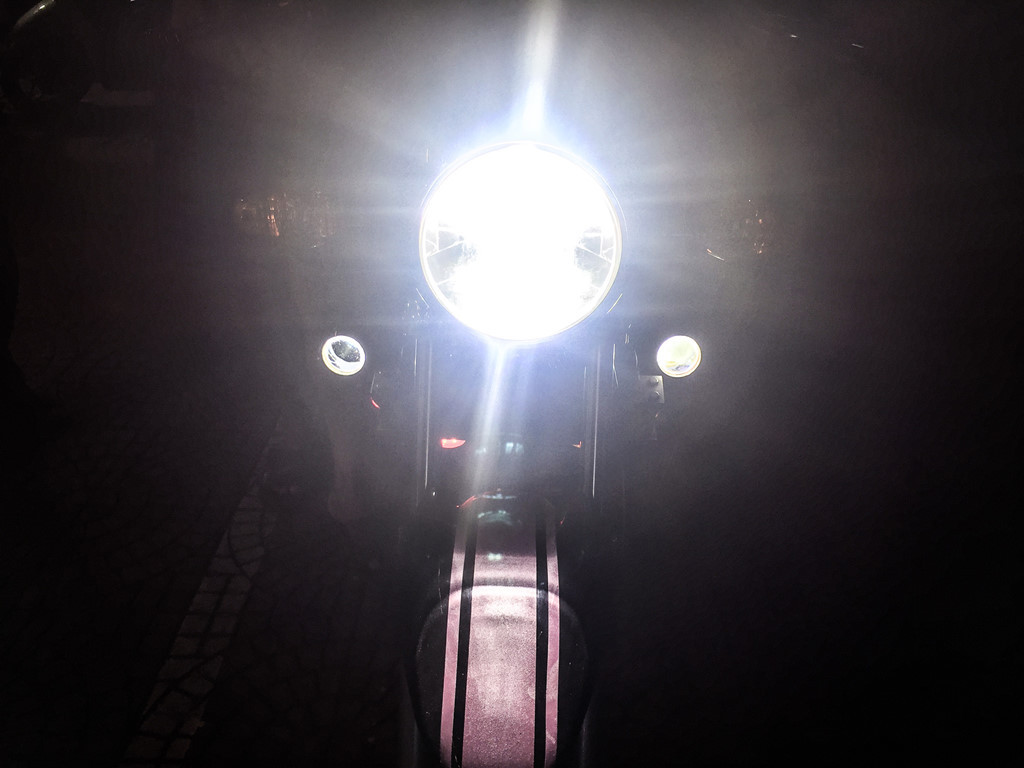
| High-intensity, auxiliary lights emit a strong beam of light, easily dazzling oncoming drivers and posing a potential risk of traffic accidents. Users should exercise caution when using these types of headlights. |
Based on Decree No. 171/2013/ND-CP and Decree No. 107/2014/ND-CP supplementing Decree 171, it is as follows:
Article 17: For motorcycles and mopeds, a fine of 100,000 to 200,000 VND will be imposed if:
"Using horns that do not meet the technical standards for each type of vehicle; lacking mufflers or smoke reducers, or having them but failing to meet environmental standards for emissions and noise."
"There are no low beam or high beam headlights, or they are present but not functional; there is no braking system, or it is present but does not meet technical standards; and the headlights used do not meet the design standards for each type of vehicle."
The general standards for motorcycle headlights are as follows: the direction of the light beam must follow the direction of travel, the main light beam must be directed downwards, and the light color must be white or pale yellow.
Therefore, installing headlights or auxiliary lights on motorcycles or scooters that are a color other than yellow and white, with a light direction different from the vehicle's direction, or with headlights that shine directly into the eyes of oncoming traffic is a violation of the law. However, there are still no specific regulations regarding penalties for installing LED, xenon, or other high-intensity lights.
To ensure safety for themselves and other road users, drivers need to be mindful when installing and using headlights. If replacing headlights, use lights that don't scatter light haphazardly, causing glare to oncoming traffic. Switch from high beam to low beam when approaching from the opposite direction. Choose high-quality, genuine headlights to avoid damaging your vehicle.



Governing body: Nghe An Provincial Party Committee
Director: Tran Minh Ngoc
Electronic newspaper operating license number: 153/GP-BTTTT
Issued by the Ministry of Information and Communications on March 24, 2022