
Delicious dishes made from durian peel and seeds.
(Baonghean.vn) - Durian is considered the king of fruits because it not only has a distinctive taste but also has very good effects in nourishing health and treating diseases. However, like jackfruit, mango, banana, or papaya, durian is also a fruit that is frequently artificially ripened with chemicals and sold widely in markets and supermarkets, directly threatening the health of consumers.
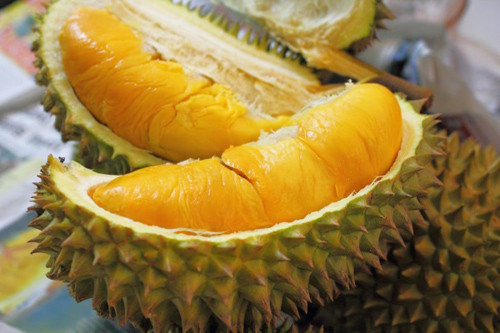 |
| Naturally ripened durians usually look very fresh and green on the outside. (Illustrative image: Internet) |
Visual signs that can be identified:
Regarding the spines and stalks:If the durian is artificially ripened with chemicals, people usually pick green fruit from the tree and then use the chemicals to ripen it. Because it's left for longer, the fruit often wilts, rots, or loses its thorns, becoming bruised and discolored. In contrast, with naturally ripened durian, when you gently press the stem with your finger, you'll feel that the stem is wet, even still oozing sap, and the thorns look fresh, green, and firm.
On the surface of the shell:For durians with cracks, when you press on them, the flesh feels hard like stone and your hand turns yellow as if you've just touched dye; this indicates the durian has been treated with chemicals. Naturally ripened durians have softer flesh.
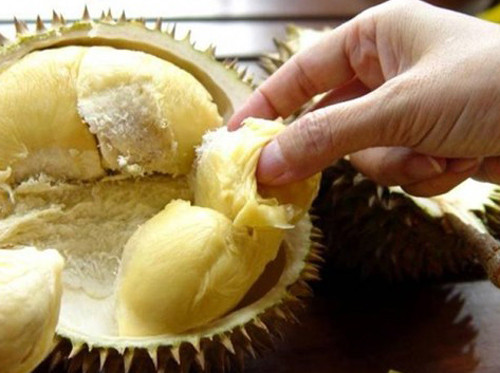 |
| If the durian has cracks and the flesh feels hard like stone when pressed, it means it has been treated with chemicals. (Illustrative image: Internet) |
Regarding durian segments:With naturally ripened durian, you can easily separate the segments, which are golden yellow, creamy, and have a smooth, pliable flesh. Conversely, durian ripened artificially with chemicals is difficult to separate, the segments are pale yellow, taste bland, and the flesh is tougher.
Regarding taste:Durian that has been soaked in chemicals will not have the characteristic strong aroma when ripe, and sometimes will have no smell at all. Naturally ripened durian, on the other hand, has a strong, fragrant aroma that can be smelled from a distance.
Delicious dishes made from durian peel and seeds.
The spiky outer shell of the durian, seemingly useless, can actually be used to make a delicious soup. This spiky shell, simmered with pork ribs, creates a fragrant and rich soup with a unique flavor. The durian seeds shouldn't be thrown away either; the hard brown outer shell can be peeled off, boiled or roasted, and eaten like jackfruit seeds, but with a much more fragrant and nutty taste. Additionally, durian seeds can be cooked with pork to make a very tasty soup.
Although durian is a nutritious fruit, it is recommended that you do not eat more than 150 grams of durian pulp per day. Durian is considered "heating" in traditional medicine, so eating too much can cause itching, boils, hives, and internal heat. Pregnant women or people with high blood pressure should not eat too much of this fruit.
| How to choose a delicious durian: 1. Choose durian by observing the shape of the fruit. June is the month when durian trees bear the most fruit, ripen the most, and taste the best. Start choosing a durian by observing its overall shape. When choosing durian, size isn't as important as the evenly swollen middle section, which isn't crooked. The fruit should have large, clearly defined segments. Ripe durians have slightly cracked outer shells and emit a distinctive aroma. Avoid durians that look too rigid, round like an oval ball, and lack segmentation. 2. Inspect the durian for thorns. A ripe durian has large, very hard thorns, but the tips are slightly rounded, not sharp and tiny. If you squeeze two thorns close together and they don't press against each other, the durian is ripe. Conversely, if they feel soft when squeezed, the fruit is unripe or artificially ripened, and will not be sweet and delicious, and will likely be tough. 3. Durian stem A ripe, evenly ripened, and delicious durian will have a firm, still-green stem. Absolutely avoid durians with missing or withered stems, as these are not tasty and may have been harvested and stored for a long time. Also, pay attention to the tip of the stem, as durians harvested a long time ago may have a shriveled stem tip, which sellers often cut off to make them look like freshly harvested durians. 4. The sound when tapping a durian You can borrow a specialized durian opener from the seller or gently shake the durian. If you hear a solid, muffled thud or a hollow sound when you tap it, it means the flesh is thick and the seeds are small. If you hear a hollow sound when you tap it, it means the durian has many seeds and is not as tasty. This is a useful and fairly accurate tip for buying a good durian. So don't skip this step when choosing a durian! 5. How to separate durian segments Observing how vendors separate the durian segments can reveal something about the quality of the fruit. Ripe durians will have their segments naturally separating, and vendors can easily do so with a specialized tool. Unripe durians, however, require considerable effort to separate. Such durians should be avoided. Paying close attention to how vendors separate the segments will greatly help you choose a satisfactory durian. 6. Observe the color of the durian fruit. Durian fruits with creamy yellow flesh and small seeds have a mossy green or yellowish-green rind. The thorns are also harder and more sparse than those of unripe durians. Durian tastes best about 2 to 3 days after harvesting; it shouldn't be eaten sooner or left for too long as it will lose its characteristic sweetness and aroma. |
Hoa Le
(Synthetic)
| RELATED NEWS |
|---|


