
An evening cloud
Short stories by Tinh Bao
1.
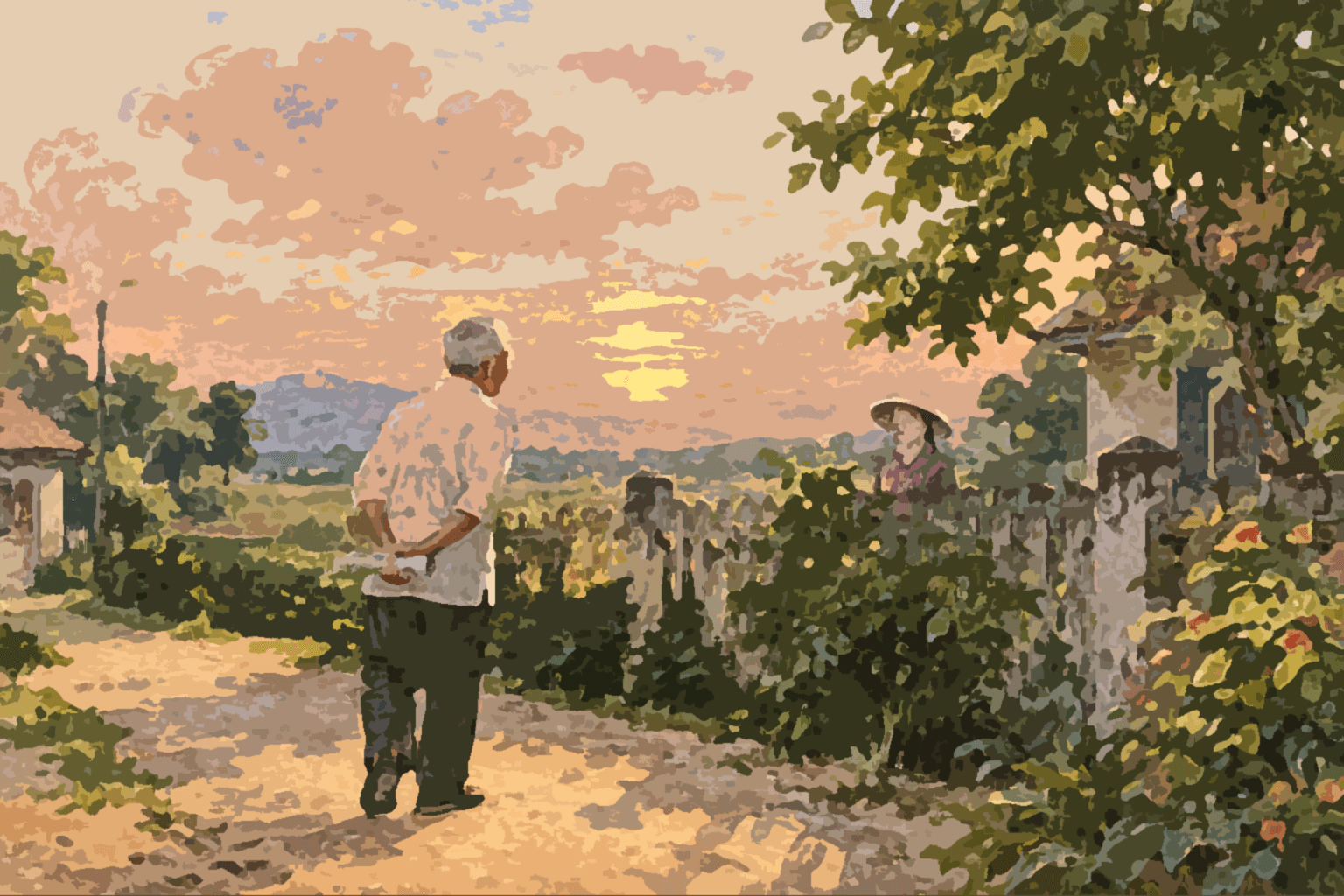
In the distance, Mr. Binh's eyes caught a glimpse of a lush green hedge, densely covered with butterfly pea flowers stretching out to reveal their smooth, purple blossoms. He held a rolled-up newspaper, clasped his hands behind his back, and strolled leisurely towards the hedge when he heard his son and grandson shouting inside. Every day was the same; from small matters to big ones, anything could be the cause of an argument between father and son.
He watched his rebellious grandson frantically searching for a reference book amidst the clutter on his desk, and sighed softly. He slowly turned and walked to the stone table and chairs, sat down, brewed a pot of tea, and then opened the newspaper he had bought that morning to read.
His neighbor Mrs. Chau's voice from across the fence startled him. She smiled brightly, quickly went outside to open the gate, and came over. She smiled back at him and placed a packet of sticky rice with fried onions on the table—his favorite dish. For decades, since his wife's untimely death, he had been a single father raising his son. He had long forgotten what it felt like to be cared for. For him, caring was something he could only give, and the only recipient was his son, who was then just eight years old.
Since Mrs. Chau moved in next door, sometimes with a few oranges, sometimes with a ear of corn, the distance between the two old people, who were used to living alone in their own cages, surrounded by a yearning for the joyful laughter of their grandchildren, had gradually narrowed. He began to find the morning sun gentler, the wire fence needed greener, and the flowers and plants in the yard needed more watering than before. He took out his old guitar and played a few notes, his fingers gently gliding across the strings of "Little One" with such tenderness.
Mrs. Chau gazed at him with wide, admiring eyes. She never imagined that her elderly neighbor, who spent his days tending to his potted plants, tea, newspaper, and the fire-breasted bulbul hanging on the trellis in front of his yard, could possess such skillful musical talent.
Hearing the compliments, his cheeks flushed involuntarily. In his cheerful mood, he candidly confessed that if it weren't for the need to earn a living, he would have pursued music to the end, as his dream was to become a musician. "A musician?" A look of astonishment spread across Mrs. Chau's eyes.
2.
From Hung's window, he could see a small courtyard, lush green with a hedge of green bean plants and carefully tended ornamental trees by his grandfather. He overheard every word of his grandfather and Mrs. Chau's conversation that morning. Hung couldn't understand why adults made things so complicated. Each person only lives for seventy or eighty years at most, so why force themselves to do things they don't want to do, only to regret it at the end of their lives?
Hung couldn't understand why, if being a musician was his passion and dream, he didn't pursue it more strongly. For example, Hung wanted to become a dancer. When he immersed himself in dance, it felt like his hidden strength was unleashed, filling him with boundless energy. That exhilarating, exhilarating feeling was the energy that helped him overcome exams, dry lessons, and the pressures of being a student.
Hung couldn't understand why his father constantly nagged him, forcing him to focus entirely on his studies. His father said he had to study hard so he wouldn't starve later. Why? Wasn't the ultimate goal of a person after nearly two decades in school to earn money to support themselves and their family? How did his father know dancers didn't make money? That musicians, like his grandfather once dreamed, didn't make money? Why did his father never agree with Hung's idea that if one could both earn money and pursue their passion, it would be even better? For his father, the word "passion" was a fatal flaw. He didn't accept it and didn't want anyone to mention it.
3.
It was late at night, and he still couldn't fall asleep. The frustration and helplessness over his sensitive teenage son was driving him crazy. It's true that everything has two sides; as society develops and the quality of life improves, so too do negative aspects of family relationships. His stubborn son was starting to demand personal rights and freedom. Instead of children being obedient and completely dependent on their parents, his son was now ready to object or react aggressively to anything he disagreed with.
The argument this afternoon was no different. He no longer felt it was a conversation between father and son; it was completely steeped in the "flavor" of a confrontation between two men. In it, a father like him was involuntarily forced to accept almost all the blame, blame that he didn't even know had arisen – blame that he had always considered right for so many years.
What his son said plunged him into deep thought. Had his resentment towards Mr. Binh, his father, crossed the line, turning him into a bitter and unjust person?
He resented his father for his stubborn desire to become a musician, which had driven the family to the brink of poverty and overwhelming debt. His father only came to his senses when his hardworking wife breathed her last, finally shedding belated tears.
He knew that what his father did afterward was to atone for his mistake. He returned to his professional work, dedicating all his time and effort to giving him what he needed and what he wanted best. But deep down, he couldn't forget the image of his mother collapsing at the sewing table, blood gushing from her nostrils. He knew his father's love and sacrifice for him were immense. However, no amount of love could compensate for the difference between a father and a mother. His father owed him a mother who had wholeheartedly sacrificed for her husband and children. And the reason lay in just two words: a dream. Therefore, he hated it.
But...
The unexpected argument between father and son left him in a deep void. Suddenly, from being in a position of judgment, he found himself the accused.
"Grandma suffered so much, yet she supported Grandpa without a single complaint. So why does Dad insist on blaming him on her behalf for nearly forty years? Do you really think Grandma needed that?" What Hung said was like a clumsy but sharp knife piercing his heart.
It turned out that, more than anyone else, the one who suffered the most and felt the most regret was his father. He gave up his dream not just to atone for his sins, but to punish himself. He saw how devastated he was when his mother, who had once been so happy to pursue her dreams, passed away. To him, she was everything; when she died, he felt like he had lost his whole world, losing all motivation and faith in what he called his dreams. Therefore, no matter how you look at it, he resolutely gave up what had caused him to lose the most precious thing. Why, only now did he understand this? Ironically, it was through a black-and-white photo of his mother when she was young, holding a guitar that his father always kept hidden in his wallet, and the reproachful words of the son he always yelled at, calling him just a child.
4.
Listening to his son and grandson argue felt like someone was scratching at an old wound. Occasionally, in his dreams, he would vaguely recall his wife's image, and he would ask himself whether what he did was right or wrong. His son thought he was selfish because of his so-called dreams. He resented him for years and was harsh with his own child, all because of those dreams. But he didn't know there was another truth behind it all, a truth that he would probably never reveal until his dying day.
He gazed absentmindedly at the tiny fire-breasted bulbul hopping around in its gilded cage hanging in the shade of the honeysuckle trellis. His eyes welled up with tears, his trembling hand reached up to gently touch the cage door, and he told himself: Its dream is the sky, the freedom to fly. Imprisoned, no matter how beautiful it is, it's no longer a dream.
He gently opened the cage door, hiding a bitter smile, then turned away. He had done what needed to be done; now he should let go of the past so that nothing could disrupt the family his son was struggling to build.
But then, his feet and facial muscles suddenly froze. His son had appeared behind him without him noticing. The two looked at each other, speechless, both heads streaked with gray. An awkward atmosphere enveloped the two generations, causing his son's lips to tremble slightly before he could finally utter a complete sentence.
- I'm sorry, Dad! I only just learned the truth about what happened all those years ago. You pursued your dream… not for yourself, but for Mom.
Suddenly, his vision blurred. All the pent-up emotions welled up at once. He hugged his son tightly, telling himself: It's alright. We're father and son, we're family.
High above, faintly visible through the clouds, the image of his devoted wife from years past seemed to wear a contented smile...