
Some measures to protect aquatic animals from cold weather.
(Baonghean) - Prolonged periods of severe cold weather have caused the death of many types of fish and shrimp, significantly affecting productivity and output. The challenge for aquaculture farmers is to find ways to minimize losses caused by severe cold weather.
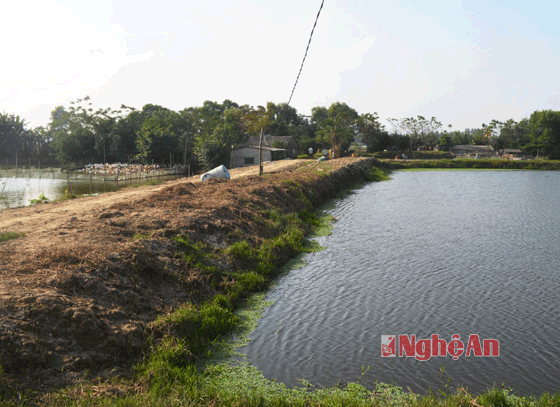 |
| The aquaculture area is located in Hung Loc commune (Vinh City). |
The following types of livestock require protection from the cold:
- Tropical aquatic species with poor cold tolerance such as whiteleg shrimp, grouper, sea bass, yellowfin tuna..., tilapia, freshwater white pomfret, catfish, basa, giant freshwater prawn, snakehead fish...;
- Aquaculture species in the juvenile stage need to be kept overnight.
- Raising broodstock shrimp and fish early to encourage early reproduction at the beginning of the season, such as tilapia and white pomfret...
To protect themselves from the cold, fish often bury their heads in the mud, allowing aquatic fungi to grow and eat away at their gills, causing suffocation and death, as well as leading to many other diseases. To proactively prevent and mitigate the effects of prolonged severe cold weather during the winter-spring season, and to limit losses caused by freezing temperatures, we would like to introduce some measures to protect aquatic species from the cold:
1. Rearing conditions:
- Raising in tanks: For facilities with indoor tank systems, it is recommended to raise aquatic animals through the winter in these tanks. The tanks must have a good water source, aeration, and a heating system to ensure the water temperature in the tanks is above 20 degrees Celsius. For overwintering of fry, raising them in tanks is recommended to minimize losses.
- Pond farming: For aquaculture ponds that overwinter, choose sheltered ponds with an area of 300-500m2, rectangular in shape, and oriented North-South. They should have a clean water source, easy water supply and drainage, good bottom substrate, and a sturdy embankment to prevent water leakage and drying out. The water level should always be above 1.5m, ideally 2-2.5m. The physical and chemical properties of the pond should be suitable for the growth of the cultured species: pH >7, dissolved oxygen >5mg/l.
- Raising in different environments: In addition, some facilities employ other methods such as raising in wells, raising in pits, etc.
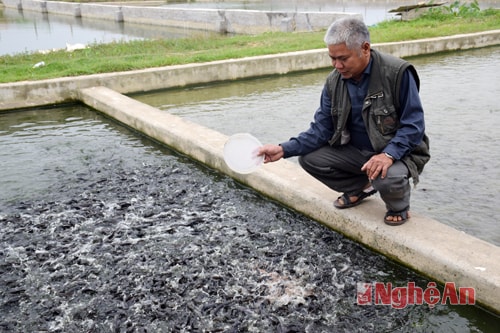 |
| Mr. Tran Van Minh, Chairman of the Do Luong Aquatic Seed Cooperative, is taking care of the fish fry. |
2. Caring for and managing shrimp and fish during the cold season:
a. Feeding regimen:
- Feed: The appropriate feed should be used depending on the growth stage of the farmed species. The minimum protein content should be >30%. Vitamin C should be added to the feed to increase the resistance of shrimp and fish, at a rate of 3-5g/kg of feed. Ideally, feed should be appropriate for each stage of shrimp and fish development.
- Feeding regimen: When water temperature >20 degrees: 3% of fish weight (WW)/2 days;
When the temperature is between 15-20 degrees: 2% TLC/0.2 days;
When the temperature is below 15 degrees: stop for
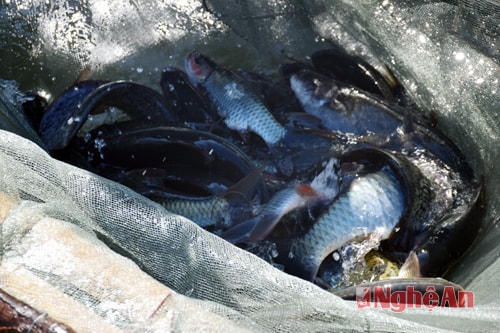 |
| Therefore, cage-farmed fish grow quickly, and their meat is firm and delicious. After 7 months of farming, climbing perch weigh 3-4 kg, while catfish, carp, eel, and other similar species weigh over 2 kg each. |
b. Management:
- Environmental management:
* Water temperature management:Ensure the pond water temperature is above 20 degrees Celsius.
Ensure the water level is >1.5m;
+ Cover the pond with plastic sheeting, coconut leaves, etc., to prevent wind from bringing in cold air and lowering the water temperature. During severe cold weather, use bamboo to build a frame over the pond or lake, covering it completely with plastic sheeting to increase heat retention. Cover about 2/3 of the pond surface with water hyacinth or plant banana trees in rows towards the north to block the wind;
+ For shrimp and fish: Use straw or tea baskets as shelters. Create a deep corner of the pond towards the north, use woven bamboo baskets filled with straw and rice husks, disinfected with lime water, dried thoroughly, and packed into the baskets. Stake the baskets and place them at the bottom of the pond. When it's cold, fish, eels, etc., will hide in the baskets to avoid the cold; you can also dig a tunnel next to the pond to provide shelter for shrimp and fish.
+ For frogs: Create shelters for the frogs. The shelters can be made of earth or plastic/bamboo pipes, with one end hollow. These pipes should be 0.5-0.6m long and 0.15-0.16m in diameter, bundled together in groups of 5-6 for the frogs to crawl into. Place the pipes in the corners or along the edges of the pond, and cover them with straw to protect them from the wind. If raising frogs in cement tanks, cover the tank completely with tarpaulin or plastic bags to protect them from the cold.
+ Coloring the pond water: using organic fertilizers and biological preparations to color the water in order to maximize the absorption of solar heat;
+ Use active heating methods: heating systems using coal, electricity, or solar energy;
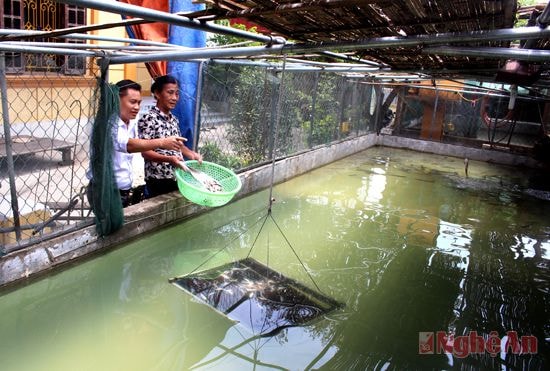 |
| Comrade Dau Phuong Nam, Deputy Secretary of the Party Committee of Nghi Tan Ward (Cua Lo Town), discusses with local people about the model of raising snakehead fish in tanks. |
* Managing environmental factors:Closely monitor environmental factors, ensuring they are suitable for the survival and development of the cultured organisms.- Managing the health of the animals being raised:
+ Increase the resistance of farmed animals through supplemental feeding with Vitamin C and B complex;
+ Prevent fish diseases periodically, once a month, using preventive medications according to the specific instructions on the packaging;
+ Regularly apply lime dissolved in water to the pond, using a dosage of 5-7 kg/acre/month;
+ Introduce some bottom-dwelling, cold-tolerant species such as carp to stir up the pond bottom, preventing fish from dying at the bottom.
When pond water is polluted, use biological products to clean the pond water.
+ During the wintering period, absolutely no nets or other fishing equipment should be used, to avoid injuring the fish, which can lead to disease and death.
When temperatures drop below 20 degrees Celsius, timely measures are needed to protect shrimp and fish from the cold:
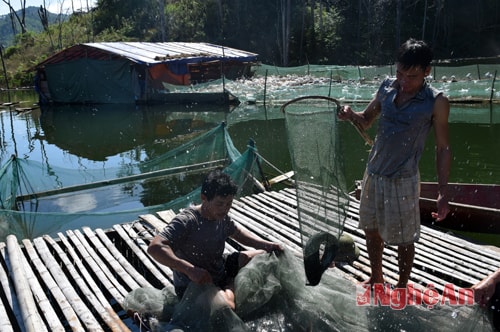 |
| Currently, there are 13 fish farming sites on Hua Na Lake, with nearly 30 fish cages, each cage raising 250-300 fish of various types. Thus, this Tet holiday, Dong Van will supply the market with tens of tons of clean fish. |
3. Protecting fish from the cold:
- Hatcheries are urgently moving shrimp and fish stocks into tank systems to proactively raise the water temperature to the appropriate level;
- For fish and shrimp in ponds, it is necessary to proactively raise the water temperature above 20 degrees Celsius to ensure their survival, using emergency temperature-raising measures, but being careful not to shock the fish and shrimp.
To ensure the survival and growth of shrimp and fish through the winter, it is best to use a combination of cold protection measures, with the motto "prevention is better than cure". Sufficient supplies and materials should be prepared proactively for cold protection of shrimp and fish. For commercially farmed species that have reached marketable size, harvesting should be done immediately when temperatures drop too low to avoid losses to the aquaculture industry.
Le Hang
(Provincial Fisheries Promotion Center)
| RELATED NEWS |
|---|


