
A new vision for Vietnam's public finance.
In his closing remarks at the 14th Plenum of the 13th Central Committee, General Secretary To Lam emphasized a strategic direction with profound reform significance: "Public finances will be allocated based on results and the specific characteristics of each locality."
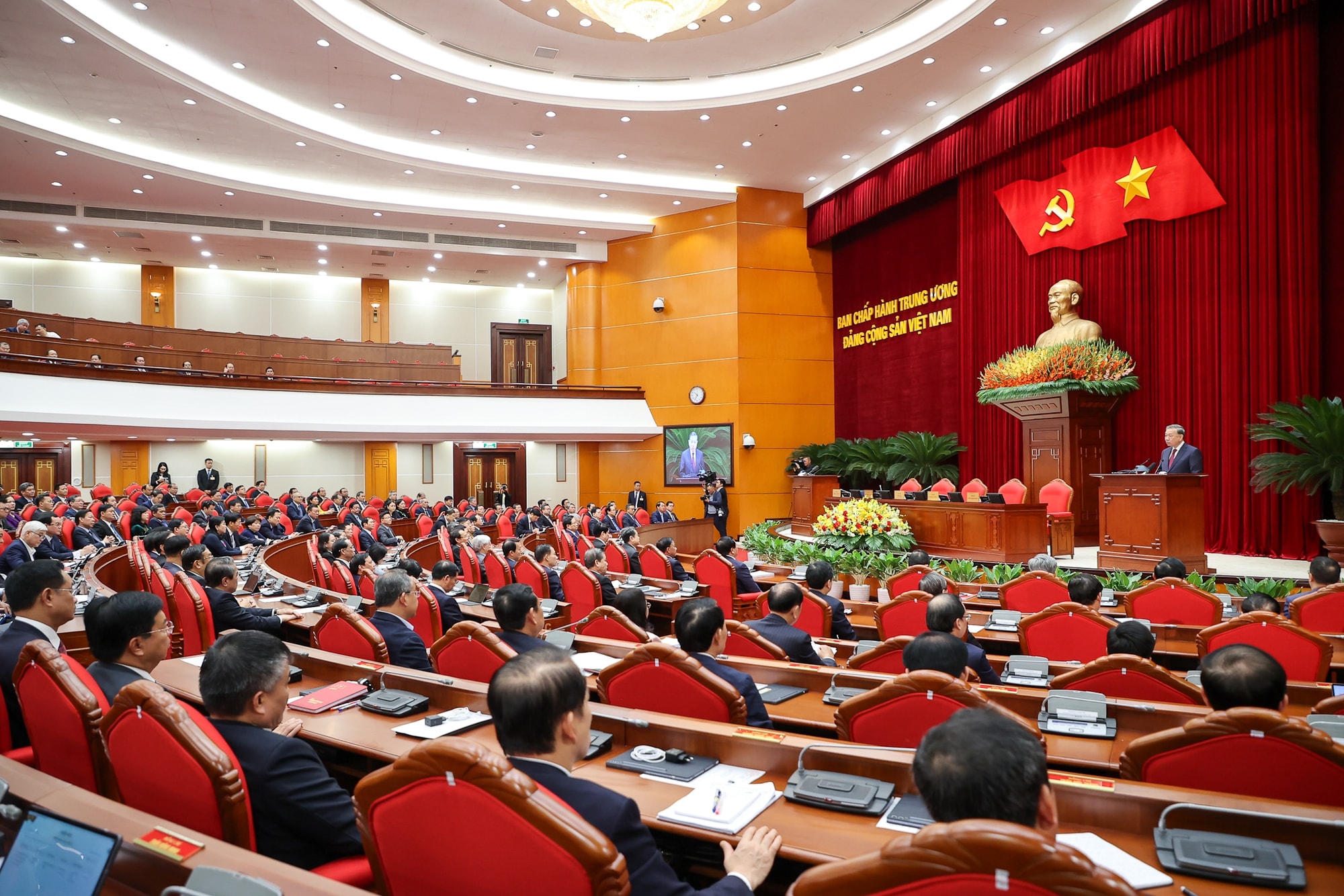
This is not merely a technical adjustment in budget management, but a radical shift in public finance philosophy, opening up a new approach to national resource allocation – one that is fairer, more efficient, and more flexible.
From the egalitarian mechanism to the requirements of an efficient financial system.
For many years, the state budget in our country has mainly been allocated based on input-based criteria: population, area, number of personnel, or poverty rate. This method makes calculations easier but ignores factors of efficiency and regional differences. Localities that perform well are treated the same as those that perform poorly; places that use budgets economically are not encouraged more than those that spend lavishly.
This mechanism creates a "request-and-grant" administrative loop: Local authorities must submit requests, ask for funding, and wait for approval instead of proactively designing and taking responsibility for their own financial plans. It stifles innovation and sometimes even encourages "spending everything to get more funding the following year."
Furthermore, current budget policies do not reflect the diversity of Vietnam's territory. A mountainous province with high infrastructure costs and a sparse population cannot be allocated the same resources as a dynamic industrial city. "The same budget" but different implementation conditions inevitably lead to different results – this is the reverse inequality that the egalitarian allocation method inadvertently creates.
Therefore, General Secretary To Lam's directive came at the right time – as a wake-up call and at the same time a strategic direction to remove institutional bottlenecks in current public financial governance.

Allocation by outcome - from input to output
Performance-Based Budgeting (PBB) is a trend that has proven effective in many countries. At its core, it shifts the focus from "how much is spent" to "what is achieved." Every dollar of budget must be linked to outputs and end-user results, measured by specific indicators.
For example, in the education sector, instead of allocating funds based solely on the number of schools or teachers, the budget is based on the quality of learning, the rate of program completion, or the level of satisfaction of parents and students. In healthcare, instead of allocating funds based on the number of hospital beds, the budget is based on the number of successful treatments, the recovery rate of patients, or the level of public satisfaction.
The principle of this mechanism is:Where things go well, they are encouraged; where things go poorly, they must improve themselves or face cuts.When budgets follow results, public service efficiency, accountability, and innovation will all increase simultaneously.
Allocation based on local characteristics - fairness in diversity
While "based on results" emphasizes efficiency, "based on local characteristics" aims to ensure fairness. Each locality has its own "development profile": natural conditions, level of urbanization, population structure, infrastructure, governance capacity, ability to balance its budget, etc. These differences require an allocation mechanism that is appropriate to the "financial terrain" and cannot be uniform.
A city like Ho Chi Minh City can mobilize significant resources and largely self-finance its recurrent expenditures, while a mountainous district in Ha Giang requires specialized support to ensure basic public services. Therefore, fairness is not about equal treatment, but about treating people differently in a reasonable way based on their actual capabilities and needs.
The combination of these two principles -effectiveness and specificityThis will help to form a model of "dynamic equity" in public finance allocation, where the budget both incentivizes development and ensures harmony between regions.
International experience: Efficiency and fairness are not mutually exclusive.
Many countries have demonstrated that high efficiency and regional equity can be achieved simultaneously if institutions are properly designed.
South Korea is a prime example. Since 2003, the country has implemented a performance-based budgeting system and a medium-term fiscal framework.Performance-Based BudgetingandMedium-term Fiscal FrameworkEach ministry, sector, and locality must define output indicators and results, which are evaluated annually by the Ministry of Finance. These reports are publicly available on the national portal and submitted to the National Assembly for discussion. As a result, despite budget spending accounting for over 30% of GDP, South Korea's public debt remains stable, and the efficiency of public investment is increasingly high.
Singapore applies the "Budget by Outcomes" model with the principle of "Value for Money". Each program hasOutput-End KPIsand are reviewed periodically. The government uses a publicly available index to evaluate each agency based on its performance in achieving its goals. In particular, local budgets are designed to be flexible, reflecting differences in population, infrastructure, and governance capacity.
Australia excels in regional equity with its "Horizontal Fiscal Equalization" (HFE) system. Through the Federal Finance Commission (CFFR), federal funding is allocated based on each state's revenue capacity and expenditure needs, ensuring that "each state is capable of providing equivalent public services with equal effort." This system minimizes bureaucratic red tape, emphasizing data and objective criteria.
All three models follow the recommendations ofOECDRegarding the "Framework for evaluating the effectiveness of public spending": (1) efficiency of resource utilization; (2) regional equity; (3) accountability.
These are the three pillars that Vietnam can refer to in order to move towards a modern, transparent public finance system that is linked to regional development.
The strategic significance of guidance.
Firstly, this represents a turning point in public finance philosophy. It shifts from "administrative distribution" to "investment based on results and absorption capacity." From "egalitarianism" to "dynamic equity." Every dollar of the budget becomes an investment, rather than a subsidized expenditure.
Secondly, this mechanism fosters a spirit of innovation and dynamism at the local level. When budgets are linked to efficiency, localities are compelled to improve their governance capacity, enhance budget utilization efficiency, and proactively propose policy initiatives tailored to their specific characteristics. Healthy competition based on efficiency will replace administrative dependence.
Thirdly, this policy contributes to perfecting the institutional framework of financial decentralization. When localities are given more power along with accountability for results, a model emerges.flexible fiscal decentralizationThis approach can be developed to both promote local initiatives and ensure unified national interests.
Fourth, this is a prerequisite for building a digital government and data-driven governance. If spending results are measured and made public, the State can operate a "National Public Finance Dashboard"—where the Prime Minister, Ministers, or Provincial Chairmen can all see the effectiveness of every dollar spent in real time. When data replaces intuition, trust in institutions also increases.
Conditions for realization
For this directive to be implemented, Vietnam needs a series of synchronized reforms:
First, improve the legal framework.The State Budget Law needs to be supplemented with a results-based spending mechanism, clearly defining the accountability of budget-using agencies, and establishing appropriate allocation criteria for different regions.
Secondly, establish a system for measuring results.It is necessary to define key performance indicators (KPIs) for each sector – education, health, infrastructure, environment – and link them to an open data information system.
Third, improve the public financial management capacity of local officials.Officials should not only know how to "spend correctly and sufficiently," but also how to "spend effectively." Training courses on results-based budgeting, public financial management, and the use of digital data are absolutely essential.
Fourth, innovate in auditing and supervision.The State Audit Office needs to shift from "compliance auditing" to "value auditing"—assessing how much real value public funds generate.
Once these four pillars are completed, Vietnam's public finance system will operate on the basis of transparency, data, and accountability – in line with the spirit of the Central Committee's directives.
A revolution in national governance thinking.
The orientation of "public finance allocation based on results and local characteristics," proposed by General Secretary To Lam, is a quiet but profound revolution. It touches the "heart" of national governance—the way we use and allocate common resources.
If implemented, this directive would create a public finance system that is as efficient as South Korea's, as fair as Australia's, and as transparent as Singapore's, yet still retains the Vietnamese identity – a country united in diversity, dynamic in innovation, and steadfast in its goal of sustainable development.
Every dollar of the budget, when allocated correctly, to the right purpose, and with the right results, will not only save the nation but also unleash the creativity, autonomy, dynamism, and aspiration for progress of each locality. This is the foundation for Vietnam to enter a new era of development – an era of efficiency, fairness, and responsibility.


