
The ultimate goal
(Baonghean) - Ultimately, whether people sell counterfeit goods or impose excessive taxes, they all aim for one thing: the pockets of the people.
A rather strange coincidence, full of randomness, yet one that leads some to believe it's orchestrated by some "supernatural" force, as if sending a message to people caught in the whirlwind of survival, is that when the Ministry of Finance "cleverly" announced its intention to tax assets accumulated from the sweat and tears of the people, authorities also discovered a well-known company packaging bamboo charcoal in capsules to use as cancer medication, and a small-scale facility mixing stone powder, battery acid, coffee husks, and flavorings to make ground coffee for sale.
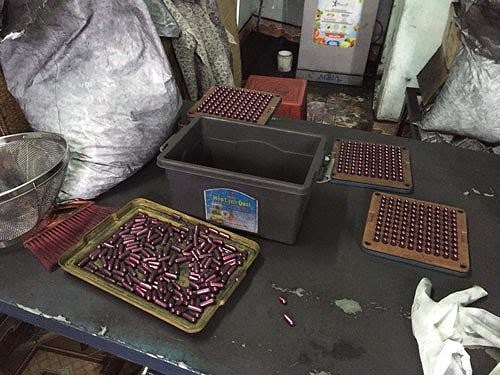 |
| Finely ground bamboo charcoal powder is used as a medicine to treat cancer. (Image: Internet) |
On the surface, all three events seem unrelated. Initiating and suggesting a property tax is a way to target people's wallets under the guise of "increasing revenue for national development." The other two directly impact consumer health. But ultimately, selling substandard goods or imposing excessive taxes both aim for one goal: the people's wallets.
Although they belong to different social classes and are complete strangers, they share the same goal: to extract as much money from the pockets of the people as possible. The only difference is that taxation is a legal act, recognized and protected by law. Producing counterfeit or substandard drugs, on the other hand, is fraud strictly prohibited by law, and violations will be punished accordingly. But whether legal or illegal, the people are ultimately the ones who bear the consequences.
At this point, some might object, arguing that while tax collection might be seen by the public as a form of "excessive exploitation of the people," it is ultimately for the common good and not for personal gain. The other two matters, however, are clearly fraudulent schemes aimed at personal enrichment. They are worlds apart and cannot be equated. While this might seem the case on the surface, a deeper examination of the three issues reveals a different reality.
First, let's talk about those two blatant and utterly unscrupulous scams. People want to make money, but they don't want to put in the effort, capital, health, or intellect—perhaps because they lack the ability or skill to create world-renowned masterpieces like Bill Gates or McDunkenberg—yet they want to make as much money as those two geniuses. And so, the only way to satisfy this desire for quick and easy money is…scamming. They do it for themselves, not for anyone else.
Regarding property tax, if it is permitted to be collected, it is state money, so it is difficult to say that doing so is for personal gain. This requires a deeper understanding. Ensuring revenue and balancing income and expenditure to serve the country's investment and development needs is the primary and extremely important task of the finance sector. If there is a revenue shortfall or insufficient revenue to cover expenditures, the finance sector must bear primary responsibility.
 |
| Houses valued at over 700 million VND will be subject to tax. (Image: Internet) |
Therefore, to avoid being perceived as incompetent, one must not allow a situation of "shortage at the top and gaps at the bottom." To avoid shortages, revenue must be increased and income secured. But increasing revenue is very difficult. Besides being skilled and intelligent, it requires dedication, high responsibility, hard work, and constant effort. It's tiring and mentally exhausting, but the extra money earned isn't even for oneself. So why subject oneself to such hardship?
They chose the simplest, gentlest, and most effective option: increasing taxes and creating more levies, without considering the consequences or who would bear the burden; as long as the assigned task was completed without further effort or fatigue. Clearly, they did this only for their own benefit. Therefore, the ultimate goal of these three different actions is the same.


