
The US is at a standstill with the Constellation frigate program.
The US Navy canceled the Constellation frigate program after spending more than $3 billion, revealing gaps in its light frigate capabilities and limitations in its shipbuilding strategy, as well as its adversarial approach to superpower warfare.
The U.S. Navy's decision to cancel the Constellation frigate program, despite having spent over $3 billion on the first two ships, highlights the impasse in the development of this new class of warships. The ongoing shortage of light frigates since 2015, coupled with technical and industrial issues and overly ambitious mission requirements, is raising questions about the U.S.'s ability to build a surface force in the face of competition from China.
Overview of the cancelled Constellation program
According to Novosti, US Navy Secretary John C. Phelan announced that the Pentagon has decided to reconsider its approach to fleet construction and deployment, including canceling the Constellation-class destroyer program. Initially, the US Navy planned to receive six ships of this class, later reducing that to two, and currently only two are under construction, with Washington having spent over three billion dollars in total.
This is described as a logical conclusion for a program where the orderer made demands that exceeded expectations for a hull of limited size. This decision comes as the U.S. Navy has had no light frigates since 2015, when the last of its 51 Oliver Hazard Perry-class destroyers was decommissioned.
The plan to replace the Oliver Hazard Perry-class ships with Freedom and Independence-class Littoral Combat Ships (LCS) failed. Despite entering mass production, the LCS ships quickly revealed numerous "initial problems," ranging from design flaws to malfunctions in the main propulsion system. As a result, many LCS ships were decommissioned after less than ten years of service, leaving a significant gap in the light escort ship segment.
From European FREMM frigates to Constellation design
Because developing a completely new ship design would take too much time, in 2018 the Pentagon decided to choose an existing design. The competition was reopened, and two years later, Fincantieri – a major Italian shipbuilder – won with its FREMM-class frigate design.
In April 2020, Fincantieri received a $795 million contract to design and build prototypes for the US Navy, with an additional $9 million option. Since the early 2010s, 19 FREMM-class ships have been commissioned into the Italian (Bergamini-class) and French (Aquitaine-class) navies.
FREMM ships are designed for multiple missions: anti-submarine and anti-aircraft defense, surface ship destruction, and land-based target attack. Their superstructure utilizes stealth technology, reducing their radar cross-section. Their modular design allows for relatively rapid adaptation to specific missions. The standard displacement of a FREMM is approximately 5,800 tons.
Despite their similar appearance, the Italian Bergamini and the French Aquitaine versions differ significantly in radar, air defense systems, propulsion systems, and weaponry. For example, only the French vessel is equipped with SCALP-Naval land-attack cruise missiles in 16 vertical launch tubes. Meanwhile, the Italian navy considered the two 127 mm and 76 mm naval guns sufficient, leaving the space at the bow intended for vertical launch systems empty on the Bergamini.
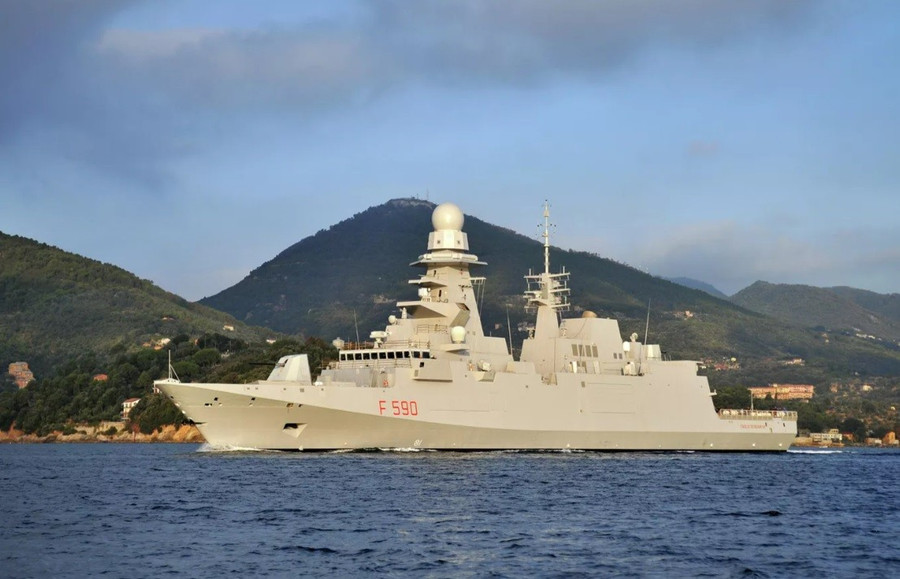
The Constellation design is based on Bergamini.
The Italian Bergamini-class destroyers were chosen as the basis for the advanced Constellation-class frigates. Construction of the first vessel began in August 2022 at the Fincantieri Marinette shipyard in Marinette, Wisconsin.
However, the Pentagon didn't stop at simply copying the Italian configuration; they made significant modifications to the design. As a result, the Constellation's specifications differed drastically from the original prototype.
According to published information, the Constellation has a total displacement of approximately 7,300 tons, a length of 151 m, and a width of approximately 20 m. For the first time in US Navy history, a surface ship is equipped with a combined diesel-electric-gas turbine (CODLAG) propulsion system. The ship also carries a lightweight variant of the AN/SPY-6 air defense and missile defense radar, which is currently installed on the Arleigh Burke Flight III guided missile destroyers.
In terms of weaponry, the Constellation configuration includes:
- A Mk 41 multi-purpose vertical launch system with 32 tubes, capable of carrying Standard SM-2 Block IIIC, Standard SM-6 ERAM, and ESSM Block 2 anti-aircraft missiles.
- Sixteen NSM anti-ship missiles are mounted on separate launchers.
- A Mk 49 RAM Block 2 short-range self-defense air defense missile system with 21 missiles.
- A Mk 110 57 mm naval gun.
- 324 mm torpedo tubes.
The ship's hangar is designed for one Sikorsky MH-60R Seahawk anti-submarine helicopter and one or two Northrop Grumman MQ-8C Firescout unmanned helicopters. This is just one of the differences compared to the Bergamini.
| Key specifications | FREMM (Bergamini, Italy) | Constellation (USA) |
|---|---|---|
| Payload (tons) | 5,800 | 7,300 (total) |
| Length (m) | Not mentioned in the source. | 151 |
| Width (m) | Not mentioned in the source. | approximately 20 |
| Dynamics | No details are given in the source. | CODLAG (diesel – electric – gas turbine) |
Reasons why the program has stalled.
The mission requirements went beyond the scope of a frigate.
According to the quoted assessment, the US attempted to "cram" almost all of its existing naval innovations into the limited space of the FREMM hull. From the initial requirement of maintaining approximately 85% similarity to the Italian prototype, the reality was that only about 15% remained.
The list of missions assigned to the Constellation by the U.S. Navy is extensive: long-range surface attacks, submarine detection and destruction, escort formation protection, active and passive electronic warfare capabilities, defense against attacks from smaller vessels, and fire support for amphibious forces. This level of multitasking is typically associated with destroyers or cruisers rather than frigates.
The burden of the mission on a medium-sized hull complicated the design, increased engineering risks, and prolonged timelines, contributing to the program's failure to meet its targets.
Limitations in human resources and industrial capacity.
U.S. military shipyards are facing a personnel crisis, with a severe shortage of skilled labor due to intense competition in other key industries. The Fincantieri Marinette shipyard is relatively young and primarily has experience with littoral combat ships, not large destroyers or frigates.
The coronavirus pandemic continued to disrupt supply chains, cutting off many crucial links in the supply of materials for the Constellation program. Continuous design changes drove the cost of the first vessel up to $1.3 billion, significantly higher than the original prototype contract.
Design thinking and force structure issues
The analysis notes that U.S. Navy designers and commanders have for decades been accustomed to operations against much weaker armed forces, primarily guerrilla forces, rather than engaging adversaries of comparable strength. This has led to a gap in experience in designing and building warships optimized for warfare against a major naval power.
The desire to incorporate “the best” into each combat unit also significantly increases shipbuilding time and limits the number that can be produced. The Zumwalt-class stealth destroyer is a prime example: after years of development and billions of dollars in costs, the US Navy only possesses three of them.
Impact and comparison with China's approach.
In a large-scale war, mass production capability is emphasized as far more important than the uniqueness and maximum sophistication of each individual warship. According to the article, this is well understood in China, a country Washington considers its primary geopolitical rival.
Chinese shipyards surpassed the US in productivity, rapidly commissioning warships described as “relatively inexpensive, simple, but effective.” The contrast between China’s focus on sufficient quantity and the US’s pursuit of complex, high-cost designs is one of the key contexts for understanding why the Constellation program was halted.
Within that context, the decision to cancel the program is presented not only as a result of technical and industrial difficulties, but also as a reflection of the deeper challenge of adjusting the design thinking and structure of the U.S. Navy in the face of competition from peer rivals.


