
The US is considering using F-35s and Tomahawk missiles to ensure Ukraine's security.
According to British media reports, Washington is discussing a mechanism that would allow the use of F-35s and Tomahawk cruise missiles from NATO territories if the ceasefire in Ukraine is violated.
According to British media citing sources close to the discussions in Washington, the US is considering using fifth-generation F-35 stealth fighter jets and Tomahawk cruise missiles as part of a security guarantee mechanism for Ukraine, linked to a peace agreement should it be reached between the parties.
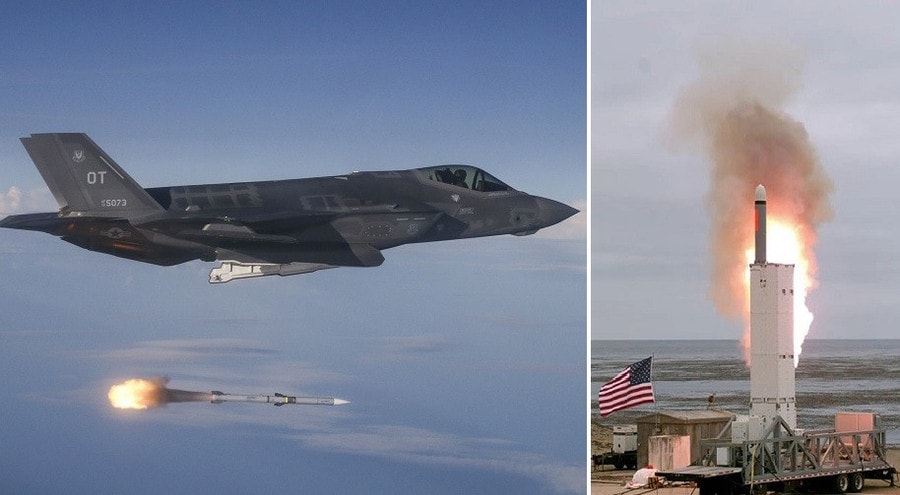
An overview of the security mechanisms currently under discussion.
According to British media, the mechanism being considered is a response to the possibility of a ceasefire in Ukraine being violated. Under this framework, advanced US weapons systems, including F-35s and Tomahawk cruise missiles or equivalent weapons, would be used as a security guarantee for Ukraine if a peace agreement and ceasefire are established.
Sources indicate that, in the event of a ceasefire breakdown, the US could deploy F-35 fighter jets, Tomahawk cruise missiles, or similar weapons systems stationed in NATO countries in response. This suggests Washington wants to link its security commitments to the ability to deploy modern weapons, while maintaining a distance in terms of troop deployment on Ukrainian territory.
The role of F-35 and Tomahawk in the deterrence strategy.
According to sources cited by British media, the F-35 and Tomahawk are considered a central part of the security mechanism. These systems are described as state-of-the-art weapons, with the F-35 being a fifth-generation stealth fighter jet and the Tomahawk a cruise missile.
Linking these weapons systems to a ceasefire agreement shows that the US wants to establish a concrete military deterrence mechanism: if the agreement is violated, Washington has the tools available to respond from outside Ukrainian territory, based on the military infrastructure already in place in NATO countries.
Deployment from NATO territories, no US troops entering Ukraine.
British media outlets emphasize that the White House and the Pentagon have no plans to deploy US troops directly to Ukrainian territory. This means that, while F-35s, Tomahawk missiles, or equivalent weapons might be used in the event of a ceasefire, military operations would originate from US or NATO allied bases, not from US forces stationed in Ukraine.
This approach shows that Washington wants to combine security commitments with limiting the risk of direct escalation on the battlefield, while also leveraging the existing military presence network within NATO.
International monitoring mechanisms and the leading role of the United States.
Before the commitments to use F-35s and Tomahawk missiles are activated, an international observer mission is expected to be deployed to monitor compliance with the ceasefire agreement. According to sources cited by British media, the United States will lead this mission.
Linking military deterrence mechanisms to an international monitoring structure suggests the idea of a multi-tiered agreement: first, a ceasefire and monitoring; second, a commitment to using force and advanced weapons if one party violates the agreement. An international observer group would be the first step in identifying and documenting compliance or violations of the agreement.
Legal framework and comparison with agreements with Japan and South Korea.
The agreements under discussion are described as similar to bilateral defense agreements that the U.S. has signed with Japan and South Korea. According to British press reports, those agreements stipulate Washington's commitment to defending its allies if they are invaded.
Sources also noted that the White House is interested in obtaining Senate approval for the F-35 and Tomahawk deployment agreement, thereby making it a legally binding and long-term deal. This would give the US President a clear legal basis to order the deployment at any time if the conditions of the agreement are met.
This approach places Ukraine's security mechanisms within the same legal framework as those of its key allies in Asia, rather than relying solely on political declarations or non-binding agreements.
A North Korean-style model for peace agreements.
According to analysts cited, the US is also currently leaning towards a peace agreement modeled after North Korea. In this model, Russia and Ukraine would agree to a ceasefire, withdraw troops from Donbass, and establish a demilitarized buffer zone under the supervision of an international body.
Thus, the agreement is envisioned on two pillars: on the ground, a ceasefire, troop withdrawal, and the establishment of a demilitarized buffer zone; and in terms of security, a deterrence mechanism linked to the deployment capabilities of F-35s and Tomahawk missiles from NATO countries, along with a legal framework approved by the US Senate.
Assessment from the Russian perspective and limitations of the proposed model.
According to the cited sources, Moscow's leadership and some military experts believe the Kremlin will not accept an agreement following the aforementioned model. The reason given is that troop withdrawal and the establishment of a demilitarized buffer zone could be seen as rendering the sacrifices of Russian servicemen futile, while the Russian Armed Forces are currently believed to have a significant advantage on the battlefield.
This perspective highlights one of the biggest political and military obstacles to the North Korean-style agreement model: whichever side holds the advantage on the battlefield may not be willing to accept a lasting ceasefire to stabilize the situation, especially if accompanied by a demilitarized zone and external military deterrence mechanisms such as F-35s and Tomahawk missiles.
Prospects and remaining unmet factors
All options for using F-35s and Tomahawk missiles to ensure Ukraine's security are currently being discussed, based on information cited by the British press from Washington. This information reflects the US thinking towards a long-term peace and security framework, but does not yet mean a specific deployment decision.
The feasibility of realizing the proposed agreement model depends on several factors: whether the parties achieve a ceasefire, the extent to which Moscow accepts the North Korean model, and whether the US Congress – particularly the Senate – approves a legally binding mechanism related to the use of F-35s, Tomahawk missiles, and similar weapons.
In this context, the F-35 and Tomahawk are mentioned as symbols of a layer of military security assurance that the US can offer at negotiations, alongside diplomatic components and international oversight, in an effort toward a peace agreement in Ukraine.


