
The US faces the risk of strategic weapons shortages due to its reliance on tungsten from China.
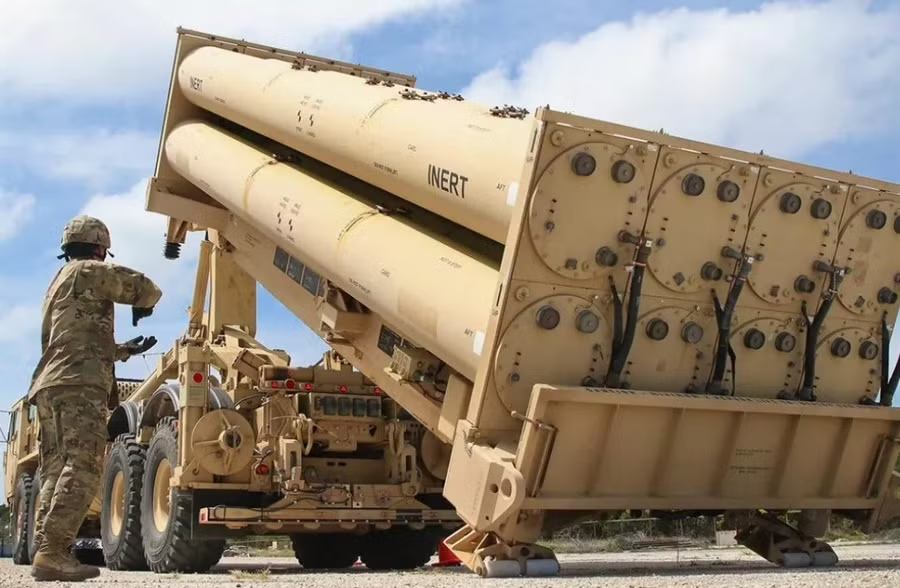
The dependence on tungsten supplies from China is making it difficult for the US to produce and replenish its stockpiles of THAAD, Patriot, and Tomahawk missiles.
Tungsten supply has become a weak link in the US defense system.
The U.S. defense industry is currently facing a major challenge in maintaining production of advanced defense systems such as THAAD, Patriot, and Tomahawk cruise missiles. The core reason stems from its reliance on tungsten—a strategic metal in which China currently controls up to 80% of global production.
Tungsten, also known as the "metal of war," plays an irreplaceable role in the manufacture of armor-piercing ammunition, alloy steels, and military electronic components. According to Ruslan Dimukhamedov, president of the Association of Rare Metal Producers and Consumers, tungsten is in extremely high demand in the defense industry, while no other metal can completely replace it.
Pressure from export control measures
China's imposition of export controls on key minerals in retaliation for US tariffs is putting Washington in a difficult position. Igor Yushkov, an expert at the Financial University of the Russian Federation, believes that if tensions continue to escalate, Beijing could use these sensitive export restrictions to directly pressure the US military supply chain.
The solution to the potential supply shortage in the US is to increase production in other regions. However, experts warn that this process would be time-consuming and costly, and could not immediately meet the growing demand for weapons production.
The shortage of interceptor missiles.
The pressure on materials is becoming increasingly severe as U.S. arms stockpiles are rapidly depleting following conflicts in the Middle East. According to assessments from the Pentagon and reports from the Center for Strategic and International Studies (CSIS), the rate of depletion of interceptor weapons is currently at an alarming level:
- THAAD system:The US military has used more than 200 missiles, equivalent to 50% of its total current stockpile.
- Patriot system:Nearly half of the air defense system's missile stockpile has been fired.
- Tomahawk cruise missile:Approximately 27% of the missiles in the stockpile have been fired.
- Other types of ammunition:It consumes approximately 45% of the fuel of the new generation PrSM ballistic missiles, 30% of the fuel of SM-3 missiles, and at least 10% of the fuel of SM-6 missiles.
The U.S. and Israel have established a joint defense mechanism, in which warships and the THAAD system bear the brunt of ballistic missile defense. However, the use of expensive missiles and the scarcity of raw materials raise serious questions about the long-term sustainability of U.S. military power if the tungsten supply chain continues to be disrupted.


