
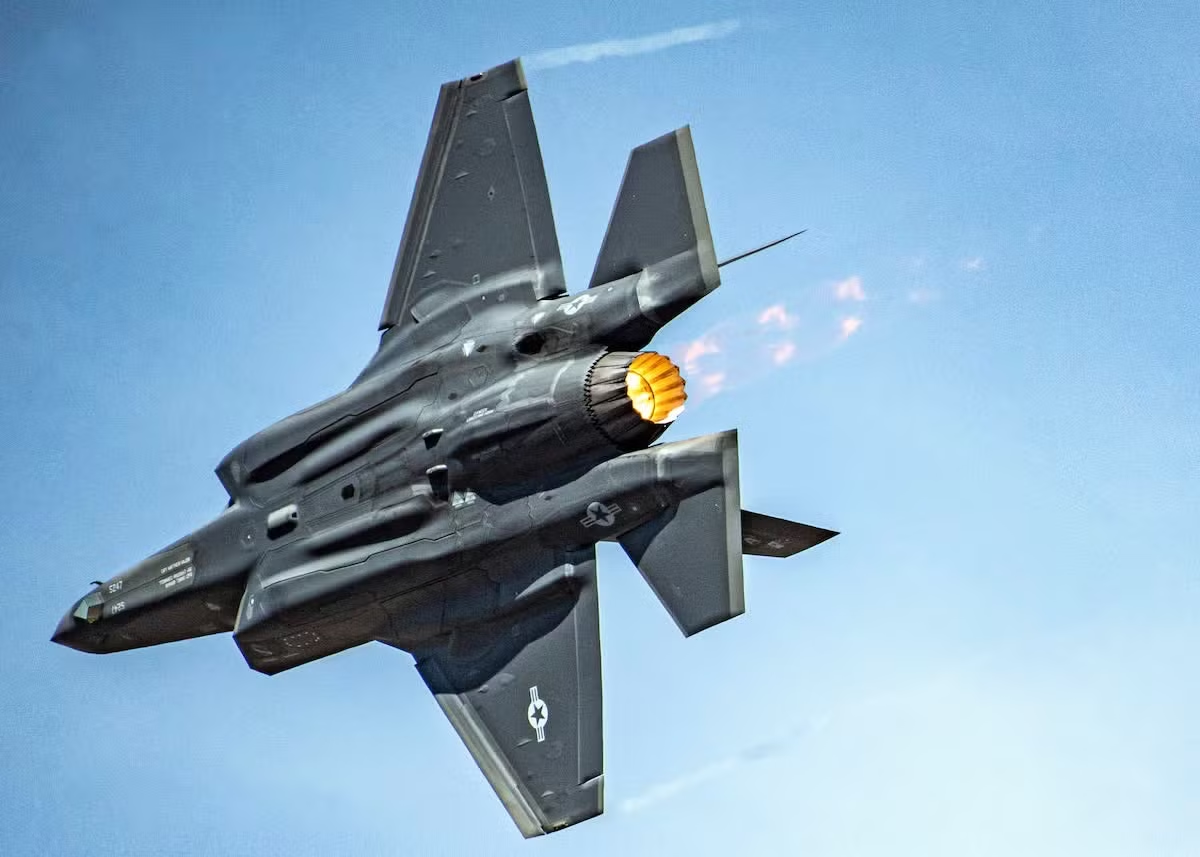
The US plans to cut its contribution of fighter jets to NATO forces by one-third.
Washington will withdraw fighter jets, strategic bombers, and warships from NATO, and require its European allies to take on their own defense in a NATO 3.0 model.
The US is planning to cut approximately one-third of its fighter jets contributing to NATO, along with other crucial strategic assets. This move marks a turning point in transatlantic military relations, forcing European nations to rapidly increase their defense autonomy to fill the power vacuum.
Washington adjusts the scale of its military presence in Europe.
According to Spiegel, a representative of US Secretary of War Pete Hegseth announced this plan in a closed-door meeting with senior NATO officials in Brussels. Accordingly, Washington will significantly reduce the military forces deployed since the Russia-Ukraine conflict erupted in 2022.
The list of planned equipment cuts includes fighter jets, strategic bombers, destroyers, submarines, and unmanned aerial vehicle (UAV) systems. Notably, the U.S. will significantly reduce its strategic bomber presence and will no longer provide submarines to the coalition's joint forces.
Challenges arising from operational capability gaps
News of the US withdrawing military equipment has caused considerable concern in Brussels. European diplomatic officials say that some US military capabilities are almost irreplaceable in the near future. While orders for F-35 fighter jets from member states may partially offset the shortage of combat aircraft, Europe still completely lacks strategic bombers capable of nuclear deterrence.
Furthermore, replacing US aircraft carriers – a key component of NATO's crisis-era force model – is considered extremely difficult. However, the US insists it will not abandon its nuclear deterrence commitment in Europe, while emphasizing that allies need to take greater responsibility for routine defense missions.
The roadmap towards the NATO 3.0 model.
This budget cut is part of the Trump administration's strategy to promote the concept of "NATO 3.0." Under this model, European countries would take over the majority of defense tasks on the continent, while the US would prioritize resources for other strategic regions globally.
To prepare for this shift, NATO member states are required to submit specific plans by early June 2025 to fill the gaps in military equipment. Details of the new responsibility-sharing mechanism are expected to be officially announced by Washington at the NATO summit in Ankara next July. This is seen as a step to optimize US defense spending in the context of a volatile international security environment.


