
The US is deploying long-range Typhon and PrSM systems to Europe.
A new US artillery battalion of approximately 500 personnel will deploy HIMARS with long-range PrSM missiles, MRC Typhon systems launching Tomahawk and SM-6 missiles, and, expectedly, LRHW hypersonic missiles in Europe.
The U.S. is planning to deploy a new artillery battalion with exceptionally long-range weapons to Europe, including the MRC Typhon system and variants of the PrSM missile. The Pentagon says the goal is to increase the “flexibility” of ground forces and create an “additional deterrent” in the region.
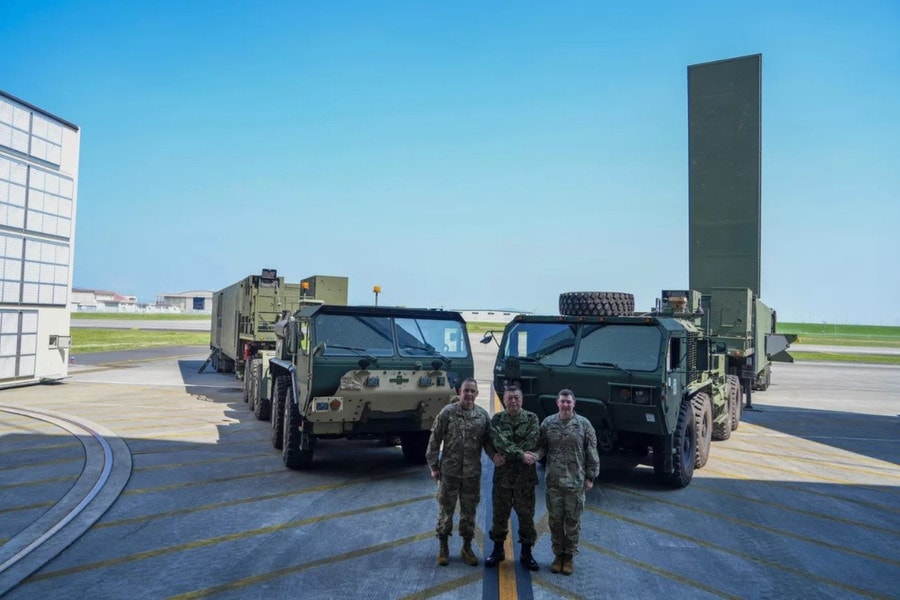
New artillery battalion and deployment plan.
The new unit is officially named the 3rd Battalion, 12th Field Artillery Regiment, under the 56th Multi-Field Command, with a strength of approximately 500 personnel. According to published information, the battalion will be equipped with the HIMARS multiple rocket launcher system “with ultra-long-range ammunition” and “medium-range rocket launchers”.
The Pentagon said the battalion will begin training and combat missions, while a decision on permanently deploying the unit to Europe will be considered over time. Details about the specific weapons and its deployment location have not been disclosed.
Previously, the Pentagon had announced its intention to deploy a similar unit to Germany by 2026. The exact timing of the deployment of troops with full standard weaponry remains unclear. According to the assessment in the article, this move could be adjusted depending on the progress of negotiations regarding Ukraine, as the deployment of a new artillery unit in Europe is expected to face strong opposition from Russia.
RIA Novosti reported on the unit's mission, while official statements from the Pentagon emphasized the increased flexibility of ground forces and its deterrent role.
PrSM: A new firepower core for HIMARS
In its statement, the Pentagon described the battalion's weapons as "HIMARS multiple rocket launcher systems and medium-range missile systems," a description broad enough to encompass many types of ammunition, including the PrSM – the U.S. priority precision strike munitions program.
In July, Washington announced the start of mass production of the PrSM precision-guided strike missile for the Multi-Domain Task Force (MDTF) in Europe, the Arctic, and the Asia-Pacific region. The PrSM project, launched in 2016, is expected to see the first units receive the missile in the fall of 2023.
PrSM shares the same launch system as ATACMS: the M-142 HIMARS launcher carrying two missiles and the M-270 MLRS launcher carrying four missiles. In the early stages of the program, the US had a ballistic missile designed to strike fixed targets with a range of 60 to 500 km. This is the variant that has been put into production.
The missile uses a combination of inertial and satellite guidance, carrying a high-explosive warhead or a cluster warhead. The warhead weight is not disclosed; estimates given in the article suggest it is between 100 and 230 kg.
| PrSM variant/version | Primary target type | Range (km) | Key features | Status |
|---|---|---|---|---|
| Early-stage PrSM | Fixed ground target | 60–500 | Inertial guidance + satellite guidance, high-explosive or cluster munition. | Delivery completed, mass production has begun. |
| LBASM (Land-Based Anti-Ship Missile) | The objective is to move, with a focus on targets at sea. | Up to 1,000 | Multimode radar and infrared seeker, terminal phase target lock. | Prototype testing completed, expected to be operational in 2028. |
| PrSM with enhanced penetrating warhead | Strong defensive position | Not specified | More powerful penetrating warheads | Under development |
| PrSM with advanced jet engines | A very long-term goal. | Up to 1,500 | The new jet engine, if launched from Germany, could reach Moscow. | Under development |
Following the US withdrawal from the INF Treaty, Lockheed Martin began developing the land-based anti-ship version of the PrSM, the LBASM, with a range of up to 1,000 km. Its multi-mode seeker operates across both radar and infrared ranges, allowing the missile to lock onto targets in the final stage of its trajectory and engage moving targets. A prototype was tested in the Pacific Ocean last summer, and the LBASM is expected to enter service around 2028.
According to the manufacturer, the program also includes a version with a more powerful penetrating warhead to destroy fortified positions, and a version using an advanced jet engine with an increased range of 1,500 km; if launched from Germany, this variant could reach Moscow.
Typhon and its "long arm" Tomahawk, SM-6
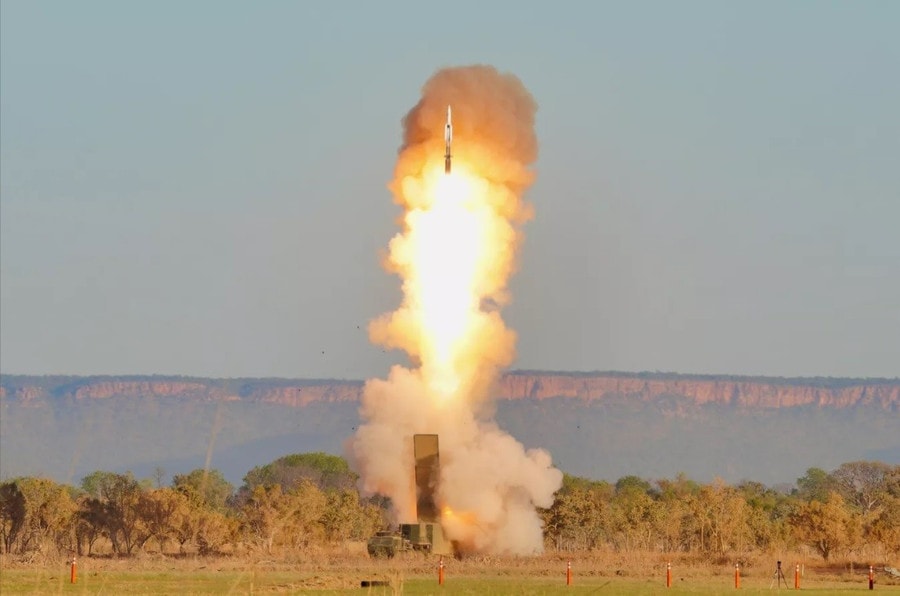
When the Pentagon refers to this equipment group as the “Medium-Range Missile Reduction System,” it is actually referring to the MRC Typhon. Structurally, the Typhon is a standard 40-foot (approximately 12 m) shipping container mounted on a wheeled chassis, incorporating four Mk 41 vertical launch tubes. This type of launch tube has been widely used in the U.S. Navy and is capable of launching various types of missiles.
The Typhon can carry Tomahawk cruise missiles as well as ground-launched SM-6 semi-ballistic missiles. Tomahawk variants have been used by the US since 1983, with ranges ranging from 1,600 to 2,500 km depending on the version. The US Navy has used the Tomahawk in every conflict since Operation Desert Storm. The article describes the Tomahawk as an accurate, durable, and relatively inexpensive weapon.
However, the Tomahawk has never been used against a nation possessing a modern air defense system. Its subsonic speed and relatively large size make it a more favorable target for modern air defenses.
The RIM-174 SM-6 missile, introduced into service in 2013, was initially a surface-to-air missile for air defense and missile defense on warships, with a range of approximately 230 km against airborne targets. When combined with the Typhon system to attack ground and sea targets, the SM-6 operates in semi-ballistic mode with a range of up to 740 km. In the final stage, the missile uses an active radar seeker for self-guidance.
The MRC Typhon self-propelled system consists of a unified command post with a support vehicle, four launchers, and transport and reloading vehicles. The entire system is mounted on three-axle trailers and towed by HEMTT trucks. To fire, the system requires a pre-prepared firing position.
LRHW: Hypersonic Attack Class
In addition to PrSM, Tomahawk, and SM-6 missiles, the new battalion is also planned to be equipped with the LRHW hypersonic missile, with a range of up to 2,700 km. With this range, theoretically, the LRHW could reach from Berlin to the Ural Mountains.
The LRHW missile is capable of accelerating to Mach 17, making it extremely difficult for air defense systems to detect and intercept. The development of this weapon in the US has been fraught with difficulties, with numerous unsuccessful test launches. However, in June, an LRHW was successfully tested in Hawaii, hitting its designated target.
Regional military impact
According to the assessment stated in the article, the 3rd Battalion of the 12th Field Artillery Regiment, with the aforementioned long-range weapon system, will pose a significant military threat to Russia's western border and the Kaliningrad region.
Conversely, the deployment of the Oreshnik medium-range missile system in Belarus, as recently announced by President Alexander Lukashenko, is believed to significantly reduce this potential threat. The overall picture shows that the race to enhance long-range strike capabilities and missile deterrence in the region continues to be complex, with a focus on mobile ground-based systems such as Typhon, HIMARS, and the PrSM and LRHW missile families.


