
The US launches a hypersonic spaceplane program.
The XS-1 spacecraft program promises to help the US reduce the cost and risk of launching satellites in the future.
Simulating the operation of XS-1
Defense Advanced Research Projects Agency (DARPA)According to Popular Mechanics, the Pentagon has selected Boeing to design and build a new hypersonic spacecraft called "Phantom Express." It is capable of reaching high altitudes to launch satellites into Earth orbit, then returning and landing like a conventional aircraft.
The Experimental Spacecraft (XS-1) program will launch a small booster rocket after reaching an altitude of over 100 km. The rocket will carry the satellite into orbit, while the spacecraft will return to Earth and land on a runway. DARPA hopes XS-1 will help the US Department of Defense be ready to launch satellites into orbit within days, instead of months as is currently the case. The XS-1 spacecraft is expected to be able to land and launch again within hours.
"XS-1 is a combination of traditional aircraft and conventional launch vehicles, aiming to reduce satellite launch costs tenfold, as well as shorten preparation time. We are very pleased with the progress of the initial phase," said Jess Sponable, XS-1 program director at DARPA.
Unlike the US Air Force's X-37B, which uses Atlas V rockets for launch, the XS-1 model will launch itself using its own engines powered by liquid oxygen and hydrogen fuel. The Phantom Express is about the size of a commercial aircraft and can fly at supersonic speeds exceeding 6,125 km/h before launching a 1,360 kg satellite into low Earth orbit.
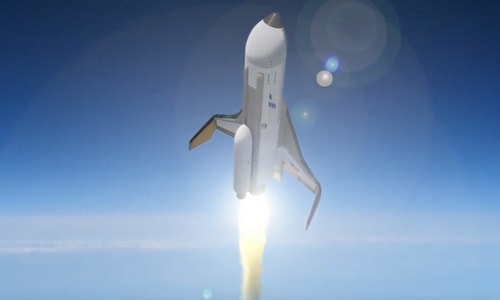 |
| The XS-1 spacecraft launched into orbit carrying a satellite on its back. Graphic: DARPA. |
Phase two of the program involves designing, manufacturing, and testing the propulsion system with 10 test launches. This phase will last throughout 2019 before Boeing and the US Department of Defense conduct flight tests in phase three in 2020.
If successful, DARPA estimates the XS-1 program will cost less than $5 million per launch. Beyond military purposes, DARPA plans to share the design with commercial aerospace companies to further reduce costs.
According to VNE
| RELATED NEWS |
|---|


