
The US upgrades Patriot missiles with 360-degree 'reverse firing' capability.
The new Patriot variant for the US Army adds the ability to intercept targets behind its rear, overcoming the 120-degree firing angle limitation and approaching the capabilities of the S-300, S-400, and HQ-9B systems.
The U.S. Army is developing a new variant of the MIM-104 Patriot long-range air defense missile system with the ability to engage targets behind the launch platform. This upgrade aims to overcome the Patriot's biggest limitation: its coverage of only about 120 degrees in front, while Russian, Chinese, and North Korean systems have long had 360-degree coverage.
Patriot adds the capability of intercepting from behind.
According to information released by the U.S. Army, the new variant of the Patriot will be capable of engaging targets not directly in front of the launch platform. This is a capability that the system previously lacked compared to its foreign counterparts.
This advancement was achieved through the parallel development of both a new generation of launchers and interceptor missiles. The new configuration allows the system to fire at threats from behind, including ballistic or cruise missiles that have already flown over the battlefield.
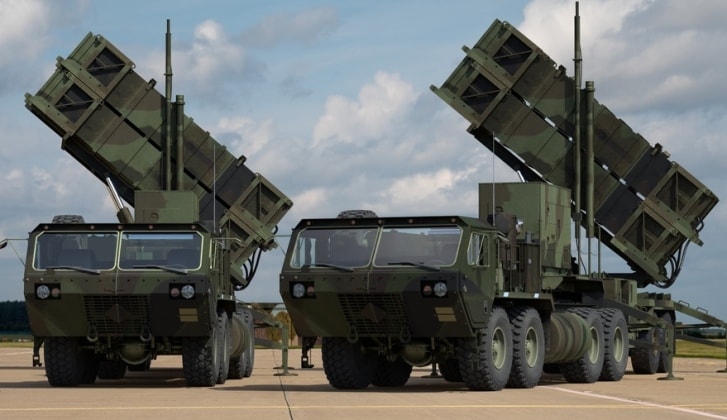
During a discussion with Defense Secretary Pete Hegseth about the current and future capabilities of the Patriot, Lieutenant Colonel Steven Moebes, Product Manager for Low-Altitude Interceptor Systems, stated that the M903 launcher currently still requires mechanical rotation to locate its target.
Mr. Moebes announced that later this year, the U.S. Army will launch a new interceptor missile program with a longer range and higher altitude ceiling. According to digital simulations, this missile will give the Patriot the capability to perform a 'backfire': the missile has enough kinetic energy to launch, change direction, and return to intercept a target behind the launch platform.
Limitations of the current Patriot configuration
In its current configuration, Patriot launchers must mechanically rotate to engage targets outside the limited firing range ahead. The system's coverage angle is only about 120 degrees, significantly lower than the 360-degree coverage of air defense systems developed by Russia, China, and North Korea.
The reliance on the mechanical movement of the launcher puts the Patriot at a disadvantage in complex interception scenarios, where the target may appear from multiple directions or change its approach axis during flight.
The motivation for the upgrade: the threat of mobile missiles.
One of the key factors driving the U.S. to add 'reverse firing' capabilities to the Patriot is the increased capability of ballistic and cruise missiles in the hands of potential adversaries. These weapons can maneuver in orbit, allowing them to strike targets from unexpected directions, even after having bypassed air defenses.
The Russian Armed Forces have been confirmed to have extensively used the highly mobile Iskander-M ballistic missile system to attack Ukrainian Patriot missile systems since early 2024. An air-launched version of the Iskander-M, the Kinzhal system, has also been reported to have participated in similar attacks.
Sources from Ukraine and the West have repeatedly highlighted the significant limitations of the Patriot system against Russian missile attacks. This has strategic implications for the United States and its partners, especially given that China and North Korea are believed to possess even more advanced tactical missiles.
Cold-launch technology and 360-degree coverage: catching up with the S-300.
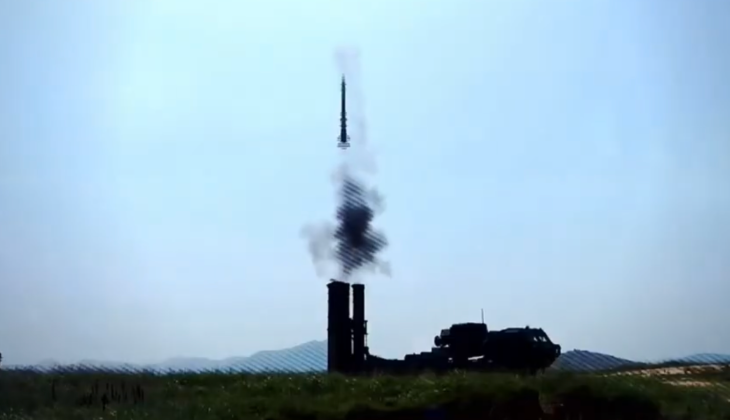
The Soviet S-300 system, commissioned in 1978, is considered a pioneering system that applies 'cold launch' technology to attack targets 360 degrees around the launch platform. This is one of the key factors that gives the S-300 an advantage in long-range air defense.
Successor generations such as Russia's S-400, China's HQ-9B, and North Korea's Pongae-5 and Pyongae-6 all have the capability to perform similar 'reverse firing' maneuvers, meaning they can intercept approaching targets from behind the launch platform's deployment area.
The new variant of the Patriot is expected to fill a long-standing performance gap. While current Patriot launchers fire missiles at an angle toward the target, future launchers are expected to adopt cold launch and vertical launch methods, similar to the configurations on air defense systems of Russia, China, and North Korea.
This approach means that the Patriot could have a completely different launch platform design compared to variants that have been in use since the 1980s, while significantly expanding the protected airspace around the launch site.
Some key differences between the current Patriot and the new variant.
| Criteria | Current Patriot | New Patriot variant (expected) |
|---|---|---|
| Coverage angle | Approximately 120 degrees in front of the launch pad | Aiming for 360-degree coverage, including targets behind you. |
| Launch method | The missile is launched at an angle toward the target. | Cold launch, vertical launch from a launch pad |
| Processing the backend | The mechanical launch platform must be rotated to bring the target into the firing zone. | The simulated missile could launch and then return to intercept a target behind it. |
| The primary threat target | Ballistic missiles, traversing a 120-degree coverage area. | Enhanced capabilities include countering ballistic and cruise missiles, enabling maneuverable attacks from multiple directions. |
With upgrades focused on the launcher and new interceptor missiles, the Patriot is being adapted to better suit the modern combat environment, where ballistic and cruise missiles are capable of maneuvering and attacking from multiple axes. When completed, the 'reverse firing' capability is expected to bring the system closer to next-generation long-range air defense systems that already possess 360-degree coverage.


