
The US, Japan, and South Korea agree to take a tough stance against North Korea.
(Baonghean.vn) - The United States, Japan, and South Korea agreed on October 27 to cooperate in imposing further sanctions on North Korea following Pyongyang's fifth nuclear test last month, as well as coordinating responses to its military provocations.
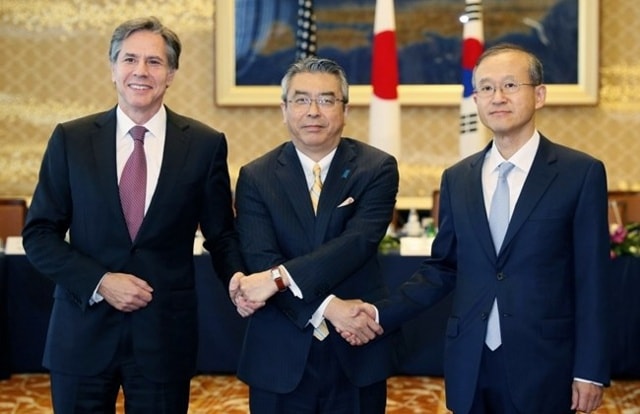 |
| The vice foreign ministers of the United States, Japan, and South Korea attended a trilateral meeting in Tokyo on October 27. Photo: AP. |
Speaking to reporters, Japanese Vice Foreign Minister Shinsuke Sugiyama stated: "We reaffirm the need to increase pressure on North Korea to abandon its nuclear and missile development programs and move toward denuclearization on the Korean Peninsula."
Mr. Sugiyama made the statement after a trilateral meeting in Tokyo with South Korean Vice Foreign Minister Lim Sung-nam and his U.S. counterpart Tony Blinken. At the meeting, the parties also carefully considered the possibility of adopting their own individual sanctions against Pyongyang.
Tensions have escalated on the Korean Peninsula this year after North Korea conducted its fourth nuclear test in January, followed by a satellite launch, a series of other missile tests, and a fifth nuclear test last month. All of these actions are seen as a challenge to international sanctions.
Russia and China – close allies of North Korea – are pushing to restart the six-party talks involving the United States, Japan, South Korea, and North Korea on denuclearization of the Korean Peninsula. These talks have been suspended since 2008.
Also related to negotiations on North Korea's nuclear issue, South Korean Vice Foreign Minister Lim Sung-nam said the government has decided to resume talks with Japan on the General Security of Military Information Agreement (GSOMIA) to share information on North Korea's missile and nuclear activities.
In 2012, Tokyo and Seoul came close to signing this agreement, but canceled it at the last minute due to opposition from the South Korean people regarding Japan's occupation of the Korean Peninsula before and during World War II.
Thanh Huyen
(According to Reuters)
| RELATED NEWS |
|---|


