
The US delays the LGM-35 Sentinel missile program, raising the issue of its $140 billion cost.
The Sentinel intercontinental ballistic missile program faces record cost overruns and delays in its operational launch to the 2030s, as it aims to replace the aging Minuteman III.
Sentinel, the US program to replace the Minuteman III intercontinental ballistic missile (ICBM), is currently facing significant challenges regarding its timeline and budget. According to the latest Pentagon statement, the project is only expected to achieve initial operational capability in the first half of the 2030s, while the complete replacement of the aging missiles will take until the middle of this century.
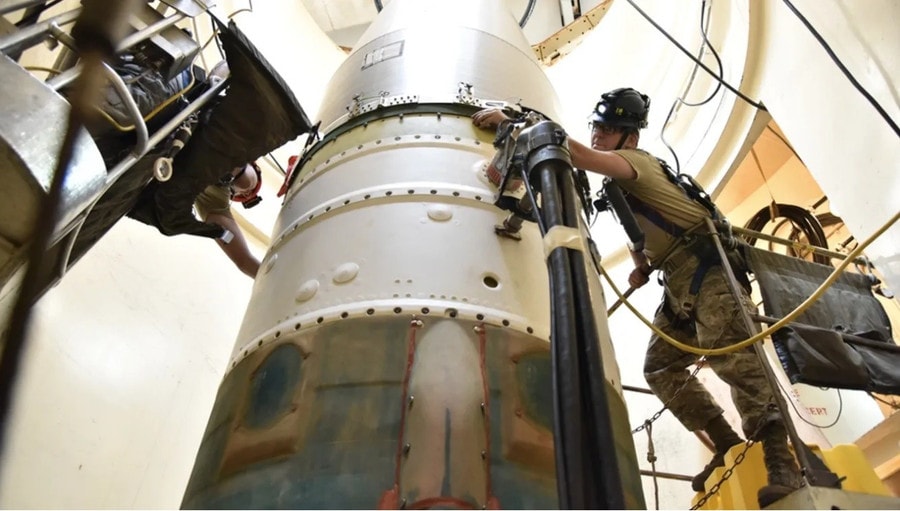
Challenges related to timelines and technical infrastructure.
General William Rogers of the U.S. Air Force, who oversees the program, stated that the LGM-35 Sentinel missile will not be able to replace the Minuteman III by 2038 as originally planned, but will be delayed until 2050. Currently, the project has not yet entered Phase B (engineering, design, and production), a milestone not expected to be reached until 2027.
One of the biggest obstacles is the complete rebuilding of the land-based component of the strategic nuclear force. Because the Sentinel missiles are larger than the Minuteman III, the old launch silos are no longer suitable. The U.S. military will have to dig new silos, install secure communication systems, and construct military barracks for 634 silo-launched missiles and 25 test missiles.
In addition, a report from the U.S. Government Accountability Office (GAO) indicates that software developers are significantly behind schedule. This raises concerns about the main contractor's ability to complete the project on time.
Budget exceeds record levels.
The competition to build the new ICBM began in 2016 with the participation of Boeing and Northrop Grumman. However, after Northrop Grumman acquired Orbital ATK – a supplier of solid-fuel rocket engines – Boeing withdrew, leaving Northrop Grumman as the sole bidder.
The program's initial estimated cost was $77.7 billion, but that figure has now skyrocketed to $140.9 billion. The Pentagon fears the actual budget could reach $160 billion, pushing the cost per missile from $118 million to $214 million. Deputy Secretary of Defense William LaPlante has ordered a restructuring of the program to mitigate the cost overrun, while acknowledging that the U.S. has no cheaper alternative to modernizing its nuclear forces.
Technical specifications and strategic correlations
The LGM-35 Sentinel is designed as a three-stage, solid-fuel missile with a range of up to 15,000 km thanks to a new composite propellant. The system will utilize GPS navigation for improved accuracy and be equipped with decoys to penetrate enemy defenses. The W87-1 thermonuclear warhead is under development for integration into a multi-purpose re-entry vehicle (MIRV).
While the US focuses on submarine-launched ballistic missiles (SLBMs) like the Trident II, Russia maintains its nuclear triad core based on ground-launched missiles. The Russian Strategic Missile Forces currently possess modern systems such as the RS-24 Yars and, notably, the RS-28 Sarmat. The Russian Sarmat system is estimated to have a range of 16,000 to 18,000 km and the ability to carry more than 10 warheads, creating significant pressure in the global strategic arms race.
The Sentinel missile is expected to be deployed at Warren Air Force Base (Wyoming), Maelstrom Air Force Base (Montana), and Minot Air Force Base (North Dakota) – locations that have been familiar in the national defense strategy for decades.


