
The US deployed LUCAS attack drones in Operation Epic Fury.
The US military has just unveiled the LUCAS (FLM 136) cruise missile, capable of flying continuously for six hours to destroy Iranian air defense targets and mobile missile launchers.
The U.S. military has officially deployed a new unmanned aerial vehicle (drone) system called LUCAS as part of Operation Epic Fury. This operation, in coordination with Israel, aims to neutralize Iran's military infrastructure. Commercialized by SpektreWorks (Arizona) under the name FLM 136, this system marks a new step forward in the use of domestically produced cruise missiles for long-range precision strikes without the need for a pilot in heavily fortified areas.
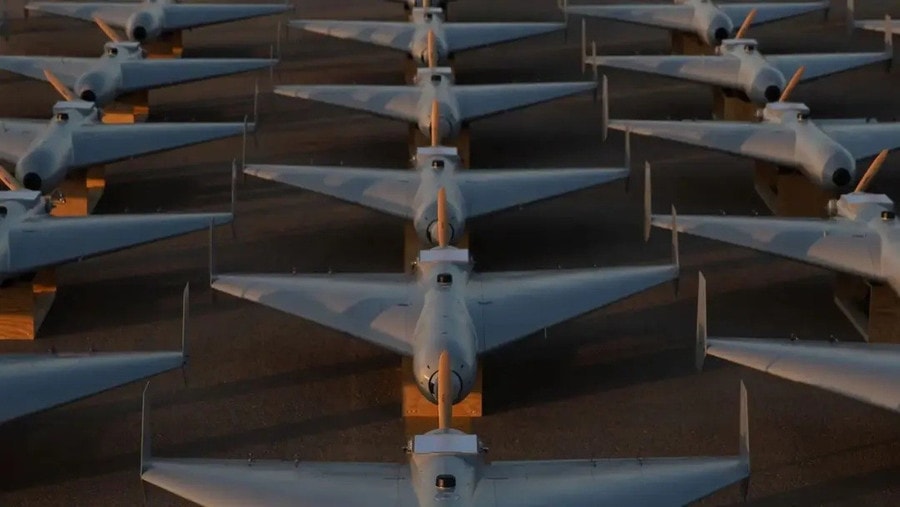
Instead of relying entirely on expensive stealth fighter squadrons or high-cost cruise missiles, battlefield commanders now have the option of aircraft capable of operating deep within contested areas. LUCAS can maintain an airborne presence for hours, waiting for the opportune moment to deliver a decisive blow to high-value targets.
Strategic objective: To weaken Iran's air defense network.
Operation Epic Fury was designed with the core objective of destroying Tehran's integrated air defense system, ballistic missile forces, and command and control structures. This operation was a multi-layered combination of stealth aircraft, long-range strike weapons, and electronic warfare.
In this operational scheme, LUCAS serves as a platform for continuous observation and attack. The device is capable of automatically identifying, tracking, and destroying moving targets, especially air defense units that frequently change positions to avoid counter-fire. Its ability to shorten the sensor-to-shooter cycle significantly increases combat effectiveness against fast-moving targets.
Technical specifications and load capacity of FLM 136
Based on data from the manufacturer SpektreWorks, the FLM 136 possesses optimal specifications for covert raid missions. The drone is approximately 3 meters long, has a wingspan of 2.5 meters, and a maximum takeoff weight of 82 kg. This compact frame allows the device to be easily transported and deployed from forward positions.
- Engine:It uses a 215cc carburetor engine.
- Speed:The vehicle accelerates at 101 km/h and can reach a top speed of 185 km/h during the final attack phase.
- Operating hours:It can fly continuously for about 6 hours over the target area.
- Operating altitude:At over 3,000m, this keeps the device out of range of many short-range air defense systems (SHORAD).
In terms of firepower, LUCAS can carry a maximum module payload of 18 kg. Warhead options include fragmentation or shaped-charge warheads, capable of destroying radar, surface-to-air missile launchers, fuel depots, and fortified control centers. In the final stage, the drone will perform a steep dive to maximize penetration kinetic energy and lethal range.
Real-world testing from a warship in the Arabian Gulf.
Notably, LUCAS has demonstrated its versatility in deployment from the sea. On December 16, 2025, the system was first tested on the Independence-class littoral combat ship USS Santa Barbara (LCS 32). The test showed that LUCAS can take off from naval platforms without the need for a traditional runway.
The launch method utilizes a pneumatic rail system or rocket-assisted propulsion, allowing for rapid deployment from the ship's deck. This opens up the possibility of combat operations from unexpected directions, putting significant pressure on the enemy's coastal defenses.
Changes in US combat doctrine
Integrating LUCAS into a real-world operation like Epic Fury demonstrates a clear shift in the Pentagon's military doctrine. Instead of relying on a few high-tech weapons costing millions of dollars each, the U.S. military is moving toward using low-cost, mass-produced glide systems.
The automatic navigation system combined with inertial redundancy helps LUCAS minimize the risk of being neutralized by electronic warfare systems. This tactic not only helps maintain constant pressure in the contested area but also protects the lives of pilots and valuable aircraft from the enemy's dense air defense network.


