
How has the New Year in Japan changed since they started celebrating the Western New Year?
If you are in Japan on New Year's Eve, you will find that the New Year's celebration there is a unique blend of Eastern tradition and Western modernity.
 |
| Crowds participate in a New Year's Eve countdown event in Shibuya, Tokyo, Japan. Photo: Reuters. |
Before midnight, the streets of Tokyo were filled with young people and foreign tourists. Tens of thousands gathered near a train station in central Tokyo for the New Year's countdown.
Security was tightened in front of Shibuya Station. Police prohibited vehicles from circulating in this busy intersection on New Year's Eve.
Meanwhile, another crowd celebrated the new year in a more traditional and quiet way at a nearby temple. A few seconds before midnight, the chief priest anxiously watched his watch, waiting for the beep to signal exactly midnight.
When the time came, he beat the large drum at the temple entrance, signaling the start of the new year. Visitors began tossing coins over the barrier, clapping twice, and then silently praying.
East-West fusion
This scene might not have unfolded on January 1st if it weren't for the Meiji Restoration in the mid-19th century, which transformed Japan from a feudal, isolated country into a civilized nation on par with Western powers.
The Meiji period was a miraculous turning point for Japan, transforming it from an agricultural nation into a powerful capitalist country, abolishing unequal treaties with the West, developing its military, and absorbing the achievements of world civilization.
The revolution not only boosted Japan's economy but also brought about profound changes in its culture and society.
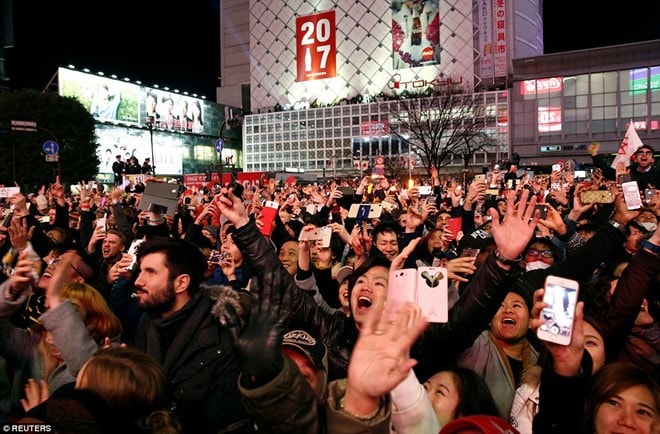 |
| Crowds participate in a New Year's Eve countdown event in Shibuya, Tokyo, Japan. Photo: Reuters. |
At the end of 1873, the government announced the adoption of the Gregorian calendar to replace the traditional lunar calendar. The reason for this change was financial.
The government's decision to start paying civil servants monthly salaries (instead of annual salaries as before) resulted in a 13th-month salary, but revenue was insufficient to cover this expense. They decided to adopt the Gregorian calendar, ending the year in the 12th month.
As a result, the Japanese abandoned the Lunar New Year in favor of the Western New Year, but their New Year celebrations did not lose their unique characteristics.
If you were here at midnight on New Year's Eve, you would notice that the Japanese New Year's celebration resembles both the countdown in Times Square in the US and possesses a mystical Eastern charm.
“This isn’t really a religious holiday,” Kitagawa, the head priest of a Shinto shrine south of Tokyo, told a New York Times reporter. “People just want to feel the new year and mingle with the crowd when they visit this shrine,” the fifth-generation head priest of the Kitagawa family remarked.
Returning to tradition
Throughout Japan, people celebrate the first morning of the year in ways that are both common and unique. Tens of millions of people visit temples and shrines across the country to pray.
Tens of thousands of others participated in mountain climbing as part of Shinto tradition. In the capital, millions flocked to pray at Meiji Shrine, the most popular destination during the New Year's celebrations in Japan.
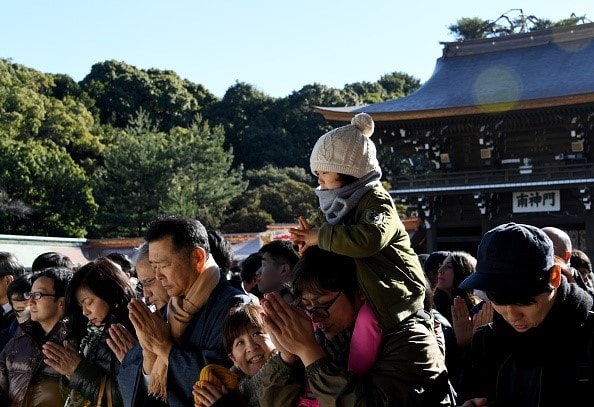 |
| Japanese people pray on New Year's Day at Meiji Shrine in Tokyo. Millions of people visit temples and shrines across Japan during the first three days of the new year to pray for loved ones and family during the New Year's celebrations. Photo: Getty. |
Each person who comes to pray at the shrine has a different motivation; some genuinely believe in Shintoism, while others simply want to do something interesting and new to clear their minds on New Year's Day.
For any temple, the New Year is a crucial business period. The sale of amulets and inexpensive jewelry provides the majority of the revenue needed to sustain operations, including the cost of maintaining the shrine and providing income for the temple's headman's family.
"Now, the main function of this shrine is to educate young people about Japanese traditions," Mr. Kitagawa's wife told a New York Times reporter while cleaning the shrine.
"In the past, people lived in extended families, so they didn't need to learn about this. Now, traditional families no longer exist," she said.
In the eyes of some foreigners, New Year's in Japan is not much different from Christmas in the West.
Traditionally, Japanese people clean and decorate their homes before the New Year, gather with relatives and family, hold New Year's celebrations, watch the sunrise on the first day of the year, and visit temples and shrines.
They typically plan to work until December 29th, then begin flocking back to their hometowns for the Lunar New Year, leaving cities like Tokyo emptier and quieter than usual.
However, Mr. Kitagawa wanted Japan to be seen by the world in a different light.
"Japan is renowned worldwide as a prosperous nation. But through all these rituals, we hope that people around the world will see that Japan is also a country of tradition," he said.
According to Vietnamplus
| RELATED NEWS |
|---|


