
NASA launches mission to study space weather.
On September 24, the US National Aeronautics and Space Administration (NASA) launched three spacecraft to enhance its ability to monitor space weather such as solar storms, which can affect technology and power systems on Earth.
Three probes were launched from the Kennedy Space Center in Florida on Falcon 9 rockets manufactured by the private company SpaceX. After reaching orbit, the probes will undertake a long journey to Lagrange Point 1 – a location approximately 1.5 million kilometers from the Sun, offering stable observation for research.
The Interstellar Mapping and Acceleration Probe (IMAP) spacecraft will use instruments to study high-energy particles from the Sun and the magnetic bubble surrounding the solar system, known as the heliosphere. This data will provide information about space weather and cosmic radiation.
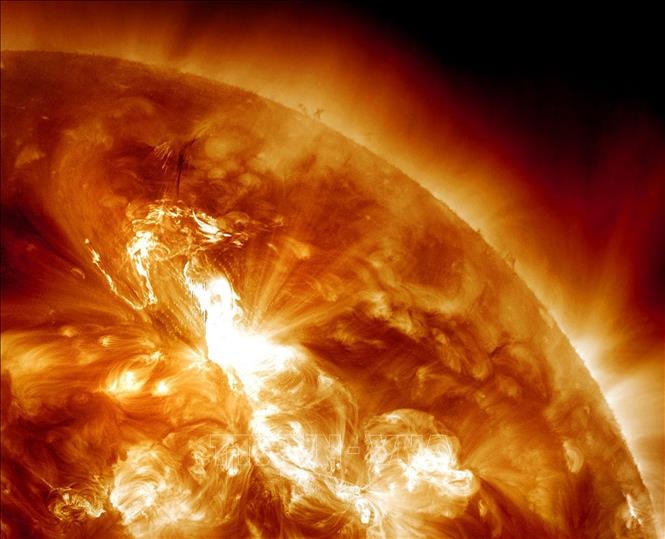
Solar storms are intense radiation phenomena arising from flares on the Sun's surface, and they are difficult to predict. They can affect many activities on Earth, such as aviation, mobile communications, and power grids – and pose a potential threat to the safety of astronauts and satellites in space.
Meanwhile, the Space Weather Follow-on (SWFO-L1) spacecraft, operated by the U.S. National Oceanic and Atmospheric Administration (NOAA), is designed to detect space weather patterns early.
Irene Parker of NOAA stated that while the threat cannot be completely prevented, it can give people time to prepare. With timely warnings, officials can protect astronauts, alert pilots to potential GPS disruptions, and adjust the power grid accordingly.
Additionally, the Carruthers Geocorona Observatory – the third spacecraft in the mission – will study Earth's exosphere to better understand the impact of space weather on this region.


