
The beautiful tradition of buying salt at the beginning of the year.
(Baonghean.vn) - There's a Vietnamese folk saying, "Buy salt at the beginning of the year, buy lime at the end of the year," referring to the customs and traditions of the Vietnamese people during the New Year. This custom has somewhat faded away today. However, many families still preserve these beautiful habits and beliefs that have existed for a long time.
In large markets such as Quynh Thien Market, Quynh Lien Market, Mai Hung Market, Ngo Market, Mo Market, Giat Market, Tuan Market, and in some large temples and pagodas, salt is available in general stores and shops specializing in religious offerings. Salt has become an indispensable item, just like betel nuts, votive paper, and fruits...
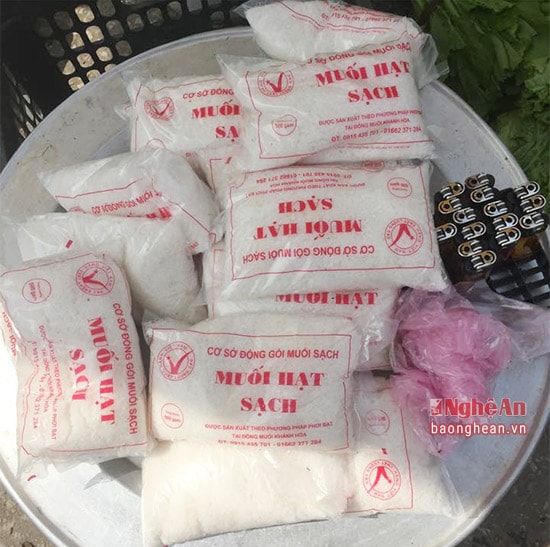 |
| Salt is now available in grocery stores and shops specializing in ceremonial items, meeting the demand for buying salt for good luck at the beginning of the year. (Photo: Viet Phuong) |
According to ancient beliefs, salt is a savory substance that wards off evil spirits and brings good fortune to the family. Buying salt at the beginning of the year has significance in culinary and spiritual culture, bringing richness to family relationships and harmony between husband, wife, and children.
Ms. Hoang Thi Nhiem, a resident of Quynh Thach commune, Quynh Luu district, said: "The custom of buying salt at the beginning of the year has existed for a long time, and my family still maintains it regularly. Salt is used for purification, warding off evil spirits, and offering to wandering souls. In general, in the New Year's rituals of my family, white salt and rice are indispensable."
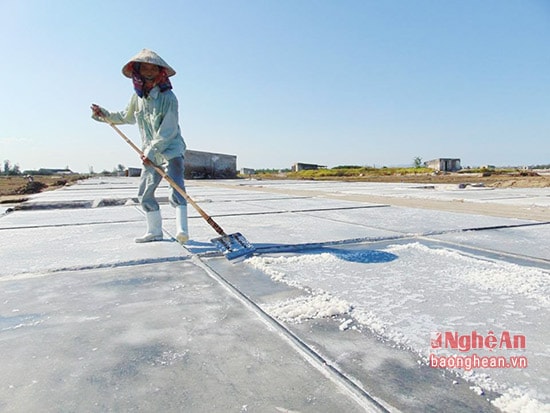 |
| Hoang Mai town and Quynh Luu district are the localities with the largest salt-producing areas in the province, with an annual salt output of over 75,000 tons. (Photo: Van Nguyen) |
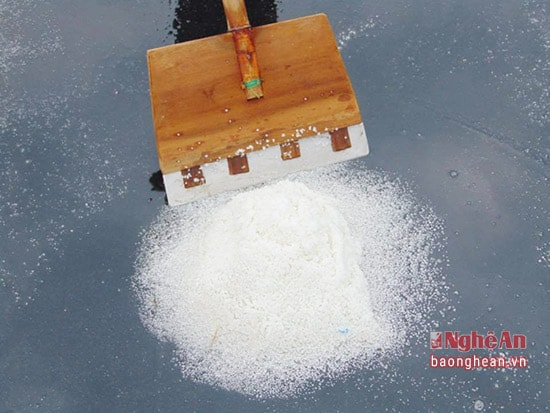 |
| In the early days of 2017, the price of salt increased by 2-3 price points. (Photo: Van Nguyen) |
In Hoang Mai town, Quynh Luu district, which has over 600 hectares of salt-producing area – the largest in the province – the annual salt production reaches over 75,000 tons. This is mainly concentrated in localities such as An Hoa, Quynh Thuan, Quynh Tho, and Quynh Phuong. Salt prices fluctuate constantly every year, reaching a low of only 500 VND/kg. However, during the end of 2016 and the beginning of 2017, salt prices increased by 2-3 price points. Specifically, raw salt sold by local people costs from 1200-1700 VND/kg, while raw salt exported from warehouses costs from 1600-2000 VND/kg. Finished salt products, including clean granulated salt, cost 2800-3000 VND/kg, and iodized refined salt costs 2900-3000 VND/kg. Ms. Dau Thi Anh Ngoc, accountant at Hoang Mai Salt Factory, said: "Right from the beginning of the year, our unit has had a shipment for export. Compared to previous years, the volume of salt exported at the beginning of this year has increased significantly, mainly serving orders to the North, where there are temples and pagodas, major spring festivals, and serving people during the first days of the new year 2017." Currently, various sectors and salt farmers are actively coordinating and boldly introducing many new technologies into production to improve the yield and quality of finished salt products, reduce costs and labor for salt farmers, so that the salt industry will no longer be left abandoned and production ceased as in the past. |
Van Nguyen
| RELATED NEWS |
|---|


