
Russia warns of retaliation against neighbors that support Ukrainian drones infiltrating its airspace.
Moscow has stated it will take necessary military measures if it confirms that neighboring countries are allowing Ukrainian drones to use their airspace to attack Russian territory.
Russia has sent a strong message to its neighbors, particularly NATO members, regarding allegations that Ukrainian drones have used their airspace to carry out attacks deep into Russian territory. Moscow asserts that it will take appropriate retaliatory measures if these allegations are objectively confirmed.
Increase the frequency of attacks in the Leningrad region.
During a press conference on March 31, Russian President Vladimir Putin's press secretary, Dmitry Peskov, directly commented on the wave of Ukrainian drone attacks targeting strategic infrastructure in the Leningrad region. These attacks reportedly occurred almost daily over the past week, causing significant damage to civilian infrastructure.
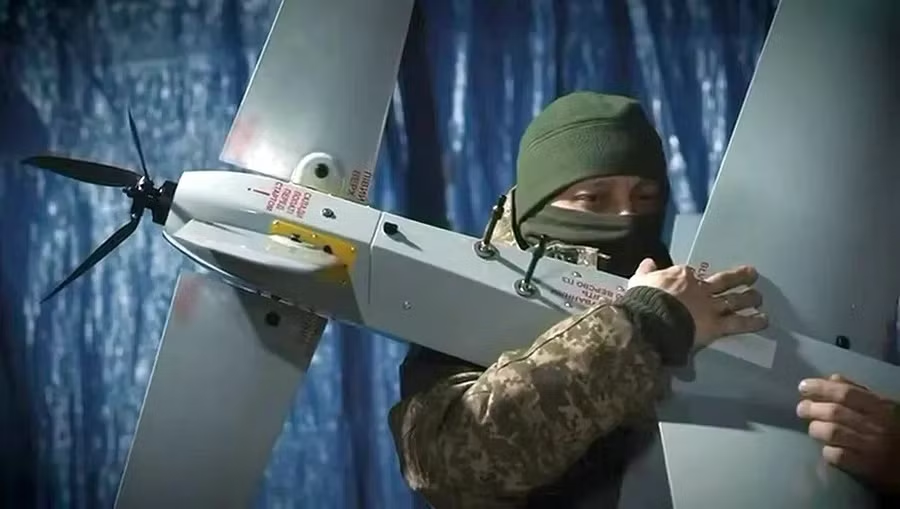
The situation escalated on the night of March 30th, when Russian air defenses shot down a total of 38 Ukrainian UAVs in the area. However, some of these devices managed to penetrate the defenses, causing damage at the port of Ust-Luga, destroying several residential buildings and a school in the village of Molodtsovo, and injuring three people.
Questions arise regarding flight corridors over NATO countries.
Russian military experts have pointed out an anomaly in the ability of Ukrainian UAVs to penetrate deep into the Leningrad region. Theories are focusing on the enemy using the airspace of the Baltic republics, including Latvia, Lithuania, and Estonia, along with Poland and Finland, to conceal their flight paths.
Russia argues that the number of reports of UAVs entering the airspace of these NATO countries is increasing, but there have been no recorded interception attempts by the host countries. This has led Moscow to suspect that some NATO members are directly or indirectly involved in supporting attacks on Russian territory.
Dmitry Peskov emphasized: "If airspace is provided for hostile operations against Russia, this will force us to draw appropriate conclusions and take suitable measures." The Russian military is currently thoroughly analyzing the situation to make high-level recommendations.
The combat capabilities of the FP-1 UAV.
From a technical standpoint, Russian military experts highly appreciate the danger posed by the FP-1 UAVs that Ukraine is operating. These drones have a range of up to 1,200 km, sufficient to reach strategic areas like Leningrad if their flight paths are optimized.
The movement through the Baltic airspace is seen as a tactic to avoid the dense air defense networks at the direct border between Russia and Ukraine. If this hypothesis is correct, it indicates a major shift in the long-range combat methods of Ukrainian forces.
Reactions from the countries involved
In response to accusations from Moscow, the Baltic states' authorities have vehemently denied them. The Latvian Ministry of Defense called Russia's statement a "large-scale information campaign" and asserted that the country had no involvement in any Ukrainian attack plans.
Latvia acknowledged that several UAVs had fallen onto its territory but explained that this was due to navigation errors or interference from Russian electronic warfare systems, causing the drones to deviate from their course. Meanwhile, in Finland, authorities also confirmed that two UAVs had crashed near the city of Kouvola on March 29.
Finnish Prime Minister Petteri Orpo described the incident as very serious. However, Ukraine has sent a formal apology to Helsinki, blaming technical malfunctions in the electronic system that caused the aircraft to stray into Finnish airspace.


