
Russia is building a massive submarine, twice the size of an A380 superjumbo jet.
Russia's new civilian submarine, twice the size of the world's largest commercial aircraft, the Airbus A380, is expected to begin development in 2020.
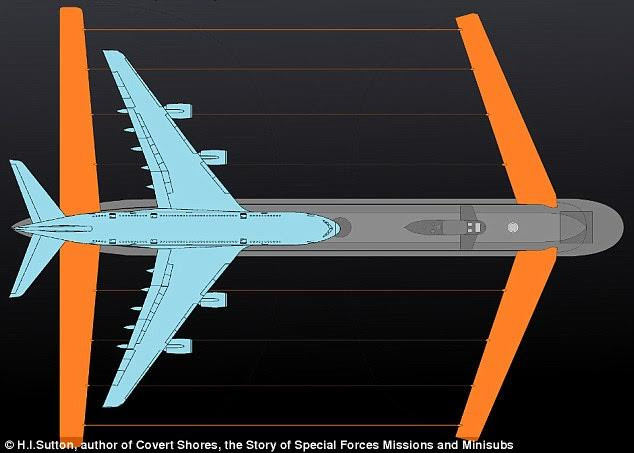 |
| Russia's new submarine is expected to be twice the size of the world's largest commercial aircraft, the A380 (Photo: Dailymail). |
The Russian civilian submarine project is designed to explore the Arctic Circle, search for new natural resource deposits, and conduct underwater scientific research.
With the support of the Rubin Design Bureau, the project will begin in 2020. The new submarine will weigh 13,280 tons, be 14.4m wide and 134m long, have a capacity of 40 people, and be nuclear-powered. This is the world's largest civilian submarine project to date.
The submarine is designed with an active sonar system that uses low-frequency waves to easily penetrate the seabed for ocean surveying. The sonar system is integrated into two wings that can be easily extended and retracted into the sides of the hull. This is also the reason for the submarine's large size.
Equipped with an extremely powerful sonar system, this submarine can capture images of the surrounding ocean from all directions.Popular MechanicsIt can conduct surveys at depths of 400m below sea level and potentially even the seabed. With a wingspan of 100m, the maximum speed the vessel can reach is 12.6 knots (23 km/h). With a capacity of 40 people, the submarine can perform underwater missions continuously for up to 90 days.
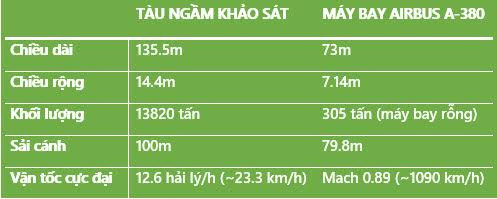 |
| Comparing the specifications of the survey submarine and the Airbus A-380 aircraft. |
The civilian survey submarine will not be equipped with weapons but will have an underwater unmanned submarine launcher located in the torpedo tube position. This will allow researchers to easily access the areas they wish to study.
However, expert HI Sutton argues that there will be many points in the Arctic that submarines cannot access because their wings are too large to navigate when encountering areas with many protruding ice columns.
According to Dan Tri
| RELATED NEWS |
|---|


