
Russia launches 579 missiles and UAVs into Ukraine: Analysis of the scale and effectiveness of air defenses.
Russia launched a large-scale coordinated attack involving Iskander ballistic missiles and hundreds of Shahed UAVs, forcing Ukraine to deploy a multi-layered defense system to intercept them.
Russian forces launched a large-scale air attack targeting critical Ukrainian infrastructure from the night of April 2nd to the early morning of April 3rd. With a total of 579 attack vehicles detected, this was assessed as an attempt to overwhelm the enemy's defenses through a high density of firepower and a diverse combination of ballistic missiles, cruise missiles, and unmanned aerial vehicles (UAVs).
Weapon analysis and attack directions
According to data from the Ukrainian Air Force, this attack involved a diverse arsenal of weapons from various regions. Russian forces launched 10 Iskander-M ballistic missiles from the Kursk and Rostov regions, along with 25 Kh-101 cruise missiles deployed from bombers operating in the Samara region. Additionally, two Iskander-K cruise missiles were also detected in this attack.
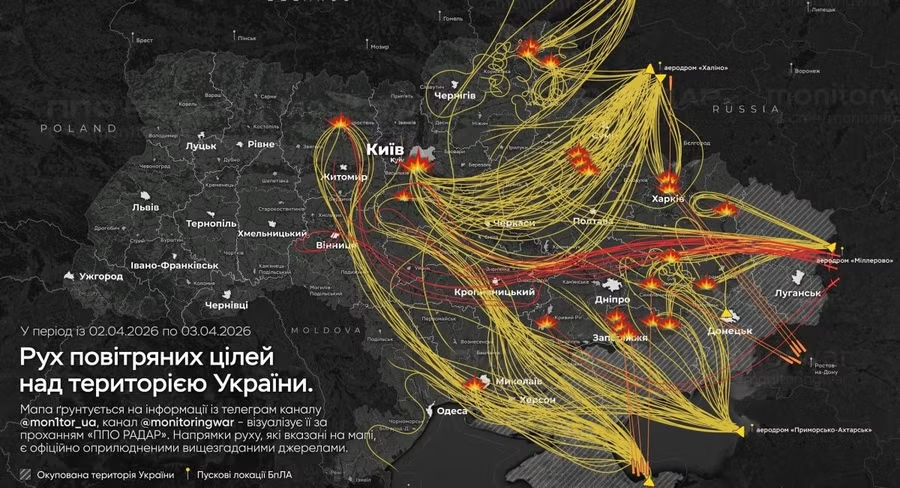
Notably, 542 UAVs were deployed, including the Iranian-designed Shahed-136 and newer variants such as Gerbera and Italma. These new UAVs often served as decoys or technical support to overwhelm existing radar systems. The aircraft were launched from multiple strategic directions including Bryansk, Kursk, Oryol, and Crimea, creating a complex multi-directional attack formation.
Ukraine's multi-layered defense strategy
To counter the intense airstrikes, Ukraine operated a multi-layered defense structure. This network combined fighter aircraft, surface-to-air missile (SAM) units, electronic warfare (EW) systems, and mobile fire groups specifically designed to hunt UAVs. The use of electronic warfare played a key role in deflecting decoy UAVs and minimizing the effectiveness of cruise missiles.
Field results show that Ukraine achieved a high interception rate despite the pressure from a large number of targets. The defense forces successfully neutralized 541 targets, specifically including:
- 24 Kh-101 cruise missiles
- Both Iskander-K cruise missiles
- 515 UAVs of various types
Impacts and damages recorded
Despite optimal interception rates, the overwhelming intensity of Russian firepower still allowed some attack vehicles to penetrate the defenses. Reports confirm that 11 missiles and 27 UAVs struck targets at 20 different locations across Ukraine. In addition, debris from destroyed targets fell in 22 areas, posing a risk to nearby residential areas and infrastructure.
This attack once again confirms Russia's strategy of maintaining continuous fire pressure, forcing Ukraine to expend large amounts of expensive anti-aircraft ammunition to counter low-cost attack vehicles such as decoy drones.


