
Russia tests robot capable of destroying targets up to 10km away.
After achieving success with the Platform-M robot in Syria, Russia continued testing a heavy-duty robot weighing nearly 15 tons.
Heavy-duty robots
According to Sputnik, the Russian Ministry of Defense and its manufacturer have successfully tested Vikhr, a military combat robot capable of autonomously targeting and attacking dangerous targets.
Currently, much information about this robot remains classified by Russia; however, according to some sources, Vikhr is considered one of the world's leading heavy combat robots (both in terms of weight and armament).
According to this source, the Vikhr weighs approximately 14.7 tons and is capable of performing a range of missions such as reconnaissance and attacking ground and air targets, protecting strategic facilities, and minimizing casualties on the battlefield.
The Vikhr has an operational radius of 600km, can travel at a speed of 60km/h on land and 10km/h underwater. In terms of weaponry, the Vikhr is equipped with one 30mm automatic cannon with 500 rounds of ammunition and one 7.62mm machine gun with 2,000 rounds.
And notably, the robot is equipped with up to six Kornet-M missiles – a weapon capable of destroying enemy tanks from distances of up to nearly 10km, as well as helicopters and low-flying fighter jets.
What sets this new combat robot apart from previous Russian-made ones is its ability to automatically detect targets and prepare to attack them. Depending on the target, the Vikhr robot selects the appropriate weapon to fire.
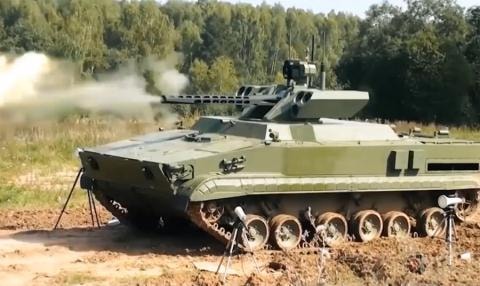 |
| The Vikhr robot fires its weapon during testing. |
He rose to fame in Syria.
Prior to the successful testing of Vikhr, Russia had produced and deployed various types of combat robots, including Platform-M. However, none of these robots had the same weight and weaponry as Vikhr.
Reportedly, in late 2015, the Platform-M robot terrified ISIS militants in Syria's Latakia province. After just 20 minutes of attack by Platform-M, the ISIS fighters fled in disarray, abandoning their weapons and equipment.
On Hill 754.5 in the Latakia mountain region, Syrian soldiers counted 70 militants killed, while the Syrian army suffered no casualties and 4 were slightly wounded.
The Platform-M robot was developed by the Izhevsk Institute of Advanced Scientific and Technological Research and was publicly unveiled for the first time in Kaliningrad during the military parade commemorating the 69th anniversary of Russia's victory in the Great Patriotic War (2014).
The introduction of Platform-M can lead to many effective operations such as intelligence gathering, patrolling, detecting and destroying mobile or stationary targets, contributing to the protection of important strongholds.
According to information released by Russia, Platform-M is compact in size (1.6 m long, 1.2 m wide, and 1.2 m high), weighs between 800 kg and 1 ton, can carry a payload of over 300 kg, travels a distance of 1.5 km at a speed of 12 km/h, and operates continuously for 10 hours.
The Platform-M robot is equipped with combat weapons including a 7.62mm machine gun and a grenade launcher, capable of destroying targets through automatic and semi-automatic control systems, along with the support of electro-optical systems and radio reconnaissance navigation.
In particular, the Platform-M robot's main weapons are four Kornet-M anti-tank missiles, an electro-optical observation system, cameras, etc.
Threat to the US
Following Russia's first successful deployment of combat robots in Syria and its continued testing of new robots, experts believe that the presence of Russian robots on the battlefield will change the landscape of warfare, creating fierce competition with the United States, a country often dubbed the land of military robots.
In contrast to the use of robots for combat support tasks (reconnaissance photography, ensuring military logistics, demining, etc.) as the US has done, for the first time a complete robotic complex system of the Russian army has directly participated in combat.
Recently, at a national security forum in Washington, U.S. Army General Robert Work stated that Russia is investing heavily in building its own army of combat robots with superior capabilities, which would put significant pressure on the Pentagon if it wanted to pursue this path.
"The Chief of the General Staff of the Russian Armed Forces, General Valery Vasilevich Gerasimov, has stated that their military forces are ready for combat using robots. And in the future, many units will switch to using combat robots entirely instead of humans as before," Robert Work said.
Clearly, with systematic and serious investment, Moscow is demonstrating to the US and the West its comprehensive defense capabilities and potential. Russia's military robotic systems, both current and planned for the future, are causing concern in the US.
According to Baodatviet


