
Russia successfully tests RS-28 Sarmat intercontinental ballistic missile.
The Russian military has successfully tested the RS-28 Sarmat, the world's most powerful intercontinental ballistic missile system with a range of 35,000 km and the ability to carry 10 heavy warheads.
The Russian Federation's military has just announced the successful testing of the advanced RS-28 Sarmat intercontinental ballistic missile (ICBM). This is considered one of the most powerful strategic weapons currently available, possessing the ability to penetrate any contemporary or future missile defense system. Russian President Vladimir Putin personally congratulated the military on this achievement, affirming Sarmat's superior position on the world military map.
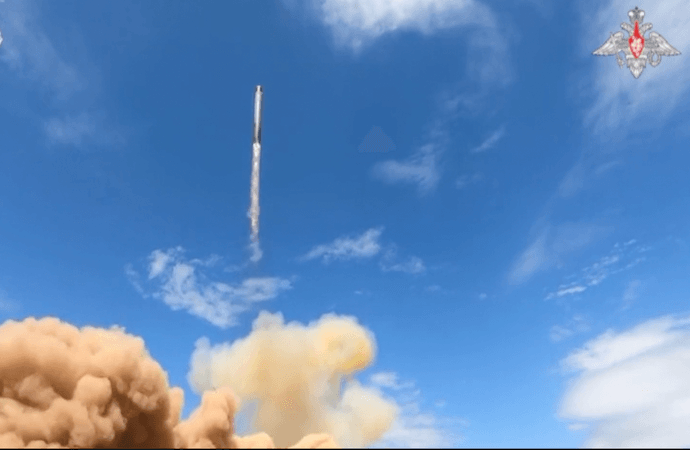
Superior technical specifications and combat capabilities.
According to a report from General Sergey Karakaev, Commander of the Strategic Missile Forces, to the President of the Russian Federation, the RS-28 Sarmat is a heavy liquid-fueled missile. This system was developed to replace the RS-20V Voevoda (NATO designation SS-18 Satan), which currently holds the record for the world's most powerful silo-launched missile.
The published technical data shows that Sarmat boasts impressive specifications compared to its predecessors and Western competitors:
- Range:With a range of over 35,000 km, it allows for attacks on targets at extremely long distances.
- Load capacity:It has the capability to carry four times the payload of any Western missile.
- Warhead:Designed to carry up to 10 heavy warheads with multiple independently targetable re-entry vehicles (MIRV) capability.
- Accuracy:A twofold improvement over its predecessor, the RS-20V Voevoda.
In particular, the Sarmat's onboard electronics and control systems are optimized to ensure "safe penetration" of anti-missile defense (ABM) networks. The missile is also fully compatible with the hypersonic glide vehicle in the Avangard system, allowing the warhead to approach its target in the atmosphere at extremely high speeds and maneuver flexibly to evade interception.
Tactics for penetrating missile defense systems.
One of the most notable tactical features of the RS-28 Sarmat is its ability to approach targets via unexpected routes. The Russian military claims the Sarmat's extremely long range allows it to be launched from Russian territory to targets in the United States via Antarctica. This tactic aims to neutralize the US ABM missile defense system deployed in Alaska, which is primarily designed to intercept missiles flying over the Arctic.
Maintaining strategic balance is the core objective of this program. Moscow stated that the development of Sarmat was a necessary response after the US unilaterally withdrew from the Anti-Ballistic Missile Treaty in 2022 under President George W. Bush. According to the Russian leadership, the country was forced to consider ensuring strategic security in a new geopolitical reality.
Deployment plans and future weapon systems
Based on successful test results, the Russian Federation's military plans to begin equipping the first missile regiment with the RS-28 Sarmat system before the end of this year. This is a significant step in the modernization of the country's strategic nuclear forces.
Besides Sarmat, the Russian Federation is also accelerating the completion of two other advanced weapon systems: the Burevestnik cruise missile with unlimited range and the Poseidon underwater drone. Both systems utilize miniaturized nuclear reactor technology, marking a new step forward in modern defense technology.
The successful testing of the RS-28 Sarmat not only affirms the technical capabilities of the Russian defense industry but also sends a strong message about strategic deterrence in the context of a volatile international security landscape.


