
Russia deploys tank and drone tactics to reduce battlefield losses.
The Russian Ministry of Defense and Rostec Corporation have announced a new combat method using drones to coordinate tanks, increasing their survivability against FPV drones.
The Russian Ministry of Defense and the state-owned defense corporation Rostec have just announced a new set of combat tactics for armored units. The key to this change is the close coordination between armored vehicles and unmanned aerial vehicle (drones) systems to counter threats from precision weapons and first-person view (FPV) drones on the modern battlefield.
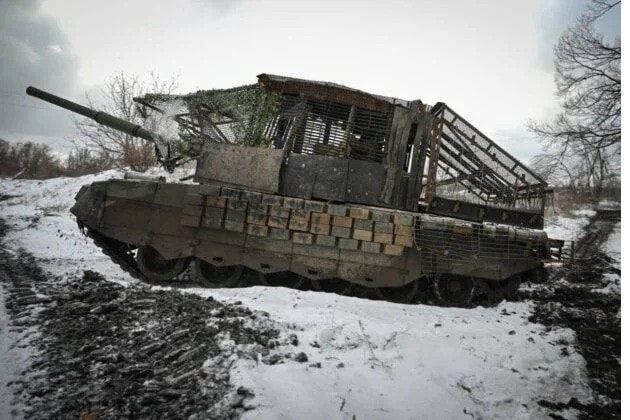
Pair combat tactics and the coordinating role of drones
According to the Russian Ministry of Defense, frontline units are currently employing a paired combat method. In this method, one tank maintains a remote firing position, out of direct line of fire, while the second tank performs rapid maneuvers to advance toward the front line. Coordination between the two vehicles is achieved via a drone.
Drones play a crucial role in target reconnaissance, fire control, and enhancing real-time situational awareness. This adjustment aims to minimize the tank's exposure to enemy attacks while maintaining the pace of offensive operations.
Rapid maneuvering is the primary form of protection.
Updated Russian doctrine mandates that tank crews must change positions constantly and rapidly. Mobility is now considered a primary form of protection, rather than relying solely on armor. In addition, improvements in engineering techniques and strict discipline in the maneuvering cycle are incorporated into the new guidelines to minimize losses.
Vision for tanks in integrated combat systems.
Rostec Corporation asserts that tanks remain the primary breakthrough force on the battlefield, despite the rapid development of new destructive vehicles. However, the company emphasizes that the effectiveness of future armored formations will depend not only on the characteristics of a single vehicle but also on the level of system integration.
Specifically, the armored "fists" need to be synchronized with:
- Automated command and control system.
- Diverse classes of drones and ground robots.
- Artillery and air defense systems.
- Electronic warfare and engineering forces.
This integration allows for the suppression of anti-tank threats from a distance before the tank enters the active offensive phase.
Transition and technical upgrade platforms
Currently, Russia is incorporating real-world combat experience into the production and upgrading of its main battle tank lines. Models such asT-90M Proryv,T-80BVMupgrade andT-72B3MModernization is seen as a crucial foundation for the transition.
Rostec stated that the protection packages and equipment systems on these vehicles have been upgraded in a timely manner to meet the stringent requirements of the modern battlefield, ensuring high survivability against a variety of anti-tank weapons, including FPV drones.


