
Russia deploys Oreshnik hypersonic missiles to attack infrastructure in Lviv.
The attack on Lviv on January 8th marked the second time the Oreshnik system was used, reaching speeds of 13,000 km/h and targeting fortified targets deep underground.
At 00:47 Moscow time on January 8, 2026, a series of powerful explosions occurred in Lviv, Ukraine. The attack was carried out by ballistic missiles from the Kapustin Yar test range, shaking the region amid widespread air raid alerts.
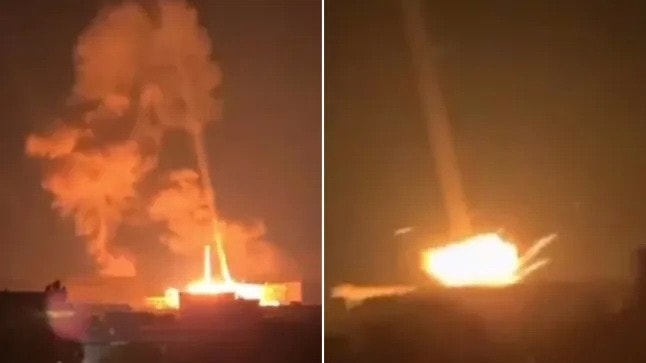
The Ukrainian side believes this is a non-nuclear version of the Oreshnik missile system. Maksym Kozytskyi, head of the Lviv Special Operations Command, confirmed that a critical infrastructure facility was hit. Videos recorded at the scene show the object hurtling down at extremely high speed, creating a strong flash in the sky.
Oreshnik's technical specifications and combat capabilities.
According to a report from the Western Air Command of the Ukrainian Armed Forces, the target was traveling on a ballistic trajectory at an estimated speed of approximately 13,000 km/h (approximately Mach 10.5). At this speed, the missile would only take about 10 minutes to fly from Astrakhan to western Ukraine.
Notably, Ukraine's air defense system detected the target but was unable to intercept it due to technical reasons. Military experts believe that the plasma shell formed around the hypersonic mass as it moved through the atmosphere is a distinguishing feature of this system, which is thought to be a variant of the RS-26 Rubezh medium-range ballistic missile.
Mechanism for penetrating fortified targets
In terms of destructive power, the Oreshnik operates similarly to a massive kinetic energy penetrator. Due to its supersonic speed and large mass, the missile generates tremendous energy upon contact with solid material. The sudden deceleration and deformation create a plasma stream and metallic jet capable of penetrating even the most robust underground structures.
Experts from a Russian military channel explain that this type of weapon is designed to destroy targets deep underground, where conventional reinforcement measures are no longer effective. The main energy of the projectile is focused on penetration rather than creating a large-scale surface explosion.
Impact on energy infrastructure
Although the specific target has not been disclosed in detail, military sources believe the attack may have targeted the Bilche-Volytsko-Uherske underground gas facility. This is a strategic storage facility with a capacity of 17 billion cubic meters, equivalent to more than 50% of Ukraine's total gas reserves.
This is the second time the Oreshnik system has been recorded in combat. Currently, technical experts in Ukraine are working to recover fragments from the Lviv site for further analysis of the structure and performance of this hypersonic projectile.


