
Nghe An: Thousands of garbage collection bins placed in rice fields.
(Baonghean) - The entire province has 14 districts, cities, and towns with 66 communes implementing the collection and treatment of pesticide waste with thousands of waste bins.
Dien Thinh commune (Dien Chau district) is one of the key vegetable production communes with a total area of over 430 hectares. October is the time when farmers focus on caring for winter crops, including cauliflower, kohlrabi, cabbage, sweet cabbage, mustard greens, Hanoi cabbage, etc., and often use pesticides to protect crops from pests and diseases.
However, upon observation, we noticed that the fields were quite clean, with no more discarded pesticide bottles and packaging like in some other places. Ms. Nguyen Thi Thu, from Hamlet 6, who was tending to her vegetables, said: "This was possible because the commune placed trash cans and disseminated information to the people on how to dispose of pesticide bottles and packaging properly, thus reducing waste in the fields."
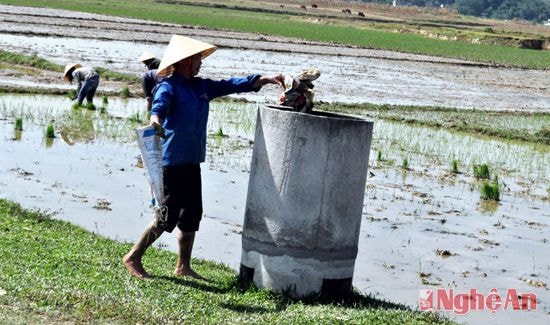 |
| Residents of Thanh Lien commune (Thanh Chuong district) collect garbage in the fields. |
The waste bins in the fields were installed by the People's Committee of Dien Thinh commune starting in 2014. The Farmers' Association advised the commune to allocate funds and combine this with social mobilization to install waste bins in the fields, with 3 bins placed in each hamlet.
Monthly and quarterly, the Women's Association of the commune will directly collect and process the waste.
According to Mr. Cao Hieu, Chairman of the People's Committee of Dien Thinh commune: This approach has proven effective, initially forming the habit of disposing of pesticide waste in the designated places. In the coming time, the commune will continue to direct the installation of more bins through a socialized model.
In Thanh Lien commune (Thanh Chuong district), the collection and processing of pesticide packaging and bottles was implemented earlier, starting in 2012.
Quarterly, the commune assigns the Youth Union to organize the collection and removal of leftover waste in the fields and transport it to areas far from residential areas for incineration. To date, waste and pesticides in the fields have been significantly reduced, contributing to the protection of the rural environment. This is an important foundation for the commune to fulfill the environmental criteria along with other criteria of the new rural development program, and to prepare to receive the Certificate of Recognition for achieving the new rural development standard at the end of this year.
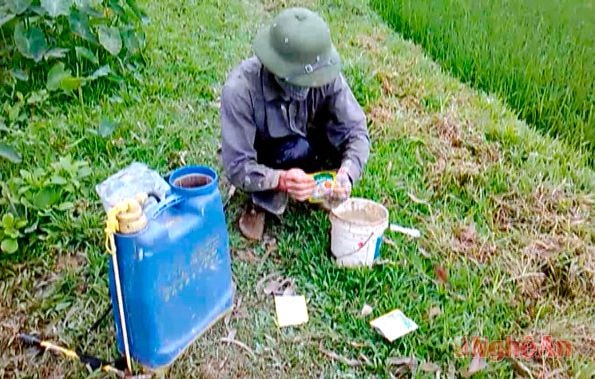 |
| Empty pesticide packaging is scattered haphazardly on the edges of rice fields in Hung Nguyen. |
According to a report from the Provincial Plant Protection Department, as of now, 14 districts, cities, and towns across the province, encompassing 66 communes, have implemented the collection and disposal of pesticide waste, using thousands of waste bins. In the localities where this has been implemented, farmers have initially developed the habit of disposing of waste properly after mixing pesticides for spraying crops. Simultaneously, this helps to address pesticide residue in the fields, contributing to the reduction of environmental pollution.
However, during periods of high pest infestation, collecting waste from just one or two key agricultural production communes is sufficient; the remaining waste must be stored or incinerated by local authorities due to a lack of funds for proper disposal. Of the 66 communes implementing the collection and disposal of pesticide waste, 33 follow the prescribed procedures, while the remaining 33 collect and dispose of the waste by incineration.
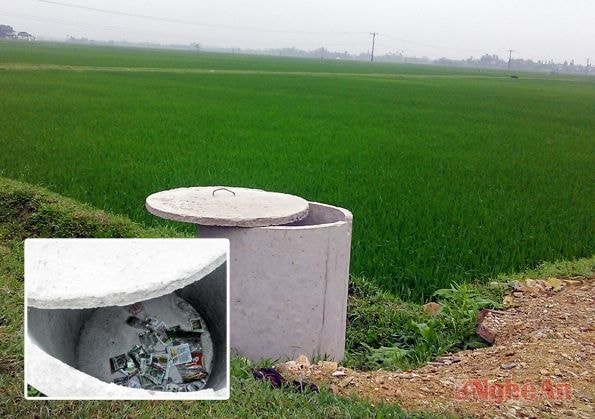 |
| Cement tanks for collecting pesticide packaging are being placed in the fields in Hung Nguyen. |
Given this reality, in addition to relying on provincial budgets, localities also need to allocate their own budgets and strongly promote social mobilization to limit environmental degradation in rural areas.
Currently, there is no funding available to implement the collection, transportation, and processing of pesticide packaging on a large scale according to proper technical procedures. Therefore, guidance is needed for localities to implement and apply a method to effectively address environmental pollution caused by pesticide packaging, ensuring both clean fields and sustainable environmental protection.
Mai Hoa
| RELATED NEWS |
|---|


