
Nghe An: Unlocking resources for building new rural areas.
With a total mobilized capital of over 66,000 billion VND during the 2021-2025 period, Nghe An has not only created a revolution in infrastructure but also formed exemplary new rural models with distinctive characteristics. From cement support policies to positive movements from local authorities, resources have been unlocked to build rural transportation and irrigation systems to serve agricultural production.
Deliverinformation Go before...
These days, the streets of Phuc Loc commune are bustling with the atmosphere of mobilization.building new rural roads, dredging irrigation canals. This momentum in Phuc Loc was created by the unity of the people and the government, demonstrated through voluntary contributions of tens of millions of dong per household.
Nguyen Van The, head of Hamlet 23, proudly boasted: "This alley used to be nearly 1 meter lower than the main road, and it would flood every time it rained. Now, each household has decided to contribute 10 million VND to raise the road level and build a covered drainage ditch, ensuring better drainage and safety and hygiene."
.jpg)
Hamlet 23 in Phuc Loc commune was formerly Hamlet 5 of the old Nghi Cong Bac commune. To raise the road level by nearly 1 meter and reinforce it, in addition to the cement provided, each household needed to contribute an extra 10 million VND. However, among the 9 households living on both sides of the road, 2 households were in particularly difficult circumstances, so the hamlet agreed to only accept 6 million VND in contributions and provide loans from other households. “The villagers shared with the needy families by contributing money to lend to them so the hamlet could build the road first; the families would repay it when they were able. Some households with children working abroad also contributed more, so the road was completed ahead of schedule,” Mr. The said.
Mr. The added that from the beginning of 2025 until now, the hamlet has received 160 tons of cement from the State for road construction. They will receive another 80 tons soon, and the people will strive to complete the concrete paving of 100% of the hamlet's alleys according to the standards of the new rural model.
With strong support from the people and the government's cement provision, rural infrastructure projects in Phuc Loc are being implemented to high standards, not only aesthetically pleasing but also sustainable. Hamlet 23 (302 households, 1,133 inhabitants) has registered to build 12 roads, of which 8 have been completed. Each typical road is built with a width of 4m and a length of 260m, with 18cm thick concrete and a covered drainage system along both sides, helping to maintain hygiene, widen the road, and prevent odors or flooding into houses.
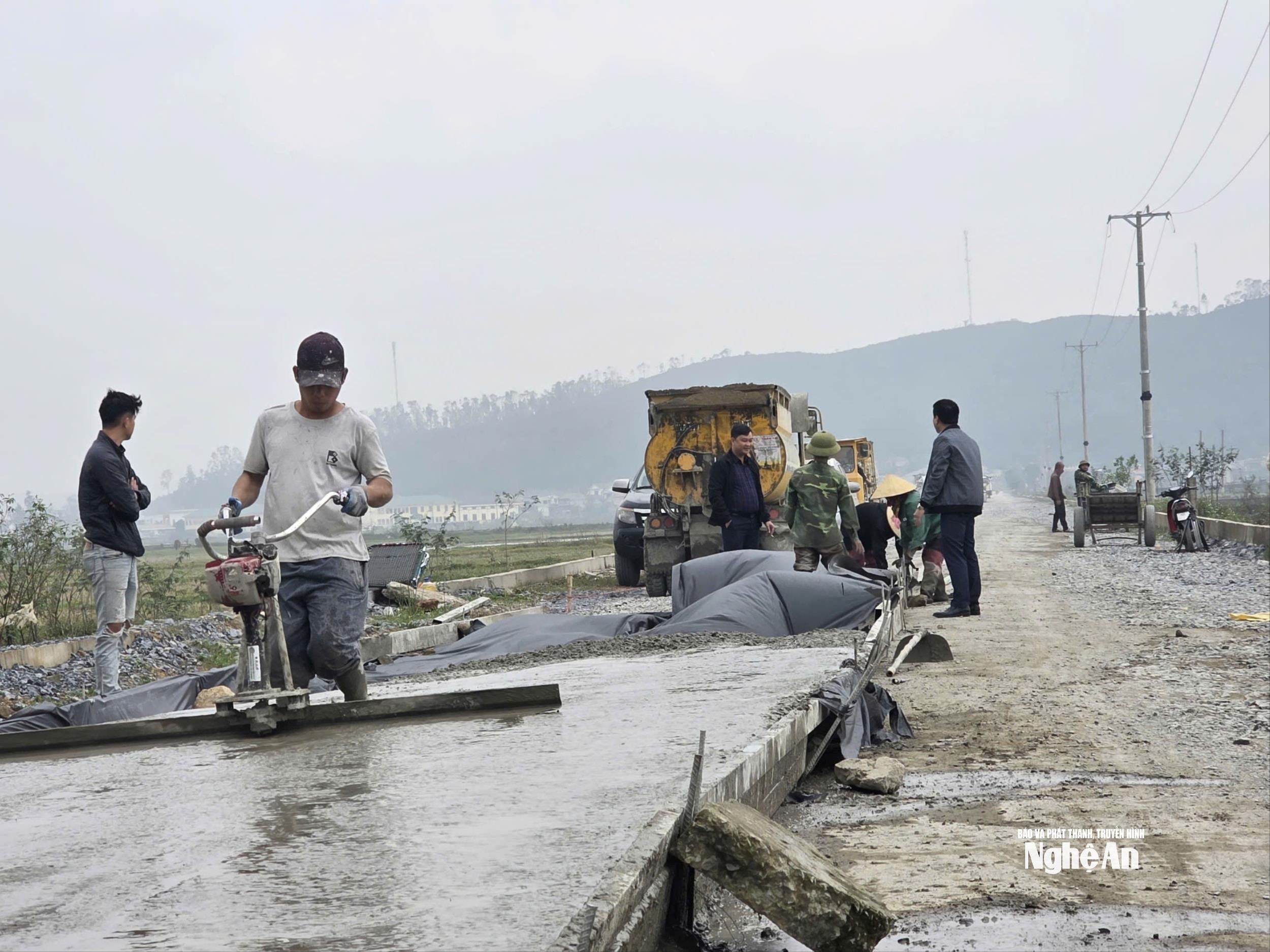
In 2025, Phuc Loc commune had 27 out of 32 hamlets registered to build new rural roads with cement provided by the State, and labor and other materials donated by the people. Many households voluntarily contributed large sums of money.
For example, in Hamlet 23, some households contributed over 10-15 million VND. For complex projects, such as building drainage ditches in the middle of the road and widening both sides, the cost could reach 13 million VND per household, but the people were always ready to support and contribute labor to ensure the construction proceeded according to plan. The hamlet and neighborhood officials were among the first to contribute to these initiatives.
Mr. Nguyen Phu Dong, Head of the Economic Department of the People's Committee of Phuc Loc Commune, said: From the beginning of the year until now, Phuc Loc Commune has had 27 hamlets registered to build new rural roads. Currently, 12 hamlets have completed the project. Three out of four communes in Phuc Loc before the merger achieved advanced new rural standards by the end of 2024. This is a solid foundation for Phuc Loc to strive to achieve advanced new rural standards by 2026 and model new rural standards by 2028.
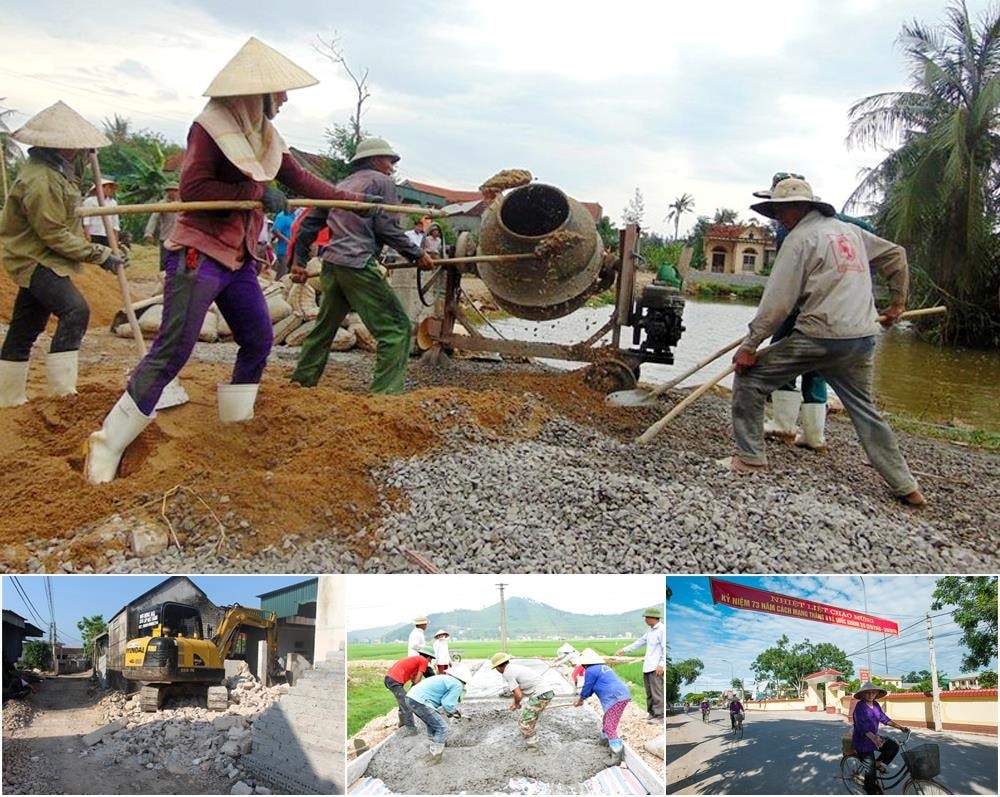
Meanwhile, Yen Thanh commune is affirming its position as a "rice granary" undergoing a strong transformation towards advanced new rural development. Yen Thanh focuses on regional planning linked to the development of processing industries and high-tech agriculture. Yen Thanh's breakthrough demonstrates a strategic vision in connecting rural and urban areas, where economic infrastructure is inseparable from the goal of environmental protection and preserving the unique agricultural ecosystem. Investment in electricity and irrigation systems has created a solid foundation for agricultural projects in the locality.
The enthusiastic efforts in rural road and irrigation construction in localities show that the new rural development program is not just about achieving targets, but also about building a self-reliant and united community. Along with road construction, localities have launched campaigns to improve irrigation, linked to the movement to build advanced and model new rural areas. These efforts focus on strengthening drought, flood, and waterlogging prevention and environmental sanitation, with the motto of efficiency, practicality, and cost-effectiveness. These tasks aim to clean canals and strengthen the system before the peak water intake period for the 2026 spring crop.
Night destroy from main book support assistancecementbamboo shoots
Looking at the picture of new rural development in Nghe An province during the 2021-2025 period, the brightest highlight is the breakthrough in transportation infrastructure. According to Mr. Nguyen Van Hang, Deputy Head of the Provincial Department of Cooperative Economics and Rural Development: Instead of choosing a completely "subsidized" approach, the province has implemented a flexible and effective policy of supporting cement for rural road construction in accordance with Resolution 24/2020/NQ-HĐND. This is considered an extremely successful "catalyst" policy, activating the internal strength from the grassroots level.
By the end of 2025, the province had supplied over 571,000 tons of cement, equivalent to paving approximately 2,436 km of roads with concrete. In addition, localities mobilized public participation and integrated matching funds to complete over 3,001 km of transportation infrastructure. The total funds mobilized for this sector alone reached over 3,308 billion VND. Thousands of billions of VND in cash, along with tens of thousands of man-days and square meters of land donated, speak volumes about the consensus among the people of Nghe An in building new rural areas over the past period.
.jpg)
This policy not only solves the transportation problem but also provides a "boost" to change the face of rural areas. The roads are not only wider and smoother but are also equipped with lighting systems and greenery, following the "bright - green - clean - beautiful" model. Even more importantly, when the State gives the people the "fishing rod"—cement—they readily contribute the "fish"—money, labor, and land—to build their homeland. Thanks to improved transportation, the face of rural areas is constantly changing, creating momentum for socio-economic development.
In Nam Dan, the pilot project to build a model new rural district focusing on "cultural development linked with tourism" for the period 2018-2025 has truly borne fruit. The rural areas of Nam Dan now not only have solid infrastructure but also many model new rural gardens. They are no longer simply agricultural production areas but have become eco-tourism destinations, contributing to sustainable income improvement for the people through services and experiences.
.jpg)
The key factor that enabled Nghe An to mobilize over 66.154 billion VND – a record figure amidst a volatile economic environment – was the positive shift in the capital structure, with credit capital accounting for 73.1% (over 48,000 billion VND). The participation of socio-political organizations such as the Women's Union with its "5 No's, 3 Cleanliness" model, the Farmers' Association with its "New Rural Standard Garden" movement, and the Youth Union with its "Lighting Up Rural Roads" initiative, created a strong foundation of public support. No longer relying on the central government budget (which only accounted for about 3.2%), the people of Nghe An truly took ownership of the program.
The period 2021-2025 is a crucial stepping stone for Nghe An to move towards the 2026-2035 cycle with a new mindset. Despite remaining planning bottlenecks in mountainous communes and pressure on the supply of materials, Nghe An is shifting from building new rural areas to improving the quality of life in rural regions, moving from quantity to quality.


