
Nghe An province repeatedly discovers food products of unknown origin.
From the beginning of 2025 until now, the Market Management Department, in coordination with other functional forces, has continuously detected and handled many cases related to food of unknown origin, showing signs of spoilage, and posing a serious risk to consumer health.
Repeated seizures of food of unknown origin.
According to representatives of the Market Management Department, from the beginning of 2025 until now, the unit has coordinated with relevant agencies to continuously seize many cases of contaminated food and food of unknown origin. These contaminated foods mainly include meat and animal offal, poultry, such as buffalo, beef, and pork meat, intestines, and tripe, as well as eggs and chicken intestines.
During the inspection, these food items were found to be frozen and lacked documentation proving their origin. Many of them had a foul odor and were spoiled or moldy.
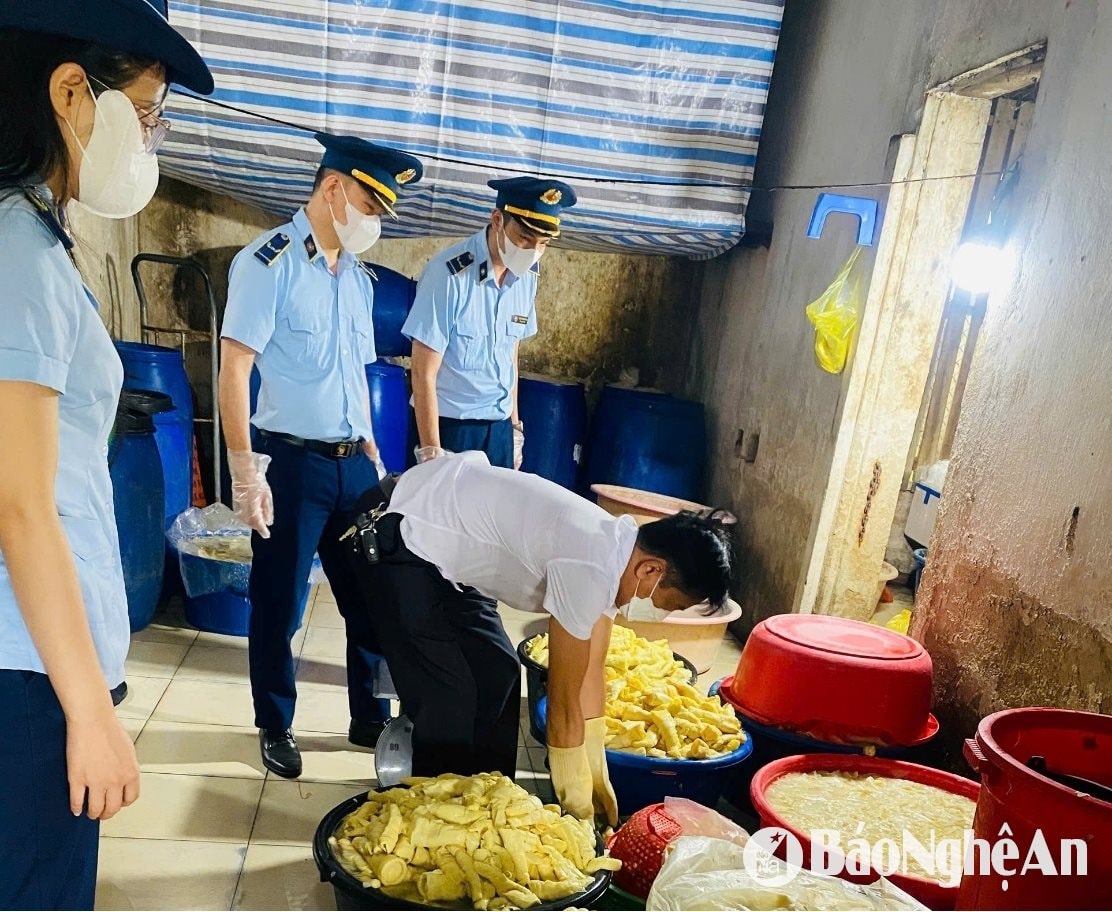
For example, on May 13, 2025, Market Management Team No. 3 conducted a surprise inspection of a fresh bamboo shoot processing and trading facility in Quang Trung Ward, Vinh City, owned by Mr. Le Duc S. During the inspection, authorities discovered 600 kg of pre-processed bamboo shoots without any invoices or documents proving their origin. The owner could not produce any legal documents related to the shipment. Market Management Team No. 3 issued an administrative fine of 12 million VND and organized the destruction of all the infringing bamboo shoots in accordance with the law.
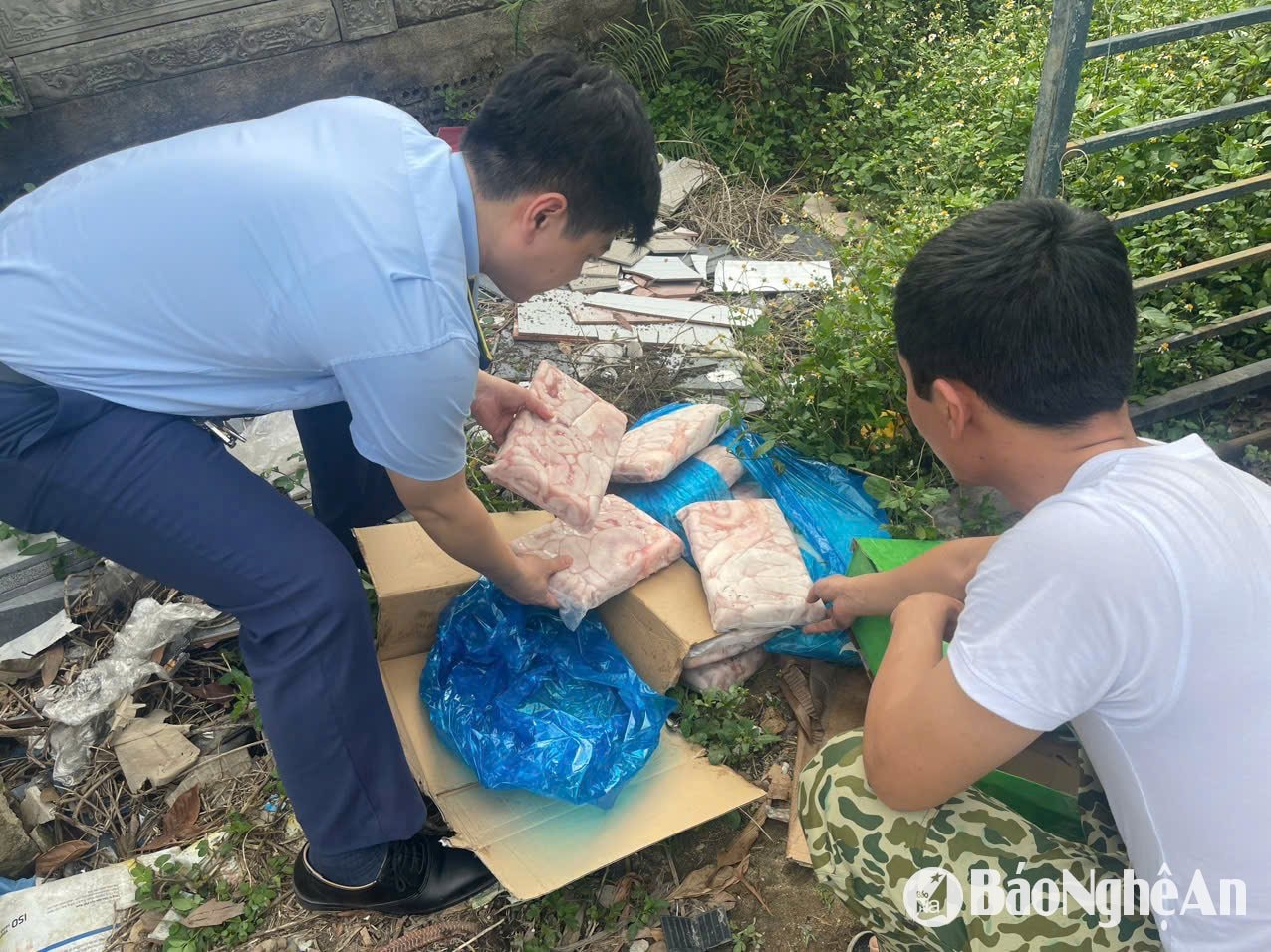
Also on May 13th, Market Management Team No. 3, in coordination with other functional forces, conducted a surprise inspection of NK Clean Food Import-Export Company Limited in Hung Dong Ward, Vinh City, managed by Mr. Tran Ngoc T. During the inspection, the team discovered the company was trading 350 kg of frozen chicken feet and 125 kg of frozen pig tails of unknown origin and without valid invoices or documents. Authorities fined the company 34 million VND and confiscated the entire consignment for further processing according to regulations.
On May 13th, Team 11 of the Market Management Department, in coordination with the Economic Police Department of Nghe An province, inspected a THACO truck with license plate 74C-xxx driven by Mr. Tran Quoc Tuan (residing in Hue City). During the inspection at Cua Tien urban area, Vinh Tan ward, Vinh City, authorities discovered the truck unloading 3 tons of smuggled yellow granulated sugar under the brand name BURIRAM SUGAR (Thailand), in 50 kg bags, with an estimated total value of approximately 45 million VND. The sugar lacked Vietnamese labels and valid invoices or documents, and was identified as smuggled goods and confiscated.
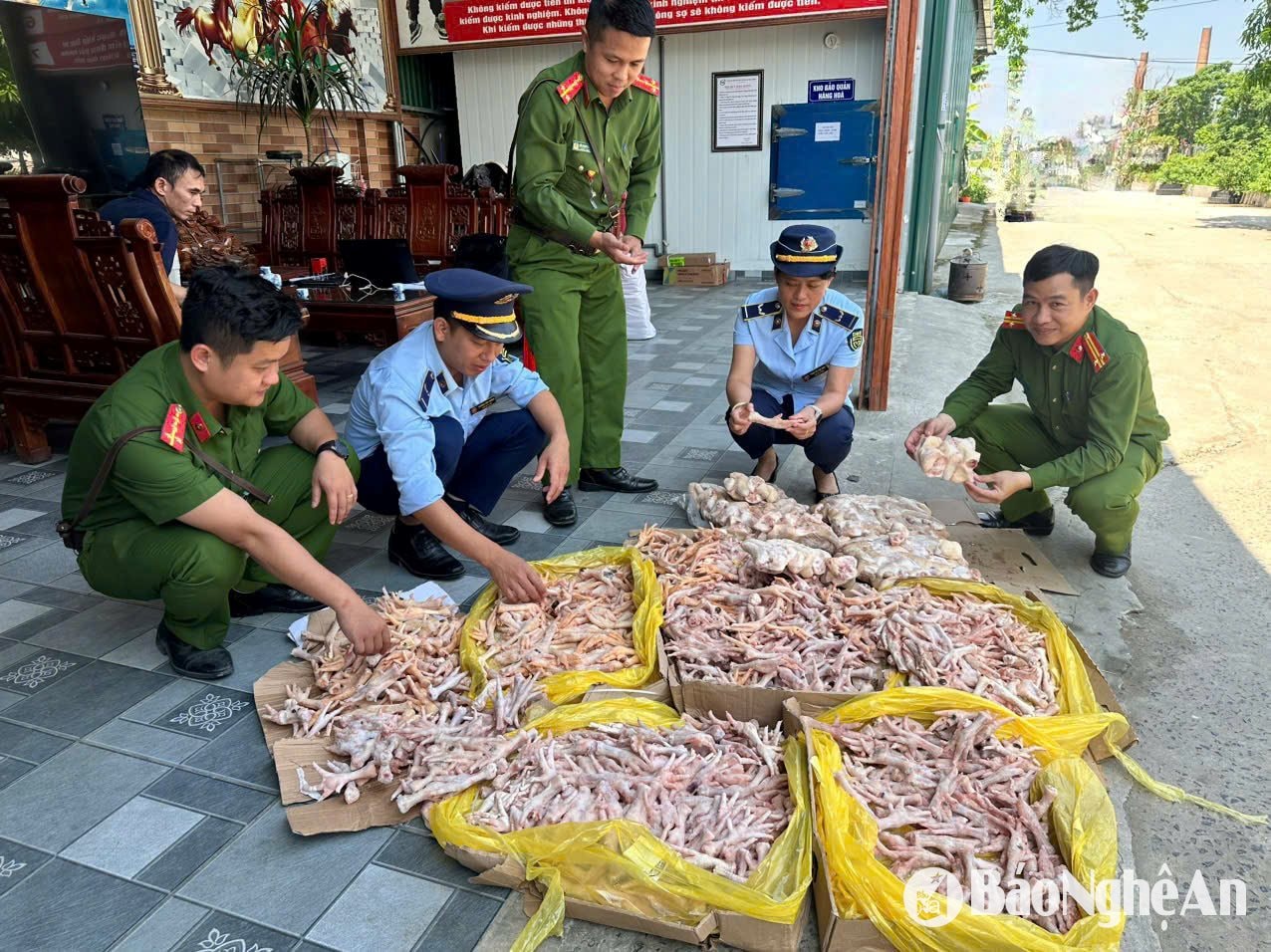
Previously, over two days (April 21st and 22nd, 2025), Market Management Team No. 3 discovered and handled two violations related to unsafe food in Vinh City. Nearly 1 ton of food, including pork sausage and frozen chicken, without clear origin, was destroyed, with total fines amounting to nearly 60 million VND.
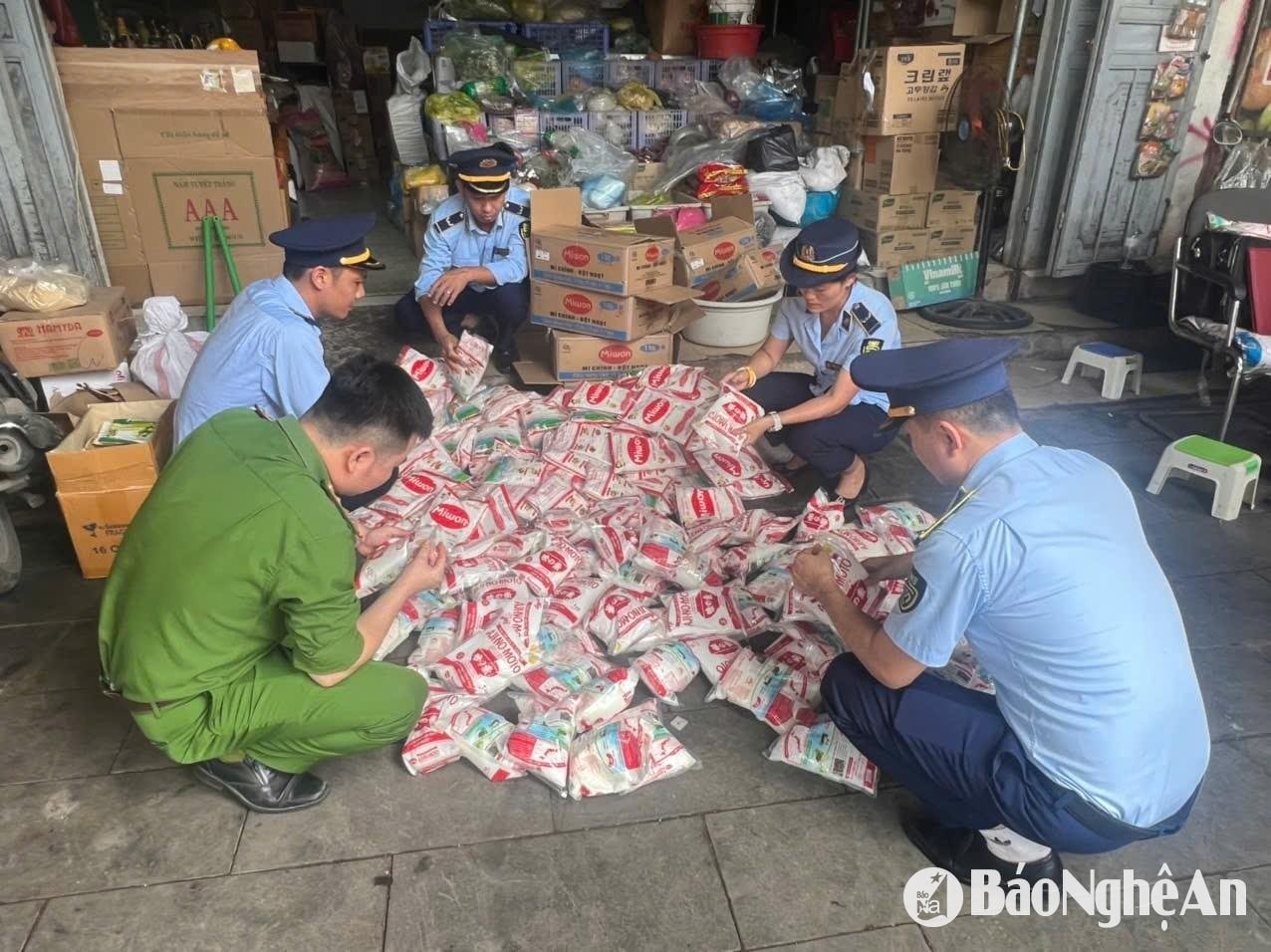
Subsequently, on April 29, 2025, Market Management Team No. 3, in coordination with other functional forces, conducted an inspection of the business establishment D.TH, located in the West Vinh Market area, Vinh Tan Ward, Vinh City.
During the inspection, authorities discovered that the establishment was selling 174 packages of 1 kg MSG bearing the MIWON and AJINOMOTO brands, which showed signs of being counterfeit, along with 350 kg of MSG of unknown origin. The total weight of all the goods was over 500 kg.
Market Management Team No. 3 has temporarily seized the entire consignment of infringing goods and is continuing to verify and clarify the matter for handling according to the law.
Previously, authorities in Nghe An province discovered a bean sprout production facility using banned chemicals. The seized items included nearly 2,000 containers of bean sprouts, weighing approximately 25 tons in total, along with 25 liters of a chemical solution containing 6-Benzylaminopurine (6-BAP) – a growth stimulant banned in food production – and 150 liters of the prepared solution. According to authorities, 6-Benzylaminopurine (6-BAP) can cause pulmonary fibrosis, endocrine disorders, and a risk of death with long-term use.
Say no to contaminated or unverified food.
The recent repeated seizures of contaminated food by authorities have caused considerable public concern. If not detected and dealt with promptly, these batches of food of unknown origin could have secretly infiltrated local markets, restaurants, and eateries in Nghe An province, and even reached consumers through online sales channels.
With the rapid development of online sales channels and social media, food is becoming a widely traded commodity without any inspection. A few simple online searches using keywords like "pork udder for sale," "young chicken intestines," "boneless chicken feet," "pork offal," etc., can yield hundreds of results from various vendors. Worryingly, most online sellers only advertise their food as "fresh," "newly produced," or "homemade," but completely lack any documentation proving its origin, quality, or food safety.
In reality, most of these food products have been frozen, poorly packaged, and do not meet storage standards when they reach consumers. According to a representative of the Market Management Department, from the beginning of 2025 to the present, authorities have detected and handled more than 46 cases of trading in food of unknown origin, imposing administrative fines exceeding 245 million VND.
Mr. Nguyen Hong Phong, Deputy Head of the Market Management Department of Nghe An province, stated: “Violations of food safety regulations remain widespread. The main reasons are poor awareness of and compliance with the law, and declining business ethics. Many people involved in production, transportation, storage, and processing are willing to violate the law, disregarding public life and health for the sake of profit.”
Alarmingly, a significant portion of consumers still don't genuinely care about their own and their family's health. They are easily attracted by visually appealing and cheap food without considering its quality. Taking advantage of this mentality, many individuals have smuggled goods into the country, exacerbating the problem of unsafe food. Meanwhile, social media platforms have become fertile ground for this trade, allowing free advertising without requiring verification of product origin.
To prevent and mitigate food safety risks, in addition to raising awareness among producers, businesses, and consumers, strong and coordinated action from all levels and functional agencies is needed. Strict control at border crossings, increased inspections and checks, and severe penalties for violations are urgent requirements.
People also need to proactively say no to unsafe food, and at the same time, uphold the spirit of fighting and bravely reporting establishments that violate food safety regulations. Only when the whole society joins hands can the fight against unsafe food achieve real and lasting results.


