
The job of 'carrying' drums in Thanh Chuong
(Baonghean.vn) - Although it doesn't form a distinct craft village, the drum-making profession in Thanh Van commune (Thanh Chuong district, Nghe An province) has developed significantly over the years.
Along National Highway 46B, passing through Rang market town in Thanh Van commune, Thanh Chuong district, it's easy to spot the drum-making workshops of some members of the Phan family. They're easily recognizable by the bustling activity of the crafting process and the resounding sounds of various types of drums being tested by both owners and customers before purchase.
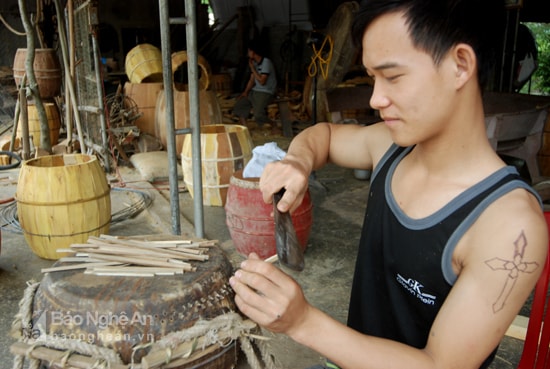 |
| "Bưng" is a technical term in drum-making, referring to the technique of stretching and covering the drumhead. This is one of the most complex techniques in the process of making a drum. Photo: Dinh Ha |
Mr. Phan Van Cu, owner of the largest drum workshop in Thanh Van, proudly stated: "This is a family tradition passed down from Hung Tay commune, Hung Nguyen district, for 11 generations. My family mainly produces drums based on orders. In the past, our ancestors only sold drums locally. Back then, technology was lacking, and it took a whole month to complete one drum. Now, many stages are supported by machinery, so it's much faster. We can complete a standard drum every day. Our drums are now sold to customers all over the country."
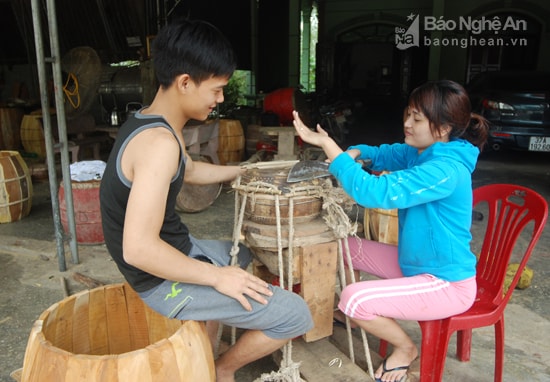 |
| Nowadays, women can also participate in drum making. Photo: Dinh Ha |
Currently, a drum costs around 3 million VND, but at one point, Mr. Cu received an order for a large drum priced at nearly 100 million VND. This drum was commissioned by a customer in Hanoi and had the following dimensions: drumhead diameter 1.6m, height 2.1m, drum body circumference 6.2m…
Mr. Cu said: "That drum is bigger than both the drum at Quang Trung Temple on Quyet Mountain and the drum at the Temple of Literature in Hanoi. It might be one of the largest drums in Northern Vietnam at this time. Lifting the drum onto the truck required a crane and over 10 people to assist."
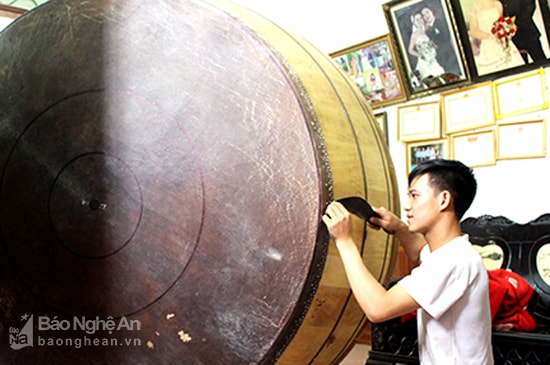 |
| Mr. Phan Van Dung, son of Mr. Cu, is putting the finishing touches on a massive drum measuring 2.1 meters in height and 6.2 meters in circumference. Photo: Dinh Ha |
Technically, according to Mr. Cu, there are four crucial steps in creating a good drum. First, the wood and buffalo/cowhide for the drumhead. The wood must be entirely jackfruit wood, and the buffalo/cowhide must be purchased fresh locally without any processing. After obtaining good materials, the next step is shaping the wood into regular elliptical strips. Next is attaching the drumhead (covering and sealing the drum), and finally, adding the hoops and decorations. Each step has its own secret techniques; without understanding them, the finished drum may have flaws such as a dull or distorted sound.
Thanks to their reputation, the workshops of Mr. Cu, Mr. Ngu, Mr. Tu, and others are overwhelmed with work; each workshop regularly employs 5-7 workers, and at the end of the year or when there are large drum orders, they may hire up to 15 workers. Previously, hired workers were assigned specific tasks and would leave as soon as the job was finished for fear of losing their skills. But now, many young people have learned the drum-making craft and are boldly opening their own workshops.
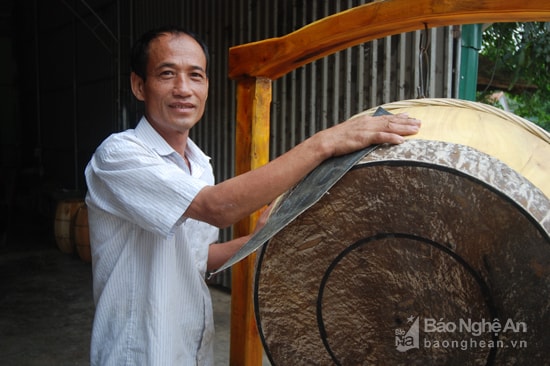 |
| Mr. Phan Van Cu is putting the finishing touches on a drum before it leaves the workshop. Photo: Dinh Ha |
In these drum-making workshops, the average worker is paid between 200,000 and 300,000 VND per day, with skilled workers earning up to 400,000 VND. After deducting material and labor costs, each workshop earns an average of tens of millions of VND per month. Thanks to this, in addition to ensuring a decent livelihood for their employees, the drum-making workshop owners also have a substantial income, allowing them to build multi-story houses...
With economic development and increased attention to cultural and spiritual needs, the drum-making profession is seeing opportunities for expansion. Starting with the drum workshops of the Phan brothers in Thanh Van commune, it is believed that more drum-making establishments will emerge, enriching the profession and contributing to society.
Tran Dinh Ha


