
The art of turning weakness into strength in the Vietnamese Navy.
(Baonghean.vn) - On August 2nd and 5th, 1964, the Vietnamese Navy successfully drove the US destroyer Madoxx out of the Gulf of Tonkin, coordinating with other forces to shoot down 8 aircraft, and for the first time captured an American pilot alive, contributing to the glorious tradition of "winning the first battle" of the Vietnam People's Army in general and the Vietnam People's Navy in particular.
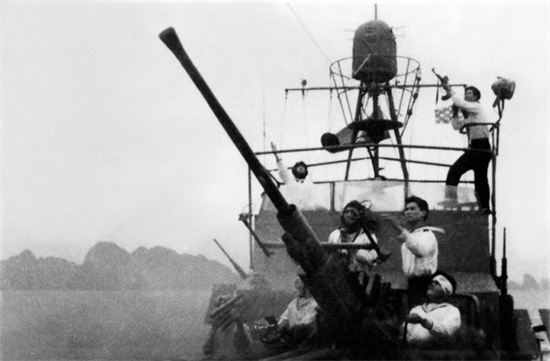 |
Vietnamese Navy soldiers repelled American aircraft (Photo courtesy of tapchiqptd.vn). |
By 1964, the situation for the US and its South Vietnamese allies in the South was increasingly precarious. The "Special War" strategy had essentially failed and faced the risk of complete bankruptcy. In light of this, the White House believed that bolder actions were necessary, including expanding the bombing campaign against North Vietnam to weaken the North and establish it as part of the "Special War."
To achieve this goal, on the one hand, the US promoted "Operation 34A" to spy on North Vietnam, abduct North Vietnamese citizens to extract intelligence, and organize and use commandos for sabotage. On the other hand, it intensified reconnaissance patrols by US warships in the Gulf of Tonkin to project power and gather intelligence on North Vietnam's coastal defenses. From there, the US took further steps, creating a pretext according to a pre-prepared scenario, to justify attacks on North Vietnam.
On August 2, 1964, the American destroyer USS Maddox approached the coast of Thanh Hoa (about 6 nautical miles from the shore) and launched a bombardment, aiming to provoke, lure, and create a pretext. However, our Navy bravely repelled them from our waters, preventing the Americans from achieving their goal.
To create a strong psychological impact on Congress and the American public, and to cause "an international crisis," "a challenge to the honor of America," on the night of August 4, 1964, the American destroyers USS Maddox and USS Turner Gioi deliberately opened fire and signaled an attack, fabricating the "Gulf of Tonkin incident" with the false claim that their destroyers were "unprovoked" by the North Vietnamese Navy for a second time while operating normally in international waters.
On August 5, 1964, US President Johnson unexpectedly mobilized 64 aircraft for a massive bombing campaign against North Vietnam, marking the beginning of a large-scale war of destruction against the North.
Thanks to prior preparation and a high level of vigilance, the armed forces and people of North Vietnam inflicted significant blows on the enemy. In the first confrontation with the US Air Force, the North Vietnamese army and people shot down 8 jet aircraft, damaged 3 others, and captured one pilot; the enemy's casualties reached 12%.
This victory is the culmination of the qualities, intelligence, and traditional strength of the Vietnamese people against invading enemies, with many lessons learned about the art of organizing people's warfare and the art of air defense combat - the art of turning weakness into strength.
The decisive factor in the first victory on the air defense front for the North Vietnamese army and people was the building of determination, initiative, and resolute determination to defeat the US Air Force when they violated North Vietnamese airspace. This was the first time our people had to confront a new type of warfare, with the US Air Force – modern supersonic jet aircraft – as the target of combat, which had a significant impact on the thoughts and psychology of the entire population.
In that situation, our Party, led by President Ho Chi Minh, mobilized the entire Party, the entire people, and the entire army to overcome all difficulties, uphold the spirit of revolutionary vigilance, and resolutely defeat the enemy when they recklessly violated the airspace of the North.
On March 27, 1964, President Ho Chi Minh convened a special political conference. At this conference, he called upon the entire nation and army to uphold their fighting spirit, ready to crush all provocative and destructive actions of the American imperialists; and ready to sacrifice for the benefit of the Fatherland, the people, and the national revolutionary cause.
With the high spirit and determination of a nation with a glorious tradition of fighting foreign invaders, immediately after President Ho Chi Minh's encouragement, all levels, sectors, forces, and localities, from construction sites and factories to rural and urban areas, were determined to defeat the American imperialists, protect the North, and liberate the South.
In that spirit, despite the unexpected launch of the "Operation Pierce Arrow" by the US, our radar systems promptly detected enemy aircraft formations in each direction and notified air defense, naval, and militia units to retaliate fiercely and achieve resounding victories.
In the battle of August 5, 1964, we not only successfully carried out our combat mission, shooting down many enemy aircraft, but our forces also ensured transportation, assisted in the evacuation and protection of the people, organized production and daily life well, and were ready to engage in a protracted struggle with the US.
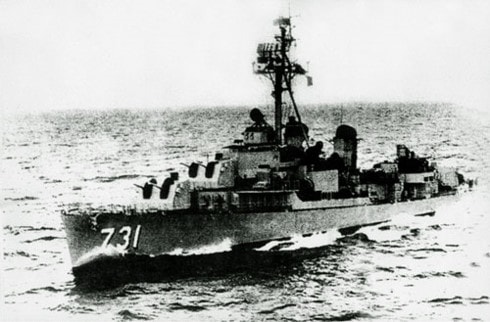 |
| The destroyer Maddox was chased away by a Vietnamese Navy torpedo boat on August 2, 1964 (Photo courtesy of VOV). |
In addition to building determination and proactively and resolutely defeating the US Air Force when they violated the airspace of North Vietnam, based on an analysis and assessment of the revolutionary situation in both the South and the North, and with a strategic vision, as early as 1963, the Central Military Commission developed and approved the Plan for the Defense of North Vietnam and the Wartime Mobilization Plan.
Subsequently, as the threat of an air attack on North Vietnam became increasingly apparent, the General Staff organized the first People's Air Defense Conference (January 1964); issued a combat readiness alert for air defense forces (March 1964) and a combat readiness alert for all armed forces in North Vietnam (June 1964).
This was the wise direction of the Central Military Commission; the necessary and timely preparation of the armed forces and the entire population, aimed at building a people's air defense posture and a people's war posture on a continuous and solid anti-aircraft front to counter the enemy's new combat methods. Accordingly, the three-branch air defense system was deployed and built extensively, concentrating on key locations in cities, industrial zones, airports, seaports, and major infrastructure projects.
Simultaneously, people's air defense forces were established in localities; patrols and defenses in coastal areas, border regions, and along the western border were strengthened. Air defense drills, alerts, medical assistance, and firefighting were organized rigorously and regularly. The national air defense forces upgraded their combat readiness and intensified training.
In particular, a network for shooting down low-flying aircraft was formed throughout North Vietnam with 2,500 militia units secretly ambushing aircraft in key areas and locations where the enemy could easily infiltrate. Thanks to this strong, widespread, deep, and focused people's air defense system, the army and people of North Vietnam won the air attack right from the first battle.
Although the enemy launched surprise attacks on numerous targets in widely separated areas, our army and people intercepted them everywhere, forming a multi-layered, multi-range air defense network. It can be said that our air defense network was deployed everywhere, on land, on rivers, and at sea.
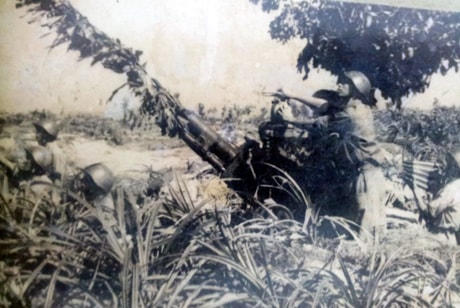 |
| Air defense troops return fire against US air and naval forces in August 1964. (Photo courtesy of hocvienpkkq.com) |
The remarkable aspect of our air defense strategy in the battle of August 5, 1964, was that even without modern air defense weapons and equipment, or even the participation of missile and air force units, we were able to maintain control of the battle situation and push the enemy into a passive and unexpected position with this unique strategy.
Despite the enemy's relentless attacks, high-altitude aircraft were met with fierce counterattacks, while low-altitude aircraft were intercepted from multiple directions. Their maneuvers and flanking maneuvers were met with ambushes and destruction by the people's air defense network. A prime example is the incident on the afternoon of August 5, 1964, at the Hon Gai battlefield (Quang Ninh province), where a 12.7mm anti-aircraft machine gun crew of the People's Militia intercepted and shot down a jet aircraft, capturing the American pilot. This was something the Americans could not have foreseen.
The unique aspect of the art of winning the first battle by the army and people of North Vietnam was also reflected in the close coordination between the three branches of the air defense forces and the People's Navy, the People's Armed Police, and other forces; and the coordination between local combat forces and mobile forces engaging the enemy.
This was clearly demonstrated when the enemy attacked seaports such as Gianh (Quang Binh), Cua Hoi (Nghe An), and Lach Truong (Thanh Hoa). Our naval forces proactively maneuvered on rivers and at sea to intercept the enemy from afar; coordinating with air defense troops and militia on shore to create a dense network of fire. Thanks to this, at Cua Lach Truong, after only 30 minutes of fighting, we shot down two American aircraft. This was a major surprise to the US regarding the spirit and strength of the Vietnamese People's War.
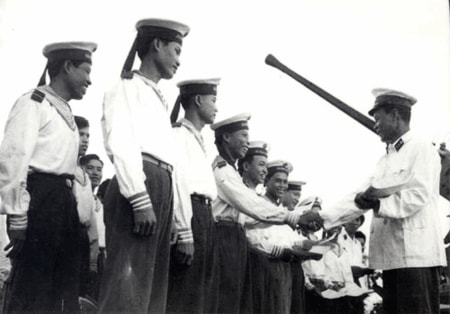 |
| Leaders of the Naval Command presented awards to collectives and individuals who distinguished themselves in the victories of the first battles on August 2nd and 5th, 1964. (Archival photo) |
The battles of August 2nd and 5th, 1964, marked the beginning of a glorious chapter in the history of the Vietnamese People's Navy's combat and victories, contributing to inspiring the entire Party, army, and people in the North and the South to compete in fighting the enemy and achieving meritorious deeds, determined to win national independence and reunification of the country.
Building upon the indomitable spirit of its initial victory, for over 50 years of development, combat, and growth, the Vietnam People's Navy has consistently upheld its pivotal role, along with other forces, in effectively preventing plots and actions that encroach upon and violate the sovereignty of the nation's seas, islands, and continental shelf. It has gradually built a comprehensive defense system encompassing the sea, islands, and coast, ensuring a strong and proactive defense of national sovereignty.
Hoa Le
(Synthetic)
| RELATED NEWS |
|---|


