
Obama's captivating art of public speaking.
US President Barack Obama is considered a master of public speaking because he knows how to repeat himself deliberately, pause at the right time, and combine it with specific, confident language.
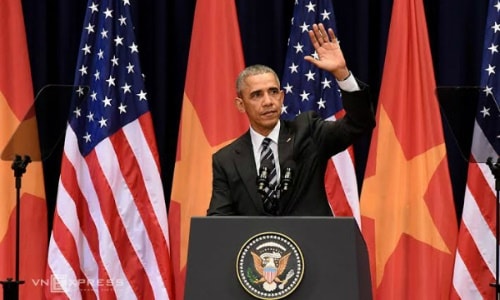 |
President Obama said "hello" in Vietnamese during his speech to 2,000 intellectuals and businesspeople at the National Convention Center yesterday morning. Photo: Giang Huy |
Yesterday morning, US President Obama delivered a speech to 2,000 Vietnamese intellectuals and businesspeople at the National Convention Center. After listening to him speak for 30 minutes, everyone in the audience stood up and applauded continuously, expressing their delight and admiration for the knowledge and excellent presentation skills of the White House occupant.
The US President has made full use of Vietnamese poetry in his speeches on bilateral relations, from proverbs and verses composed hundreds of years ago to songs by the late musician Trinh Cong Son or Van Cao.
He quoted the heroic verses from Ly Thuong Kiet's "Nam Quoc Son Ha" to speak about Vietnam's sovereignty in history, and quoted Nguyen Du's "Truyen Kieu" when discussing relations between the two countries. Each time US President Obama quoted poetry, the Vietnamese and foreign audience applauded continuously.
Tran Khanh, K10 student, Business Administration, FPT University,He said that what he admired most about Obama was his understanding of Vietnamese history, mentioning historical figures such as Ly Thuong Kiet, the Trung Sisters, and famous people like Nguyen Du and General Vo Nguyen Giap, something that not many young people like him can do.
Mai Thu Hang, studentThe Department of International Politics and Diplomacy at the Diplomatic Academy was particularly impressed by the friendly demeanor and warm, deep voice of the US President.
Clearly, President Obama's speech resonated deeply and left a lasting impression on many Vietnamese people. This is understandable, as Obama has long been known as an excellent orator.
These are Vietnamese poems and songs that Mr. Obama quoted.
Outstanding Speaker
Telegraph writer Alan Tovey argues that possessing the qualities of an outstanding speaker was not the sole reason Obama became president, but it was an extremely important factor.
According to Carmine Gallo, author of several bestselling books on the art of public speaking, the reason President Obama's speeches resonate with audiences is because he skillfully employs three key public speaking techniques.
"By using concrete and tangible language, President Barack Obama can transport us to another world, while simultaneously painting a picture in our minds," Gallo commented.
In his victory speech on November 7, 2012, he mentioned his supporters and campaigners in very specific detail.
"You'll hear the determination in the voice of the young backstage organizer, who has always strived since his college days and wants every child to have an equal opportunity. You'll hear the pride in the voice of the volunteer girl who regularly goes door-to-door because her younger brother finally got a job at the local auto factory that just added a new shift. You'll feel the deep patriotism in the voice of the soldier who stays up late every night on the phone to make sure that no one who ever forgot their country has to worry about a job or a home when they return from the battlefield," President Obama said, his voice filled with emotion.
According to Gallo, the reason many speakers today fail to connect with their audience is because they lack sufficient specificity in their language. "Nobody cares when you claim you're offering 'the best solution for a cloud-based ecosystem.' Audiences need specificity, relatable examples, and direct answers to their questions," he emphasized. And President Obama did that well.
The deliberate repetition of a sentence or phrase to draw attention is also a notable skill that President Obama used relatively flexibly, Gallo observed.
Obama used the "repetition" technique very effectively in his speech at the Democratic National Convention in 2004.
"We have a lot of work to do. A lot of work to do for the workers I met in Galesburg, Illinois," he said. "A lot of work to do for the fathers..." or "A lot of work to do for the women...".
"I believe we can support the middle class," "I believe we can create jobs," "I believe we have a strong headwind behind us..."
The examples above also show that President Obama liked to group pieces supporting an idea into sets of three. According to Gallo, three is "a powerful number and just the right number to remember."
Professor David McNeill from the University of Michigan, USA, who studies hand gestures, found that confident, disciplined, and well-structured speakers tend to use their hands more than usual when speaking.
Decisive hand gestures reflect the speaker's coherent thinking and instill greater confidence in the audience regarding their delivery. President Obama, like many excellent speakers, uses gestures to emphasize almost every word, Gallo noted.
The way he modulates his voice is also very effective. The US President knows where to slow down, where to lower his voice, and when to pause to make the maximum impression. But at times, he also speeds up his speech and increases the volume to highlight an important sentence.
According to Richard Newman,According to a public speaking skills trainer from the UK company Body Talk, Mr. Obama is a master at using "pauses".
The U.S. president pauses to allow the audience to catch up. He pauses to let his words resonate. He pauses, in a way, to give the listeners a moment to rest. Pausing at the right places is also a way for the president to show the audience his composure and prudence, writes speech consultant Sims Wyeth on CBS News.
Another factor contributing to the success of President Obama's speeches is his ability to place the audience at the center of the story. For example, in his first address to a joint session of Congress, Obama referred to "our story" before discussing "his own," Wyeth noted.
In his speech yesterday in Hanoi, President Obama made it clear to the audience that Vietnam was central to the stories and issues he shared throughout the half-hour session. Concluding his speech with the line from Nguyen Du's *The Tale of Kieu*, "That a hundred years also begin from here. Let this small token of trust serve as a memento," President Obama impressed and moved the audience, while also demonstrating his deep interest in and respect for the culture and history of the Vietnamese people, according to observers.
According to VNE
| RELATED NEWS |
|---|


