
Thinking from those perfect-score report cards.
A status update on a parent forum is attracting diverse comments: “At the end of the semester, I read the teacher's message in the class group that 38 out of 40 students achieved the title of Excellent Student, and only 2 students achieved the title of Good Student. Why are there so many excellent and good students these days? Looking at their electronic report cards, all the grades are incredibly high, 9s and 10s. Are our children really that good students, or is it…?”
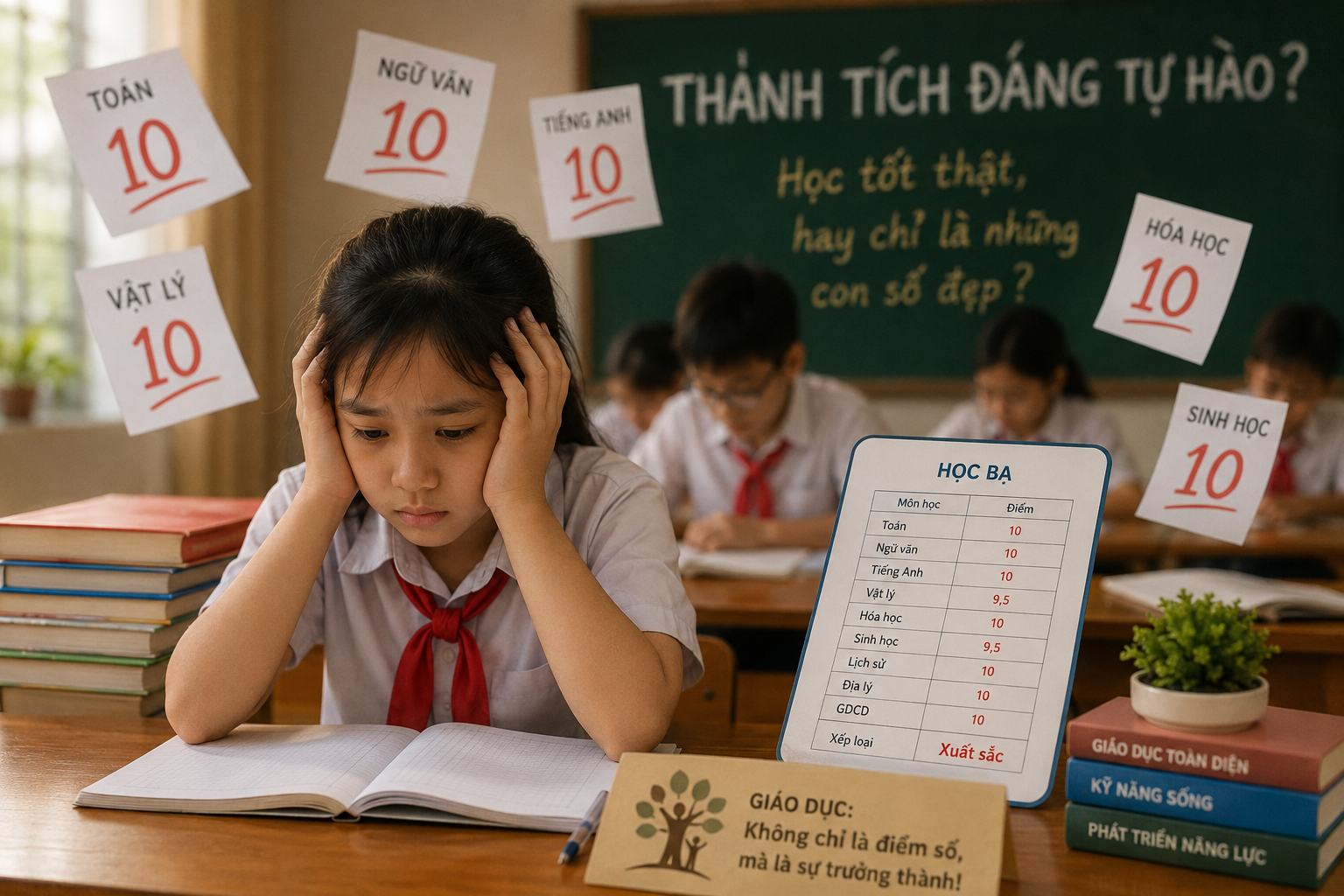
The unanswered question at the end of that status update actually resonated with many parents today. Many admit that they are happy when their children get high grades, but when they look around, they realize that almost every class is full of high-achieving students, every school is teeming with excellent students, and grades of 9 and 10 have become commonplace. To the point that sometimes, a few 7s or 8s appearing in the report card cause parents to worry and students to feel stressed and anxious, seeing it as a sign of being significantly weaker than their classmates or peers.
Report cards with near-perfect scores surprise many who experienced the education system of a few decades ago. In the past, achieving the title of "good" or "excellent" student required a truly dedicated effort. Only a few students stood out in a class. Getting an 8 in Math or a 9 in Literature was something students would remember for a long time, feeling elated and proud because it was the result of serious study and rigorous, strict assessments. Now, however, looking at their children's high scores is gratifying, but it leaves them with little peace of mind due to concerns about the quality of education and the feeling that assessment standards are becoming increasingly lax.

Since when and why have grades of 9 and 10 become so common? First, it must be acknowledged that children's learning conditions are much better than before. Children have early access to knowledge, the internet, foreign languages, and countless modern learning tools. Many parents invest almost all of their time, finances, and expectations in their children's education. Students today also face much greater competitive pressure than previous generations. Therefore, the rise in the average grade is understandable.
However, simply explaining it through improvements in learning conditions is insufficient. In reality, in many places, achieving high grades has gradually become a "collective goal" for schools, teachers, and parents alike. Student achievement is linked to competitive performance, the pressure to maintain the school's "brand image," and parents' expectation that their children "don't want to be inferior to anyone." When so many expectations are placed on test results, isn't it inevitable that student evaluation will tend towards leniency, rounding off scores, or prioritizing safe, aesthetically pleasing results?

On another level, the way society views education also contributes to this "flood of perfect scores." For a long time, we have been accustomed to evaluating children more by academic achievement than other values. A student with high grades is always more easily praised, recognized, and admired than a student with good life skills but average academic performance. Many parents readily accept their children lacking communication skills or real-world experience, but find it very difficult to accept a report card with a few low grades. This mentality of valuing diplomas and the glitter of titles has inadvertently pushed parents, students, and teachers alike into a long-running race for achievement.
In reality, many parents understand very well that a report card full of 9s and 10s doesn't necessarily fully reflect their child's true abilities. They also know that there's a significant gap between being an "excellent student" on paper and their actual academic and professional capabilities in real life. However, despite understanding this, most parents still can't stay out of this "race" because behind those academic titles are many doors of opportunity in the future. Many specialized schools now use report cards as a preliminary selection criterion, requiring students to have achieved the "Excellent" title for many consecutive years. Some universities also include high school academic performance as a criterion in their admissions process. When these "tickets" to opportunity are still measured by impressive grades, parents are forced to strive to ensure their children don't fall behind in a competition that the education system itself has, to some extent, created.

Therefore, it will be difficult to simply urge parents to change their mindset and reduce the pressure of grades on their children, while many educational institutions still heavily rely on academic transcripts for selection and evaluation. To reduce the "flood of perfect scores" and return to focusing on actual academic results, we must first change the mindset of educational management and the way society uses grades as a screening tool. If academic titles no longer carry so much "transferable" value, then naturally, the pressure to achieve perfect report cards will gradually subside.
What is even more concerning is that in this race, students are becoming the ones bearing the most direct and heavy pressure. While in the past, a good student could be confident in their abilities, today, amidst report cards filled with 9s and 10s, many children live in a state of constant anxiety to avoid falling behind. A 7 is sometimes no longer seen as a normal result for a subject, but easily becomes a disappointment for parents, a source of self-doubt for students, and a feeling of inferiority to their peers. Many students study under prolonged pressure, fearing low grades, fearing comparisons, and fearing they are not good enough. Meanwhile, what education should aim for is not creating perfect report cards, but helping students recognize their true abilities and strengths, learn independently, live a balanced life, and mature as upright individuals.
To restore the true value of grades in school reports, changes from multiple perspectives are needed. First, the education sector needs to review its value frameworks and evaluation criteria. Teachers shouldn't be forced to chase after unrealistic performance targets. Let teachers evaluate their students fairly, valuing genuine 5s and 6s more than inflated 9s and 10s. Parents also need to be more discerning; a perfect report card isn't a guarantee of happiness and success for their children. Listen to what your child truly enjoys and where their strengths lie, and nurture those talents, instead of forcing them to achieve 9s and 10s to please you. We need to teach children that grades are only one aspect; knowledge and character are what will stay with them throughout their lives. A 7 or 8 earned through independent thinking and a passion for learning is infinitely more valuable than a perfect 10 that's borrowed or misrepresented.


