
Premier League replaces PSR: 85% revenue cap from 2026-27.
Clubs will adopt a Squad Expense Ratio: spending a maximum of 85% of revenue from the 2026-27 season; exceeding the red threshold of 115% will result in immediate point deductions, replacing the PSR system which calculates losses for three years.
The Premier League will officially abolish the Squad Cost Ratio (PSR) from the 2026-27 season, switching to the Squad Cost Ratio (SCR) rule with a spending cap of 85% of football-related revenue. Exceeding the 85% green limit will result in fines; exceeding the maximum 115% red limit will result in immediate point deductions for the season, ending the slow enforcement of penalties that disrupted the competition.

At the London shareholders' meeting, three proposals were put forward: Top-to-bottom anchoring, Squad Cost Ratio (SCR), and Sustainability and System Resilience (SSR). The voting results were: anchoring received only seven votes in favor, 12 against, and one abstention; SCR was approved with 14 votes in favor and six against (Bournemouth, Brighton & Hove Albion, Brentford, Crystal Palace, Fulham, Leeds); and SSR was approved with unanimous consent. To change the rules, a minimum of 14 out of 20 clubs need to agree.
What is SCR and how is it applied?
SCR assesses expenses over a single season (unlike PSR which calculates over three years), excluding revenue from player sales from expenditures but adding the net profit/loss from player sales to the revenue figure, averaged over three seasons – similar to how UEFA applies it – in order to avoid “patching up” with sudden, unexpected transfers.
Items included in the SCR (Supply Chain Recognition) include: player and head coach salaries, agent fees, and depreciation/amortization of transfer fees. Expenses for women's teams and academies continue to be excluded. Compliance checks take place on March 1st each year; if the squad cost ratio is ≤ 85%, the club meets the standard. Exceeding 85% will result in a final account verification check at the end of the season.
How is it different from UEFA?
UEFA imposes a 70% cap on football-related revenue, while the Premier League sets a limit of 85%. Therefore, the nine clubs participating in European competitions this season are still subject to UEFA's 70% cap, while the majority of the remaining teams have more financial flexibility domestically.
Green Threshold, Red Threshold and Feedback Loop
The Green Threshold is 85%. The Red Threshold is up to 30% higher – meaning 115% in the 2026-27 season. Clubs can exceed 85% without incurring sporting sanctions if they do not exceed 115%.
The Feedback Loop adjusts the Red Threshold for the following season based on compliance levels: if the club exceeds the Green Threshold, the Red Threshold decreases accordingly; if compliant, the Red Threshold gradually increases again (up to a maximum of 115%). For example: achieving SCR = 100% in the 2026-27 season (exceeding by 15%) causes the Red Threshold for the 2027-28 season to decrease to 100%; if compliant in the 2027-28 season (≤ 85%), the Red Threshold for the 2028-29 season increases to 110%, and another compliant season will bring it back to 115% in 2029-30.
Penalty: Fine or point deduction
Exceeding the Green but not the Red threshold → a fine will be imposed. The fine is calculated based on the estimated excess amount as of March 1st or the actual end-of-season result (whichever is lower), multiplied by the percentage exceeded. For example: SCR = 90% (exceeding by 5%), excess spending is £10 million → fine 5% × 10 million = £500,000. Note: The fine will not be applied for the 2026-27 season despite the violation, but the Red Threshold will still be reduced for the following season.
Exceeding the Red Threshold threshold results in an immediate points deduction: a minimum of 6 points, plus an additional 1 point for every £6.5 million spent exceeding the threshold. This approach differs from PSR's, which emphasizes immediate penalties to prevent disputes from dragging on into the next season.
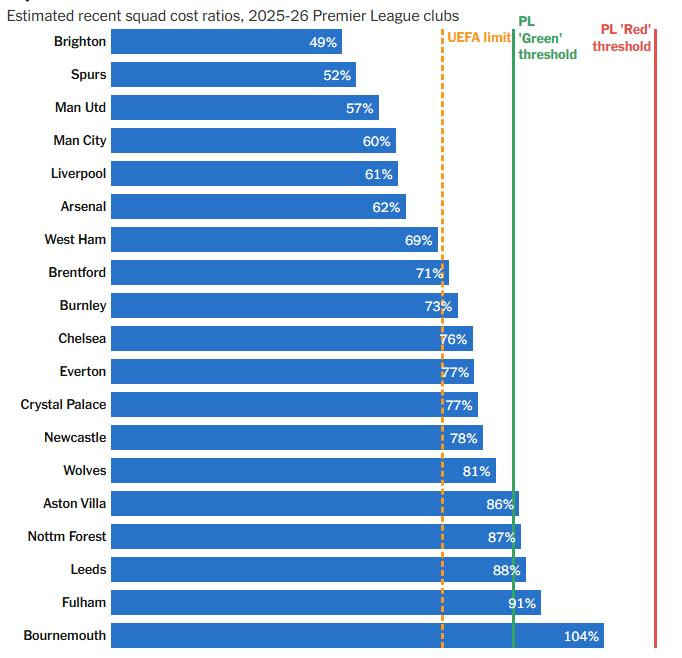
Which team is at high risk?
It's too early to draw conclusions for next season, but clubs with high expense-to-revenue ratios now face greater risks. According to The Athletic's data (2023-24), five teams exceeded 85%:
- Aston Villa
- Nottingham Forest
- Leeds United
- Fulham
- Bournemouth
Wolves' 81% figure is also quite close. Bournemouth and Forest have improved revenue and sold players well recently; Leeds have seen a strong increase in revenue since returning to the Premier League. Fulham and Wolves are at greater risk of facing difficulties.
Anchoring rejected, SSR approved.
The anchoring (hard cap) proposal was rejected with 60% of clubs voting against it. In fact, no club currently has a spending cap exceeding £600 million under this proposal, but the big teams are concerned that the hard cap will affect their competitiveness in Europe – where they are already subject to UEFA's 70% cap.
Conversely, the SSR – the financial health requirements – were unanimously approved by all 20 clubs, comprising: the Working Capital Test (a minimum of £12.5 million in cash or working capital per month), the Liquidity Test (passing the “Stress Test” with a scenario of an £85 million loss), and the Positive Equity Test (assets exceeding liabilities, allowing players to be valued at market price).

Long-term impacts and ecosystems
The PSR (Special Refereeing Regulator) terminates after the current season. "Circumventions" like selling non-football assets will become ineffective because the SCR (Special Refereeing Regulator) only counts football-related expenses and revenue. Linking squad costs to actual revenue could make the system more sustainable, although the 85% cap plus 24% operating costs still pushes total expenses above average revenue.
Teams participating in European competitions continue to be monitored by UEFA under the Football Earnings rule (three-year loss limit). Conversely, the EFL (Championship) still applies the PSR as before, so relegated teams must still comply with it when they are relegated.


